
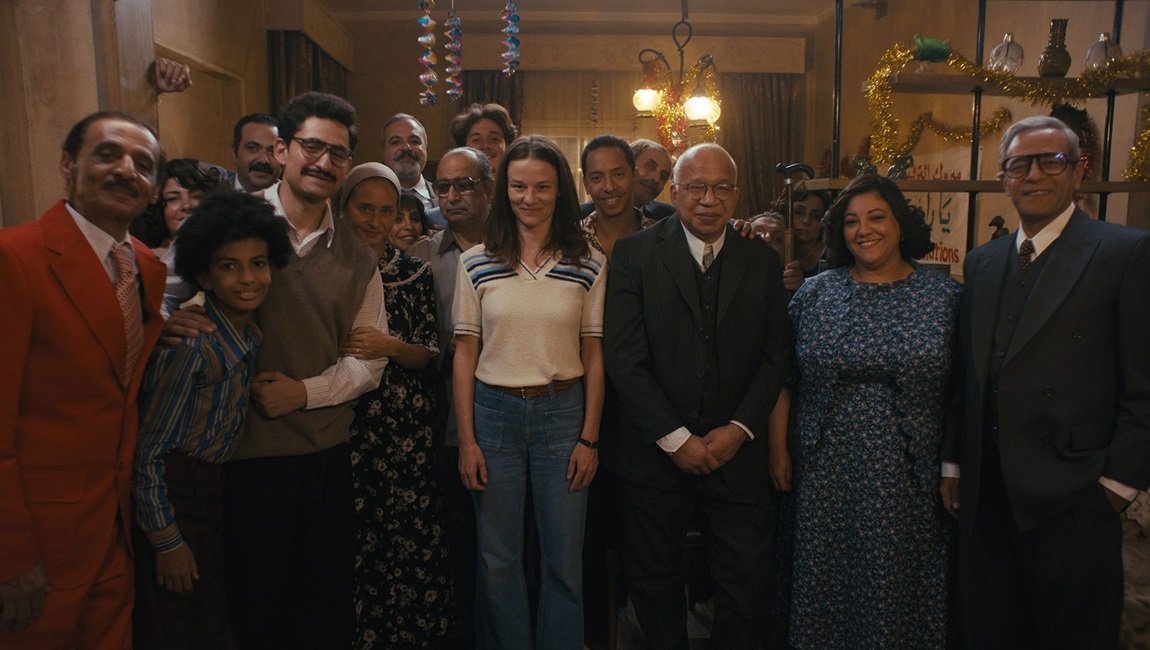
“Life is cheesy sometimes,” says Liz (Valerie Pachner) in voiceover, moments before turning around at the airport and running back to embrace her lover, Ahmed (Amir El-Masry). Life might be cheesy, but it’s never that ironic and self-conscious. Great emotions don’t come to us in quotation marks. The Stories by Abu Bakr Shawky is a sincere and endearing movie, it wears its heart on its sleeve and formally doesn’t aspire to much more than well-executed classical storytelling. It’s got a bit of a self-referential streak that undermines its emotional capabilities — we don’t feel that aforementioned embrace for its romantic power, but instead almost as a joke, simply another twist in the plot — but one can largely forgive its excesses because it does all the simple things right. It’s got a well-drawn and endearing ensemble; it’s quickly paced; it knows how to deftly use framing and cutting in a competent, but not flashy, way; and it crafts a historical portrait of a time and a place — Egypt, from 1967-1984 — that one (namely this writer, an American cinephile) doesn’t often see on screen.
Ahmed is a classical pianist, interested not in the standards but, as he describes it, in “big loud nationalistic music” that suits the tenor of the times. The times being Cairo in 1967, with Egypt on the cusp of the third Arab-Israeli war where 15,000 Egyptians would die in only six days. Ahmed lives in a cramped two-bedroom flat with two brothers, a perpetually overstressed and aggressive mother, a father whose proudest achievement is having a photo with him and Egyptian president Gamal Abdel Nasser, a host of mysterious uncles and friends who seem to live on the family couch and do nothing but watch football on TV, and an upstairs neighbor who can’t stand the constant clamor of Ahmed’s piano playing. Ahmed, naturally, wants to escape. Which is why, as one brother is getting drafted into the war and another is desperate to join the local football team, Ahmed’s main focus is on writing letters to a pen pal in Vienna, Liz.
The music takes an even bigger role in the action as the film skips ahead to 1972 and we find Ahmed now enrolled in music school in Vienna where he’s vying for a concert, but the film unfortunately has little feel for the music despite how frequently it dwells on it. We accept it as a MacGuffin, but like much else in the dramatic world of the film, there feels very little weight to it. It’s as if it, and many other events in the film’s plot, have those same quotation marks around them that are invoked by the meta statement referenced in this review’s opening. We know that this all makes sense in the logical structure of a film, but it’s unfortunately flat and lacking in a certain vitality. Perhaps Bakr Shawky is simply trying too much: the importance of Ahmed’s music career soon takes second place to his burgeoning cross-cultural romance with Liz, but that soon gets supplanted by a survey of various political goings-on in Egypt. Each one makes room for the other just as we start to begin to feel like it might land.
The Stories aims for a national allegory for the squandered hopes and unrealized potential of a generation, and adept filmmakers have pulled material like this off before. However, whether it’s due to what might be a lack of budget — two-thirds of the films seems to take place on the exact same set, and we’re afforded very few glimpses of the wider world of 1960s and ’70s Cairo — or due to a certain lack of readiness on the part of the three-time feature filmmaker, The Stories, while often compelling and enjoyable, too often squanders its own potential. Encounters with famous figures like Vladimir Horowitz and Hosni Mubarak pass like mere pieces of trivia, bereft of emotional weight or deeper intellectual questions of history. The film’s strengths — specifically, its ensemble and Bakr Shawky’s facility with melodrama — feel underrealized or unresolved. It’s ultimately a fine film, one that is hard to get too upset about, but it’s also a film that fails to simply be what it wishes it was.
Published as part of Tallinn Black Nights Film Festival 2025 — Dispatch 1.
Comments are closed.