
Silence — like its two unassuming allies, stillness and slowness — is often positioned as a response to mainstream cinema’s reckless noisiness. But contemporary indie Indian cinema that has most recently garnered international acclaim — like, Shaunak Sen’s All That Breathes (2022) and, to a lesser extent, Neeraj Ghaywan’s Homebound (2025), India’s submission for the Best International Feature at the upcoming Academy Awards — has been much more adept at slowing things down than at letting silences speak for themselves. Call it the burden of an indie filmmaker trying to make it big internationally: if your film doesn’t declaratively state what relevant thing it’s about, how will someone not aware of [insert relevant cultural issue] champion it? Or, to put it more bluntly, call it the curse of mellowing down Indian melodrama to attain a festival-friendly level of faux realism: the overuse of song-and-dance sequences and excessive melodrama are too distractingly maximalist, but their total elimination is also impossible. Thus, the filmmaker settles for an odd compromise: a one-note background score filling in for extended song sequences, restrained performances straining to be considered real. These films only appear real-er than their mainstream counterparts, then, without ever actually feeling real.
Rohan Parashuram Kanawade’s tenderly affectionate Cactus Pears is anything but that. Critics may have positioned it as an indie darling alongside the likes of Homebound and All That Breathes, given the international acclaim it has received: it’s the first Marathi-language film to premiere in the World Cinema Competition at the 2025 Sundance Film Festival, where it won the Grand Jury Prize. But unlike these films, which consistently struggle to strike a convincing balance between restraint and melodrama, Cactus Pears is entirely committed to using its slow cinema aesthetics — especially its longueurs of silence — to convincingly communicate its director’s quasi-autobiographical tale of finding queer love in the wake of a personal tragedy.
We begin — and then stay for a considerable while — on a note of funereal silence. Anand (Bhushaan Manoj), our weary, almost worn-out, 30-year-old protagonist, has just lost his father. But unlike his distant relatives — and to a lesser extent, his mother, Suman (Jayshri Jagtap) — he’s reluctant to show his grief to the world, or the camera. Instead, he’s somewhat frozen in his quietude, using the idle time he has while waiting to complete the 10-day death rituals, to occasionally zoom in on an old photograph of his father to try to reach him digitally. The sounds — of relatives pestering him to get married and settle down, of his mother telling him to maintain the façade of heterosexuality — keep coming and going, sometimes from onscreen, but mostly off. However, the static camerawork and the complete lack of a non-diegetic score maintain a guarded distance from Anand, affording him the time and space on screen to process his feelings without making a spectacle out of them.
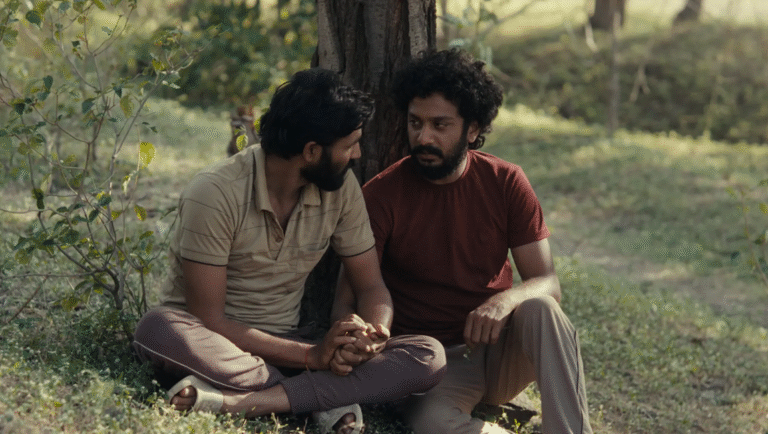
Enter Ballya (Suraaj Suman), a childhood friend of Anand who also seems to have shared a romantic past with him. And the nature of Anand’s silence (and Kanawade’s use of it) shifts. At first, the despondency that comes with grieving alone gives way to an endearing awkwardness: both Anand and Ballya acknowledge that each of them has “forgotten the other” despite sharing memories of enjoying eating the titular “cactus pears” that “no longer grow in their village.” But then, gradually, Kanawade “opens” up the film ever so gently: the camera, always static, moves for the first time as Anand and Ballya travel to another village; and here, Anand’s hushed voice doesn’t feel burdened by the weight of other people’s sounds, but simply an extension of the film’s Tropical Malady-like natural setting.
This shift, from awkward silence to a comforting one, extends beyond the sequences with Ballya, too. The initially strained relationship between Anand and his mother gives way to two extraordinary sequences in which the two of them don’t so much loudly reveal what they feel, but simply have a quiet conversation about how they barely have this kind of conversation anymore. It is, in the cheesiest possible sense, what we would call the healing power of (queer) love. But Kanawade’s complete lack of overt sentimentality — and dedicated commitment to structuring his film around the shifting tides of silence — makes this, and most every gesture of his film, feel deeply honest and, hence, tremendously moving.
DIRECTOR: Rohan Kanawade; CAST: Bhushaan Manoj, Suraaj Suman, Jayshri Jagtap, Harish Baraskar; DISTRIBUTOR: Strand Releasing; IN THEATERS: November 21; RUNTIME: 1 hr. 52 min.
Comments are closed.