
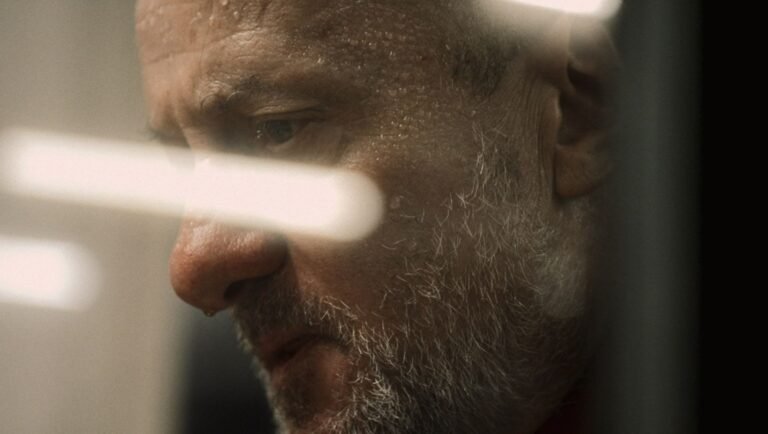
A man has fallen: Argentine director Matías Szulanski’s A Summer Tale opens with a classic noir setup, one rendered gorgeously in Sunset Boulevard, Le Jour Se Leve, Double Indemnity, The Killers, and too many other canonical texts to keep naming here. A metaphoric fall from great heights is an essential element of tragedy; opening with such a fatalistic visual trope poses a question the rest of the film hopefully answers: how can a man find himself descended so low? A Summer Tale, however, begins five seconds later than we’re accustomed to: we don’t see the fall, we just see a man getting up. He’s schlubby, drenched in sweat, a cigarette perpetually dangling from his lips, dressed in an ill-fitting suit over an awful mustard-yellow shirt. We never know what brought him down in these moments, and the look of confusion on his face tells us maybe he doesn’t quite know either, but what’s perhaps more important is the way he picks himself up and pushes forward, barely looking back. For the next 80 minutes, as one ill-conceived hustle after another goes wrong, we’ll keep wondering how Jorge (Fabián Arenillas) has the willpower to keep getting up, to push ahead when it’s so obvious to us that it will only end in defeat.
A Summer Tale is a film of perpetual forward momentum, and that is the only thing sustaining Jorge and, too often, the film itself. We spend most of the film’s scant 80 minutes watching him plow down the streets of Buenos Aires, briefcase in hand, stopping only to guzzle down a french fry-stuffed double cheeseburger with a side of coke or hassle a shop owner who owes money to his loan shark boss. After getting mugged mid-heart attack, Jorge finds himself $6,000 in debt and out of job unless he can recoup the money. Increasingly desperate, with no plan, no hope, and nothing but that endless forward momentum to keep him going, Jorge soon finds himself involved in an ill-conceived home invasion with a prostitute out for revenge on a teenage client who scammed her. It’s a plan so formless, so desperate, and so ill-conceived that the suspense comes from the question of not will it fall apart, but when.
If one were to guess, it would be reasonable to say Szulanski owes much of his kinetic hyperactivity, frantic cinematography, and dopey underworld flavor to the Safdie brothers, and A Summer Tale often risks coming across as little more than a watered-down version of Uncut Gems. It’s technically competent: Szulanski has no trouble stringing us along, making us feel each twist of the knife in Jorge’s back; the performances feel dynamic, filled with expressive yet ordinary faces; and there’s even a certain idiosyncratic absurdity to the proceedings that doesn’t fully flower until a late-film snake bite. Despite its charms, however, the film too often does come across as monotonous. The camera rarely wanders more than three feet from the characters’ heads; the propulsive synth score is excellent, but rarely strays far from the same tense tone; and there’s an overall slightness to things that often feels empty despite the film’s charms.
It’s not hard to perceive that Szulanski, who is credited with releasing five films in 2024 and 2025 alone, clearly shoots from the hip and works quickly on shoestring budgets. It’s partly what gives the film both its entertaining immediacy and disappointing lack of depth. It’s not a bad film, even if it is a slightly disappointing one. Hopefully Szulanski takes a lesson from Jorge’s non-stop chase to the gutter and slows down in the future, rethinks his choices, and makes a film with more deliberation. Like Jorge, he’s clearly crafty; it would be terrible to see his talents meet the same end.
Published as part of Tallinn Black Nights Film Festival 2025 — Dispatch 2.
Comments are closed.