
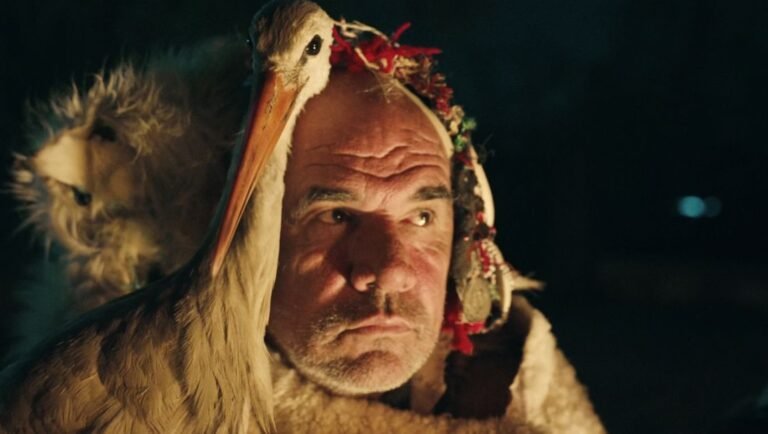
Tamara Kotevska’s The Tale of Silyan begins with a recounting of an old Macedonian fable. Young Silyan, tired of backbreaking labor on the family farm, tells his father that he will not submit to it anymore. Infuriated, the father curses Silyan and transforms him into a white stork. The film that follows does not so much illustrate this fable as use it for poetic counterpoint to its story of modern hardships and familial distress. In the rural village of Češinovo in North Macedonia, we meet Nicola and Jana, middle-aged farmers who have made what appears to be a reasonably comfortable life for themselves. Kotevska and cinematographer Jean Dakar capture sweeping vistas of the couple at work in their fields, harvesting crops in well-honed unison, but also finding quiet moments of repose. We see Nicola and his grandchildren working on an addition to the family home, and views of their town reveal a surplus of storks nesting atop buildings and telephone poles.
But this seemingly bucolic life is soon shattered by the harsh realities of the modern agrarian worker and the harsh realities of a vanishing way of life; a lengthy sequence at a farmer’s market observes much heckling and fighting over prices, as numerous local growers try to get a better price for their wares. Whatever they don’t sell will likely go to waste, but everyone is reluctant to underprice their product, which would, in effect, render their own labor valueless. Things get worse when Nicola goes to sell tobacco to a government office. The filmmakers don’t spell out all the details for unfamiliar viewers, but it becomes clear that the government has changed the standards by which they grade the crops and is now low-balling farmers on what they had assumed were pricing guarantees. As one farmer declares, once you factor in the seeds, equipment, fertilizer, and labor, they are essentially giving the product away for nothing. The government officials are unmoved, and the stubborn farmers take the product back home rather than sell it for a pittance. Kotevska then captures another chaotic scene, as Nicola, Jana, and a number of their fellow farmers close down a busy street in protest and throw their produce into the road. Everyone is at their wits’ end, and soon a number of people are leaving the town and emigrating to Germany looking for work. Nicola’s daughter, son-in-law, and grandchildren leave, soon followed by Jana.
Structured into roughly two parts, the film’s second half finds Nicola alone, the house now empty. He’s no longer farming, instead driving a tractor around the local landfill. The collapse of the farming ecosystem also affects the storks, who once flocked to the fields to find food but are now forced to scrounge for waste and garbage amongst the very detritus Nicola is hauling around. The message is clear: the equilibrium between humans and animals has fully collapsed. A truly horrifying scene shows reams of dead or dying birds, desiccated remains, and newly hatched babies gasping for food (animal lovers beware: it’s a brief sequence but very difficult to watch). Nicola and a friend stumble across an injured stork and decide to care for it, nursing it back to health and then attempting to reintroduce it to the wild. It’s heartwarming in the best way, a small act of kindness that stands in sharp contrast to the rapidly devolving natural world surrounding both the people and these wild animals. Thankfully, the filmmakers do not attempt to anthropomorphize the animal or turn it into a cute pet, but instead allow this strange relationship to play out unadorned. It’s a shame, then, that there is a treacly, omnipresent musical score accompanying much of the film, constantly reminding audiences of the grandeur on display, even as the images are doing a fine job of it in their own right. Still, it’s a small misstep, and The Tale of Silyan stands as a lovely document of one small glimmer of hope amongst the essential cruelty of modernity. Amongst the muck, there is still beauty in the world.
DIRECTOR: Tamara Kotevska; DISTRIBUTOR: Picturehouse; IN THEATERS: November 28; RUNTIME: 1 hr. 21 min.
Comments are closed.