
With only two features — 2020’s Shithouse and 2022’s Cha Cha Real Smooth — and a short film under his belt, Cooper Raiff has already established himself as one of the most promising young voices in American indie filmmaking. Emerging initially from Sundance Film Festival attention, Raiff has carved out a distinctive niche: a low-key, emotionally intimate, and transparent style that sits somewhere between the casual naturalism of yesteryear’s mumblecore and his own unique, warm, and gently cringe-inflected brand of dramedy. His two projects thus far could roundly be described as small-scale, mood-driven character studies that survey people who are existentially fragile yet profoundly human, navigating awkward, yearning attempts to forge meaningful and deep connections with each other. In that sense, his newest project — the (mini)series Hal & Harper — feels exactly like a natural continuation of his artistic preoccupations.
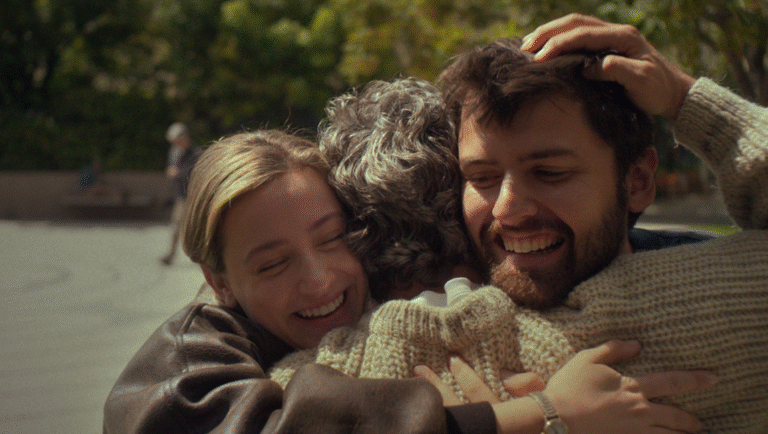
Like Raiff’s earlier work, Hal & Harper presents a slice-of-life realism, here tracking the intertwined emotional lives of the codependent titular siblings. Hal (Raiff), is an immature, slightly awkward, and jumpy Peter Pan-minded college senior failing in his search for a soulmate with his on-and-off girlfriend Abby (Havana Rose Liu). Harper (Lili Reinhart), meanwhile, is facing the slow unraveling of her long-term relationship with Jesse (Alyah Chanelle Scott) after developing feelings for a co-worker, Audrey (Addison Timlin). As the siblings’ messy orbits of attraction, frustration, and affection intensify — both toward each other and toward their partners — they are confronted with unexpected news: their guilt-ridden and melancholic father (Mark Ruffalo) and his live-in girlfriend Kate (Betty Gilpin) are expecting a child. This development, dropped almost matter-of-factly into the narrative, becomes the quiet catalyst that forces the show’s core quartet to re-examine their familial bonds, lingering emotional wounds, sense of loss, and the pasts they have tried, with varying degrees of success, to outgrow.
Although Hal & Harper arrives in the format of a nearly five-hour, nine-episode series, it resists the rhythms and expectations of conventional episodic television. Raiff’s choice of structure is deliberate: the short-form, modular layout mirrors the show’s inherently fragmented and ambient storytelling. Rather than guiding viewers through a cleanly linear plot, Raiff opts for an atonal, almost fractal narrative methodology stretched across decades via leaning into frequent jump cuts, elliptical transitions, abrupt flashbacks, and brief, fleeting dream and nightmare sequences (the tragic death the siblings’ mother). At times, Raiff even dissolves the barrier between the real and the imaginary — for instance, most notably, in scenes where the adult siblings appear within their own childhood memories, blurring the boundaries between past and present. The result is a free-flowing stream of consciousness in which moments appear, dissolve, and reappear with the same irregularity and emotional logic as actual lived experience. In fact, this narrative texture is crucial to the show’s effect. Raiff uses fragmentation not as a stylistic gimmick but as an avenue for emotional truth. Life, after all, rarely unfolds in neat arcs; memory intrudes, fantasies drift in, and difficult feelings interrupt the quotidian routine. Then, by letting the structure meander, Raiff creates a form that feels intimately tied to the interiority of his characters, which invites the viewer to not simply observe the characters (especially Hal and Harper), but to partially inhabit the way they introspectively feel their beings — hesitant, hopeful, confused between the demands of adulthood, unfulfilled childhood, and tensions of growing up always longing for a clarity that continually evades them.
Hence, while the series is obviously enriched by its quiet drama, punctuated by nonchalant humor, understated banter, and a relaxed and natural chemistry among the actors — Reinhart in particular is the show’s true anchor, bringing a grounded emotional intelligence to Harper’s turmoil that deepens every scene she’s in — what truly makes Hal & Harper resonate is Raiff’s unwavering empathy for the tenderest aspects of his flawed, deeply human characters and their most tangible vulnerabilities. This is all captured through continuous snapshots of unadorned yet heartfelt situations and heart-to heart-moments — hesitant conversations, push-and-pull reconciliations, and small gestures of affection or unexpressed internal grief. In eschewing overt dramatization, then, Raiff allows the emotional stakes to feel both understated and profoundly genuine, which ultimately results in Hal & Harper standing as a bittersweet yet cathartically refreshing portrait of inevitable adulthood, sibling entanglement, intergenerational bonds, paternal concerns, anxieties, guilt, and the lifelong struggle to understand oneself in relation to others. The project reaffirms Raiff’s skill at crafting hazily atmospheric stories that nevertheless feel emotionally expansive, and it further cements him as a filmmaker uniquely attuned to the quiet and unexpressed corners of the human experience.
DIRECTOR: Cooper Raiff; CAST: Cooper Raiff, Lili Reinhart, Mark Ruffalo, Havana Ros Liu, Betty Gilpin; DISTRIBUTOR: MUBI; STREAMING: November 30; RUNTIME: 4 hr. 30 min.
Comments are closed.