
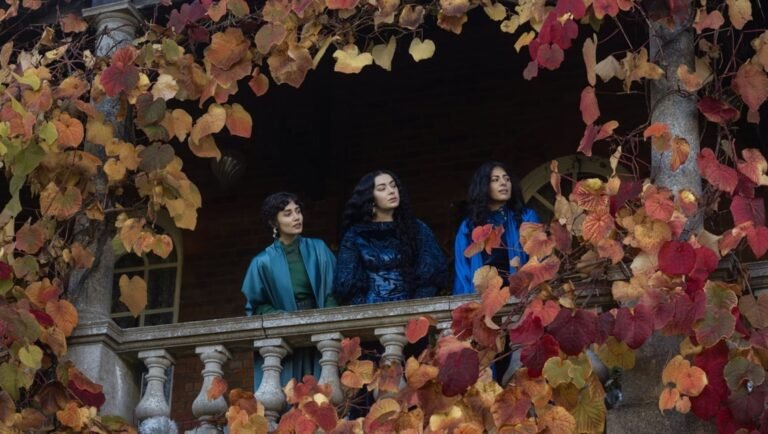
Julia Jackman’s sophomore feature 100 Nights of Hero, adapted from Isabel Greenberg’s graphic novel of the same name, has the shape and tone of a fairy tale, coupled with a clear reference to One Thousand and One Nights. In a fantasy world that worships the patriarchal god Birdman (Richard E. Grant in a hammy cameo), feudal lord Jerome (Amir El-Masry) and his wife Cherry (Maika Monroe) have been given 101 days by their punitive government to produce an heir, or else Cherry will be executed. Jerome, closeted and unwilling to have sex with Cherry, instead leaves Cherry with his lothario friend Manfred (Nicholas Galitzine) while he travels for the entire hundred days. But he and Manfred have made a wager: if Manfred successfully seduces Cherry, Jerome will hand over his castle to him, but if Cherry successfully resists, Manfred will give Jerome one of his illegitimate children to pass off as his heir. Complicating Manfred’s seduction is Cherry’s maid and best friend Hero (Emma Corrin), who senses Cherry’s discomfort with Manfred’s presence, and so tells a story each time Cherry wants Manfred to be distracted.
Befitting of its fairy tale nature, the fantasy world is established with minimal worldbuilding, and the characters are archetypes rather than three-dimensional individuals: the beautiful but spurned bride; the louche seducer; the crafty maid; the neglectful husband. Jackman uses these classical elements to build a commentary on misogyny and women’s rights, yet she seems to get stuck between her fantastical mode and her deeper political angle. Despite ultimately being a feminist parable that invokes the power of storytelling to effect political change, 100 Nights of Hero is never subversive or challenging enough to provoke. Instead, the film settles into a pleasant but unsophisticated light-fantasy aesthetic that smooths out any potentially fascinating wrinkles.
It’s immediately apparent that Jackman aims to craft a boutique aesthetic experience in 100 Nights of Hero; with a limited budget, Jackman and her creative team admirably assembled an internally cohesive Medieval-inspired kingdom, with colorful and architecturally quirky costumes designed by Susie Coulthard, and no shortage of avian accessories for the members of this Birdman-worshipping society. Yet Jackman’s visual style also leans too heavily on all-too-evident references. As shot by director of photography Xenia Patricia, we see fishbowl-lensed frames of corseted women striding down the halls of an English manor that directly echo The Favourite; images bluntly communicating archetypal sexual and gender dynamics, such as a shirtless and bloodied Galitzine carrying a deer he has just hunted, that are straight out of Saltburn; and many shots of precisely centered actors surrounded by carefully arrayed trinkets that could have been cribbed from practically any Wes Anderson film. 100 Nights of Hero’s visual style is most engaging when Jackman follows her more idiosyncratic impulses, but her more derivative gestures consistently fall flat.
Jackman also brings Lanthimos and Anderson to mind by, like these auteurs, encouraging a consistent acting style amongst her cast: nearly all of the film’s actors perform their roles in a declarative, near monotone tenor. This proves to be an ineffective choice for Hero. Monroe and Corrin, already subtle actors, are so recessive here that their performances read as passive and unengaged, which becomes particularly problematic when their characters’ friendship develops into a passionate romance. Galitzine distinguishes himself among the cast in a much more dynamic performance, effectively highlighting his abilities to play both a classic heartthrob and a comically exaggerated cad. One strong supporting performance cannot compensate for a generally weak ensemble, though, and so the film as a whole stays on the same too-muted level as its leading actors.
If there are clear missed opportunities in aesthetics and performance in 100 Nights of Hero, its most significant issue is its lack of meaningful narrative substance. Jackman teases out over the course of the film that, in addition to compulsory pregnancy for married women, the film’s patriarchal society outlaws reading and writing for women. We learn this from the single story that Hero tells — piecemeal over the entire hundred days of Manfred’s visit — of three sisters who paid for their lives after their literacy is revealed. Storytelling, then, is an act of everyday rebellion, one which the film’s climax shows can have the power to topple corrupt societies. The feminist parable here would feel right at home in a revisionist children’s story — the kind where kings are revealed not to be all-powerful, and princesses can rescue themselves from peril — yet Jackman has clearly crafted 100 Nights of Hero for an adult audience, seeing as the entire plot revolves around a manipulative sexual pact. The simplicity of the allegory does not gel with the volatile ménage à quatre the plot revolves around, and so the film feels stuck in a no-man’s land: too risqué for kids, not intellectually or sexually sophisticated enough for adult audiences. Ultimately, though there are some glimmers of aesthetic and narrative interest around the margins of 100 Nights of Hero, the film fails to add up to a cohesive or captivating whole.
DIRECTOR: Julia Jackman; CAST: Nicholas Galitzine, Maika Monroe, Emma Corrin, Charli CXC, Amir El-Masry; DISTRIBUTOR: IFC Films; IN THEATERS: December 5; RUNTIME: 1 hr. 32 min.
Comments are closed.