
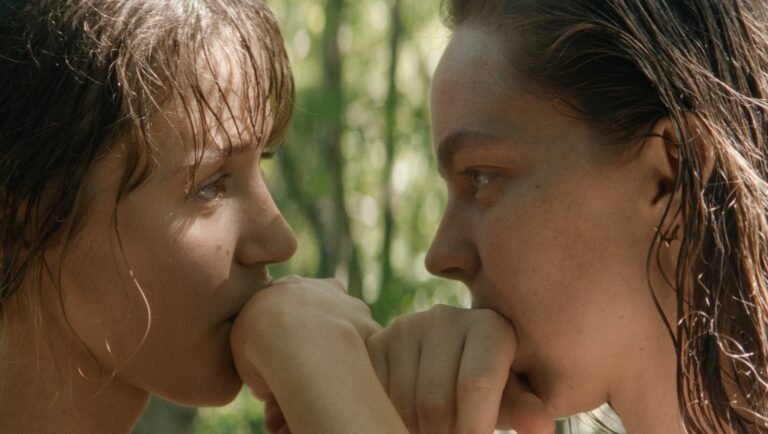
It’s not uncommon for an international film to obtain a different name in English-speaking markets, and that ends up being the case with Little Trouble Girls, the debut feature from Slovenian filmmaker Urška Djukić. Its original title, Kaj ti je deklica, literally translates as “What’s Up, Girl?”, but its English title takes inspiration from Sonic Youth and Kim Deal’s “Little Trouble Girl,” which the film features in its conclusion. But more than just an aural compliment, it’s a thematic fit too, as the song seeks to vocalize the act of trying to win approval while acknowledging true feelings. The track’s chorus reflects those two desires — “If you want me to / I will be the one / that is always good / […] But you’ll never know / what I feel inside / that I’m really bad” — and so too does Djukić’s intriguing film about burgeoning desires and sexuality, conveyed discreetly and subtly.
When introverted 16-year-old Lucia (Jara Sofija Ostan) joins the choir at her Catholic school, she meets the older Anna-Maria (a confident Mina Svajger). Outgoing and trouble-risking, Anna-Maria turns out to be the opposite in almost every way to Lucia, who looks upon her transfixed. Meanwhile, the student body are heading on a trip across the Italian border, where they will have intensive rehearsals at a convent in the town of Cividale del Friuli. However, these practices are disrupted by renovations being completed. Lucia sees one of the workers in the distance (and naked) when she arrives, and as she begins to fixate on him, she simultaneously grows closer to Anna-Maria. These attractions will serve as Lucia’s sexual awakening — and also test her beliefs, as she threatens to become a dissonant note that upsets the harmony of the choir. “A choir is a joint formation; if one of you doesn’t conform, it’ll fall apart,” the choirmaster (Sasa Tabakovic) sternly warns. But this is just a glimpse of the cruel side he later exhibits in full voice.
Little Trouble Girls opens with a collection of echoing inhales and exhales. They are part of a vocal exercise, but without any visuals, they could easily be interpreted rather as sounds of pleasure (and they are indeed later reincorporated as such). Either way, they form part of the Julij Zornik’s singular sound design, which emphasizes whispers and other delicate noises, from the smacking of lips to the tapping on a phone. When we pivot to the a capella choral performances, they are rendered dynamic and forceful. And when we see Lucia during one of her regular daydreams, all sound fades out. This aural construction of intimacy is supported by DP Lev Predan Kowarski’s tight shots of mouths singing, or of Anna-Maria’s red lips and, later, her belly button. Insert a match cut of a flower in bloom, and it becomes obvious what feelings are being stoked in Lucia for the first time.
This all leads to moments of queer sexuality exploration that have earned the film comparisons to early Céline Sciamma (specifically her debut Water Lilies). But at the same time, Djukić differentiates Little Trouble Girls by adding a strong religious foregrounding. Slovenia is a predominantly Catholic nation, and the religion’s key tenets of shame and repentance go against what a doctrinal passage read out near the start calls “deceitful desires.” Moments of adolescent playfulness feel like taboos in this context, such as when Lucia and Anna-Maria peek at the workers bathing or when Lucia, during a game of truth or dare, kisses a statue of the Virgin Mary, “the most beautiful girl in the convent.”
Lucia is a deeply interior character, as is the performance given by a noteworthy Ostan. This is by design, as Djukić platforms the character’s emotional course by emphasizing her doe-eyed and hesitant expressions. There’s a virtuousness to Lucia that has been built up by her mother (Natasa Burger), the kind of strict figure who bans lipstick and switches TV channels whenever a sex scene crops up, but this mostly leads to the young girl feeling plagued by uncertainty, and we watch as her process of self-discovery and newfound sense of self leads to a conflict between her conceptions of desire and sin. Human’s touch and God’s touch.
Little Trouble Girls unfortunately does lose steam across most of its second half. It’s constructed so that one feels as if things should kick into another gear at this point, but the film instead begins to move with less momentum and potency in its back end. Nevertheless, on the whole it remains a sturdy and effective drama confidently assembled by the debuting Djukić, and she at least leaves off on a strong note with a coda that is poised enough not to be needlessly overexplanatory or cloying. From a messy and isolating experience comes the chance for Lucia to find herself, and that is something that she is newly equipped, even in her youthfulness, to do.
DIRECTOR: Urška Djukić; CAST: Jara Sofija Ostan, Mina Svajger, Sasa Tabakovic, Natasa Burger; DISTRIBUTOR: Kino Lorber; IN THEATERS: December 5; RUNTIME: 1 hr. 29 min.
Comments are closed.