
There’s an overly edited, scored, and produced version of Sam Abbas’ Europe’s New Faces that would have taken the ongoing awards season by storm. Its current events topicality — the film, as per MoMA’s description, is about “confronting the humanitarian crisis of African and South Asian refugees and asylum seekers adrift both in the Mediterranean Sea and in the legal limbo of the EU’s broken immigration system” — automatically qualifies it “for your consideration.” All it needed to do was commit to the awards-season mandated degree of noticeable emotional manipulation. Throw in that twinkly piano score (or a sad orchestral violin one) that crescendos at the exact moment when the camera closes in on one of its subject’s emotional breakdown and, voila! — you have your perfectly concocted front runner for Best Documentary Feature at the upcoming Academy Awards.
The problem — for its relative popularity, not its filmic quality — with Europe’s New Faces is that it steers clear of this awards-friendly, faux-realist documentary approach. Abbas, almost naively one could argue, is trying to confront the ongoing humanitarian crisis of African and South Asian refugees and asylum seekers by simply capturing it without any “noticeable manipulation.” And while it’s nigh impossible to do that, Abbas’ commitment to a kind of Bressonian asceticism does achieve something that awards-friendly documentaries rarely do: it modestly and honestly captures its subjects’ lives, not “for your (emotional) consideration,” but simply for humanitarian documentation.
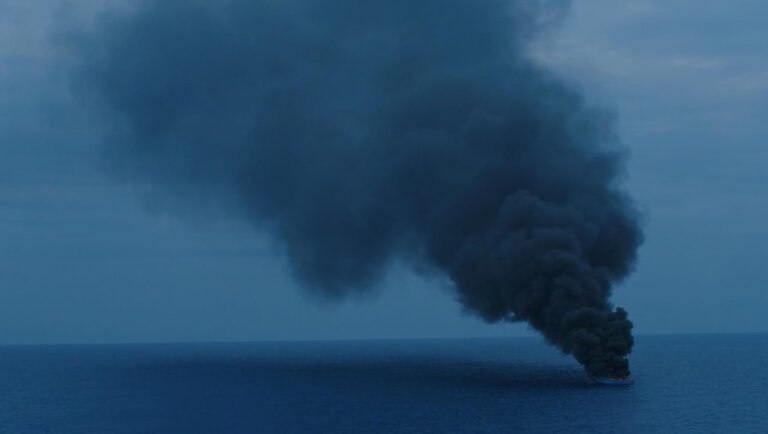
The non-chronological structure of Abbas’ film is indicative of his humble intentions. The director splits his 160-minute film into two equal 80-minute parts. The first, titled “Land and Integration,” focuses on a group of African refugees living under precarious conditions in Paris. Abbas doesn’t attempt to overtly sympathize with any of these people by neatly narrativizing their harrowing journeys from Libya to Europe. He simply observes their realities post-migration. The second part of the film, titled “Sea and Passage,” takes us back to the passage that refugees and asylum seekers are forced to take from Libya to reach Europe. But rather than focusing on the same group of people we became familiar with in the first part, Abbas, here, focuses on South Asian refugees left adrift in the Mediterranean Sea. Again, he makes no overt attempts at contextualizing their individual narratives here: we see what the camera sees.
What all does Abbas’ camera actually see, though? Across both parts of Europe’s New Faces, Abbas, contrary to the film’s title, is not interested in revealing his subjects’ identities (partially, this is, as the end credits state, “for the safety and privacy of all migrants featured in the film”). Instead, his camera — always fixed, static, carefully angled — is obscuring these faces. Extreme close-ups reveal our subjects’ body parts, not necessarily to show their bruises, but — especially in the film’s first part — to show them doing their daily tasks. Mundanity, imposed by a still but precarious form of waiting, defines these people’s existence, and Abbas captures this beautifully, not by having them tell us this, but by showing it to us as an accumulation of gestures. Cooking, showering, eating, sleeping, dancing, talking, water-fighting — everything is captured, but from a guarded distance.
In “Sea and Passage,” this approach is trickier to pull off because Abbas is closer to documenting the “action” of migration rather than the inaction that follows its harrowing struggle. But in what’s arguably the most “thrilling” sequence of the documentary, Abbas, quite spectacularly, pulls back. Any other documentary about migration would want to — cinema verité-style — capture the (crude as it may sound) spectacle of rescue boats saving migrants and asylum seekers. Abbas hints at adopting the same approach, and it’s the only time in the film his camera doesn’t feel fixed or carefully placed. But at the exact moment of rescue, Abbas cuts to black, replacing the thrill of seeing all this in “real time” with still, somewhat blurred photographs of the successful rescue mission.
This concentrated lack of “noticeable manipulation” — in other words, de-dramatization — is, of course, its own form of manipulation. And Abbas’ austerity does call attention to itself. But thankfully, it never does so in a disingenuous way. The camera’s distance from its subject matter comes across as respectful rather than a purely academic exercise, an admission almost on Abbas’ part that no matter how much time he has spent with these people, his camera can’t entirely capture or depict their vast lives. There’s a humility and humanity in that gesture that makes Europe’s New Faces an incredibly valuable film.
DIRECTOR: Sam Abbas; DISTRIBUTOR: Maxxie, Suzzee & Cinema; IN THEATERS: December 12; RUNTIME: 2 hr. 39 min.
Comments are closed.