
Throughout Laura Poitras and Mark Obenhaus’ documentary Cover-Up, Seymour “Sy” Hersh, claims that he does not psychoanalyze himself. The irony is that the legendary journalist is seated for a talking head-forward work of nonfiction where he is the subject. This isn’t Poitras’ first rodeo with direct address either. In All the Beauty and the Bloodshed, the Academy Award-winning director wove together Nan Goldin’s reckoning with her family history, addiction, and her public fight against the Sackler family, while elsewhere Citizenfour documented Edward Snowden’s NSA leaks from the seclusion of a Hong Kong hotel room. In these intimate environments, psychoanalysis with Poitras is inevitable. Hersh will reveal his patterns of justification, doubt, and shortcomings through memories, research, and personal anecdotes.
Hersh is perhaps best known for exposing the My Lai Massacre from the Vietnam War to the American public. In 1969, Hersh reported to a number of national newspapers like The New York Times and The Washington Post that between 347 and 504 unarmed Vietnamese civilians (mostly women, children, and elderly men) were murdered by U.S. soldiers in a village on March 16, 1968. There was only one American casualty; he shot himself so he wouldn’t have to participate in the carnage. Hersh walks the audience through his methodologies — investigative reporting combined with research and gossip — while Poitras swirls in archival footage that includes maps, newspaper clippings, telephone recordings, and interviews with individuals like William L. Cally, the “fall guy.” According to Sy, “My Lai is the massacre that got out,” but it was hardly an anomaly. Success was measured via body count, and General William Westmoreland wanted numbers. What remains most memorable in Hersh’s eulogy for the unarmed civilians — and, in some ways, for the soldiers who carried out the massacre, mostly farm boys from places like Indiana — is the insistence that atrocity was policy. Decades later, that bitterness and disillusionment with the U.S. government remains intact, a wound that has never healed or recovered.
Born in 1937 to Yiddish-speaking parents, Isador and Dorothy, in Chicago, Sy tells Poitras that he comes from an “unthinking family.” His father changed their surname from Hershowitz to Hersh to assimilate to American culture and operated a dry-cleaning business. Sy’s lingering bitterness is easy to detect. Perhaps this is the psychoanalysis he wanted to avoid? His recollections are vulnerable, even painful, yet Hersh skillfully flips them. After his father’s death, Sy attended a local junior college at 17. There, a professor pulled him aside, asked what he was doing, and literally walked him over to the University of Chicago. It’s here, for the first time, that Hersh allows himself to feel the weight of his past, becoming visibly emotional. The moment was life-changing. His newfound confidence, or “moxie,” as he calls it, became a driving force that propelled him into the man we see on screen.
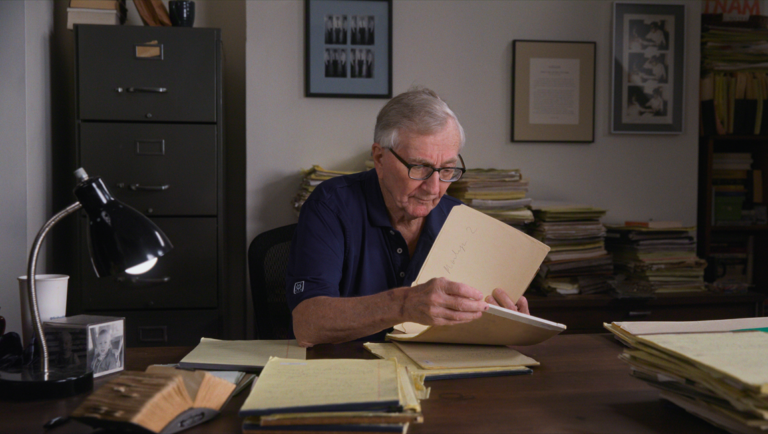
A title card announces that it took Poitras 20 years to persuade Sy to show up for this documentary. Now, with the help of Obenhaus, and 65 years of work in the business, Hersh sits at his home office surrounded by stacks of manilla envelopes, yellow notepads, and several cameras. Sy’s news career moves the film forward, but his speech, inflections, and behavior command the tone of the film. Despite his screwball newspaperman charm — think Cary Grant in His Girl Friday — he’s not always the most willing subject. His personality oscillates from spikey to cranky during difficult one-on-one sessions with Poitras (colleagues from his newspaper days describe a volatile man, prone to screaming and threats). He’s an engaging subject, but his outbursts are disruptive. Sometimes they feel rehearsed, most notably when he abruptly ends an interview after Poitras raises the issue of confidential sources, but in sum Cover-Up remains an enticing portrait of a man whose genius and bravado is sometimes overwhelmed by his defense mechanisms.
Besides My Lai, Hersh also contributed to Watergate-era reporting, wrote investigative books on Henry Kissinger and the Kennedy family, and brought the Abu Ghraib torture scandal to public attention in the early 2000s. Only near the end of Cover-Up does the film acknowledge that Hersh now publishes primarily on Substack, after many major outlets declined to run his most controversial work. In honoring Hersh’s past, the film avoids reckoning with the present: it canonizes him as a patriotic truth-teller while sidestepping the radically altered media landscape that has pushed his journalism to the margins. Still, Cover-Up succeeds as a portrait of a journalist shaped by a recently bygone era, when faith in the press as a public good had not yet fully eroded. It reminds viewers of what investigative journalism once demanded, and why those demands still matter.
DIRECTOR: Laura Poitras & Mark Obenhaus; CAST: Seymour Hersh; DISTRIBUTOR: Netflix; IN THEATERS: December 5; STREAMING: December 26; RUNTIME: 1 hr. 57 min.
Comments are closed.