
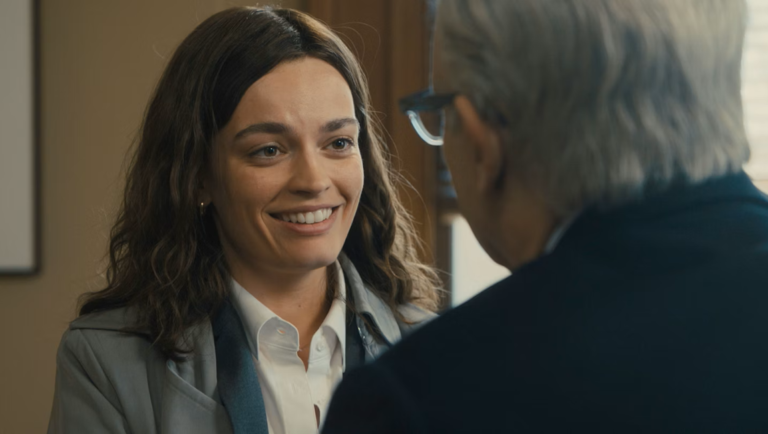
In a moment in history increasingly submerged in a swill of irony and pessimism, James L. Brooks’ insistence on goodness feels like the last burst of energy from the family dog before it’s laid to rest. His latest, a political dramedy set in that fondly remembered year of 2008 — you know, that time when, according to the Julie Kavner-voiced narrator, everyone still got along (or when studio comedies turned a profit) — attempts to revive man’s long since dead best friend: political optimism. That Ella McCay not only exists in 2025, but succeeds in spite of its unfashionable elements, is its own kind of miracle.
Invoking the supposed goodness of a time like 2008, when mainstream politicians still questioned the legitimacy of Barack Obama’s American citizenship and stayed silent as racists burned him in effigy, should strain any conscious viewer’s sense of reality. One watches Ella McCay and wonders if it’s not time to take Grandpa back to the old people’s home for an early night. But Brooks’ forthright characterizations somehow make you believe. We meet Ella (Emma Mackey) on the verge of numerous crises. She’s about to become her state’s youngest Governor — that is, should her boss (Albert Brooks) get called up to the big leagues in Obama’s cabinet; her womanizing father (Woody Harrelson) is back in town to make amends; a journalist is blackmailing her and husband, Ryan, (Jack Lowden) for special access to the Governor’s office; and a new obstacle, perhaps involving her agoraphobic younger brother (Spike Fearn), looms ahead.
Ella handles all of this with Brooksian nerve and verve over a strenuous three days. A winning combination of Holly Hunter in Broadcast News and Jean Arthur (pick any film) — two heroines from whom Brooks most clearly draws — she’s a mess of little ticks and exclamations, a well of emotion, baggage, and passion; she’s never slow to call out the passivity of others when it concerns the common or even individual good. A standout scene toward the film’s climax depicts a long policy session in which Ella, arguing ad nauseum about maternity benefits and subsidized dental care, enters a flow state while her staff slip in and out of consciousness. It’s the epitome of her former boss’s observation that she would have no chance getting elected under normal circumstances because she too obviously cares about making the world a better place.
Brooks’ target isn’t just the political institutions that incentivize politics over policy — he takes pains to point out the inherent double standard Ella faces for technically improper use of government property, while every member of state congress spends most of their waking hours out of their offices asking their constituents for money — or the family structures that forgive transgressions. It’s the weak-minded and -willed men who take advantage of them who also draw his ire. Often these men encircle Ella, embroiling her in their insipid quests for self-importance or desperate pleas for unearned forgiveness. Other times, she inserts herself in their troubles. Regardless, we chafe at them because they’re presented with easy solutions to their problems and struggle — sometimes refuse — to use them on their own. The powers that be always seem to conspire against Ella, to the point that her precipitous fall from the Governorship arrives nearly as quickly as her serendipitous ascent. Ever the optimist, though, Brooks has faith in his character’s future that others might not have the generosity to afford her.
The big swings that constitute almost every choice in Ella McCay — from gesticulating performances to unresolved subplots — are testament to Brooks’ desire for his world to exist outside the typical register of our own. This plea for an alternative is also an acknowledgment that it exists, and that barring some miracle that might allow us to overcome our current moment, the best, and to him most noble, thing to do is to get through it and not look back. While the early Obama-era setting suggests a director lost in a nostalgic soup of his own making, it also throws into sharp relief just how much farther there is to go today. When Kavner, as the narrator, suggests at the close of the film that the opposite of trauma (the film’s long-standing and most laborious theme) is hope, she should be suggesting that it is also the opposite of cynicism; a counter-perspective we can, and should, choose in order to face reality. No matter how mawkish the presentation, Brooks never lets this slip through his grasp.
DIRECTOR: James L. Brooks; CAST: Emma Mackey, Jamie Lee Curtis, Woody Harrelson, Albert Brooks, Jack Lowden; DISTRIBUTOR: 20th Century Studios; IN THEATERS: December 12; RUNTIME: 1 hr. 55 min.
Comments are closed.