
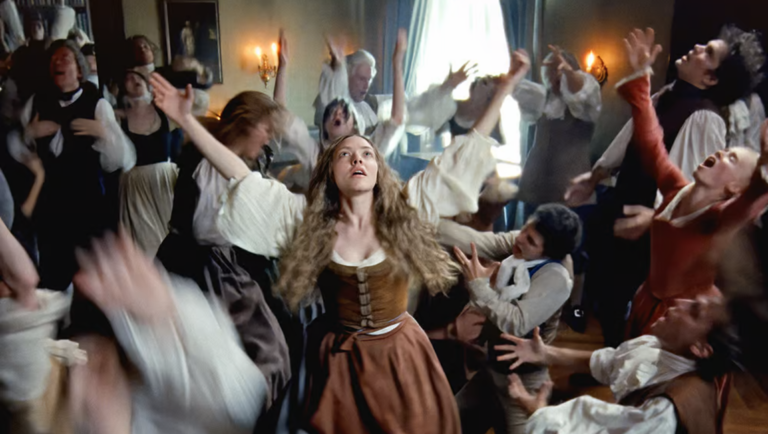
Those inclined to immediately exit the theater or press stop on their remotes the instant a film concludes would do well to take a beat once the end credits of The Testament of Ann Lee begin. If not to acknowledge the work of the hundreds of people who made the film or to sit quietly with your thoughts on an unwieldy, uncompromising film, then at least to receive some important historical context that the film has otherwise danced around up until that point (that bit of wordplay will seem more precious momentarily). A heavily stylized, historical account of the founding of the Shaking Quakers faith — informally referred to as the “Shakers,” identifiable by the rapturous, rhythmic movement shown here as inextricable from conversing with a higher power — in colonial America, the film presents the then nascent faction of Christianity as espousing relatively progressive values of feminism, abolitionism, and non-violence all in service of creating a utopian society on Earth built around hard work and prayer. There is, however, one tenet that would appear to be at odds with growing the flock: absolute celibacy, even between a husband and wife. Watching the film, set entirely in the 1700s, one might wonder how exactly a fringe religion is meant to grow its numbers if “be fruitful and multiply” isn’t an option, and what the intertitle sketchings that populate the credit crawl confirm is: “it can’t.”
The Testament of Ann Lee is the new film from Mona Fastvold (The World to Come), who along with her creative and romantic partner, Brady Corbet, was the driving force behind last year’s festival and awards season darling The Brutalist. It’s not surprising, then, that the two films are in conversation with one another, thematically and aesthetically. Both films are broadly about the immigrant experience in America and religious persecution. Both were produced on relatively shoestring budgets in Budapest, yet are sweeping works of scale, production value, and a reverence for labor as a means of expression, all captured on celluloid. The two films share a composer in Daniel Blumberg who attempts to outdo his soaring, Oscar-winning compositions from the earlier film by adapting more than a dozen songs based around hymns. The Testament of Ann Lee is a full-fledged musical, and a remarkable one at that; the most stirring sequences are those where the film gives itself over to the earnest pageantry of being swept up in song praising the Lord and the fervor of dance. There is an important difference between the two films, though, as The Brutalist is a wholly original work — drawing inspiration from historical figures, political movements, and well-documented artforms, no doubt — whereas The Testament of Ann Lee is, in its own way, a fairly conventional hagiography. The filmmaking itself is often exhilarating and its lead performance is a revelatory display of full-bodied commitment by Amanda Seyfried, but the film’s spine is straight Wikipedia.
Split into three chapters covering the nearly 50 years that the real Ann Lee lived, we’re introduced to the title character as a child living in Manchester, the second eldest of a large family. Living in the shadow of the church and informed by the assorted fundamentalist street corner preachers screaming out at her as she walks through town, young Ann (played by Esmee Hewett and Millie-Rose Crossley at different ages) draws the ire of her father for condemning his sexual congress with Ann’s mother, getting her hands whipped with a lash for her youthful impertinence. Some years later and now a grown woman, (Seyfried) Ann, in search of spiritual guidance, is drawn to the Quakers religion; in particular, a sect that practices their faith by undulating and chanting as though they were inhabited by the Holy Spirit. As filmed by Fastvold, these displays of “shaking” are near orgiastic set pieces of coordinated movement and elaborate choreography by the cast and the camera operator; bodies thrusting in time with one another and being hoisted aloft while repetitive yet undeniably catchy spirituals are sung by the company of actors, all while Seyfried’s Ann holds the center of the frame with wild-eyed zeal. It’s at one of these revivals that Ann is introduced to Abraham (Christopher Abbott), a handsome farrier who she will go on to marry. In spite of her misgivings, Ann gives herself willingly to her husband, and over the years gives birth to four of his children. However, in an unimaginable series of tragedies, all four of her children would go on to die before celebrating their first birthday. Believing God is punishing her for her “sins of the flesh,” Ann renounces sexual intercourse in all its forms, to the quiet (at first anyway) resentment of Abraham.
Having been elevated to the ranks of priest and spiritual leader of the movement (flouting the ingrained patriarchy of Christianity), Ann is rapidly labeled a public nuisance and is even briefly incarcerated. Imprisoned, Ann undertakes a hunger strike, and after weeks of deprivation she reemerges claiming to have received a vision from God urging her to travel across the ocean and spread his word to the recently established colonies of America. Further, she claims that the only way her followers may enter the Kingdom of Heaven is if they too forgo the earthly delights of physical intimacy. Sponsored by a wealthy benefactor (the playwright and actor David Cale), Ann, a handful of confidants — which includes her brother William (Lewis Pullman) and her second in command, Mary (Thomasin McKenzie, also doing double duty as the film’s frequent narrator) — set sail for New York. After a fraught journey across the sea — with it being said that only through Ann’s spiritual leadership was the ship able to weather the ocean’s waves — our small collective of Shakers arrive in the new world and set about identifying a plot of land near Schenectady to build their mission. Confronted by internal strife (a sexually frustrated Abraham leaves Ann after she refuses to let him into her bed), adverse elements, and hostility from the locals who tire of the incessant sounds of prayer, as well as the Colonial militia which resents the Shakers unwillingness to support their war efforts against England, the group toils in the wilderness for years. Undeterred, Ann pulls disparate locals into her small congregation while William establishes houses of worship around New England.
The tricky line that The Testament of Ann Lee is attempting to ride is in demonstrating admiration for an unorthodox religion that allowed women to serve in leadership roles, was accepting of members regardless of their race or past transgressions, and that seemingly lived the principles it espoused without hypocrisy or in pursuit of personal enrichment while also being clear-eyed that the faith was doomed to fail, in no small part because of the woman who evangelized it. Without diminishing the visions themselves, the film establishes a psychology to Ann’s confabs with the Almighty, that registers as healthy skepticism, arriving as they do at times of extreme duress or delirium. Ann’s complicated relationship with sex is the quicksand on which the church is built, and her insistence on imposing that particular neurosis upon all of her followers is self-defeating in both a micro (she banishes her young niece and early apostle, Nancy, for wishing to marry another congregant) and macro sense (without the ability to create new practitioners through propagation, the Shakers were forced to constantly recruit new disciples, venturing into communities hostile to the notion of a woman as head of a religion). And yet, without belaboring the point, it’s evident from the way Fastvold stages the film’s myriad dance numbers that the Shakers are merely channeling their sexual desires in a different, “more acceptable” form. Watching Seyfried, wildly kicking her legs in the air, running her hands down her body, patting her chest, and panting heavily from physical exertion, it’s clear there’s something a bit “doth protest too much” about the Shakers’ policing of sexual desires, and the film is smart enough to recognize it and to make the argument exclusively through inference.
As anyone who’s watched the viral video of Seyfried performing the Joni Mitchell song “California” on The Tonight Show (or, just as likely, has seen the Mamma Mia! films) can attest, the actress has a lovely voice, and it’s foundational to the appeal of The Testament of Ann Lee. Performing the repetitive, lyrically-simple songs with a credible enough Mancunian accent, it’s not so much that Seyfried’s singing is pleasing to the ears (although it very much is) as it is that it’s serving a load-bearing role in conveying the depths of Ann’s beliefs and the way the teachings move through her without limiting herself to speaking from the pulpit. Whenever it can, the film upends the convention of sermonizing via the spoken word, transforming what would otherwise be two-plus hours in church into a series of earworms you’ll find yourself unexpectedly humming days later (if nothing else, it’s an unobtrusive means of getting audiences to eat their vegetables). But for all of its iconoclasm, the film is weighted down by its more commonplace, linear qualities. The Testament of Ann Lee is constrained by the fact that despite its atypical adornments, it remains a cradle-to-grave biopic of a saint; watching the film, especially in its second half, it plays as though Fastvold and Corbet were dutifully marking off historical events out of a sense of obligation. Certainly that extends to the fleeting reverence paid to the Shakers’ famed craft furniture, its presence here feeling especially compulsory (it also serves as a visual callback to last year’s Fastvold/Corbet collaboration). At one point late in the film, Ann is arrested by the colonial militia as punishment for her pacifism, only for her to be returned home exactly one scene later, which begs the question of what the purpose of even dramatizing the incident was. One starts to become conscious of how much the film relies upon montage and McKenzie’s uncritical narration to guide the film over periods of time that are noticeably light on dramatic incident. The Testament of Ann Lee inadvertently makes the argument for the idea of its titular subject being more compelling than her life specifically. Like the religion it depicts, then, the film is perhaps destined to inspire a small but devout following of those able to reconcile its incongruities and imperfections.
DIRECTOR: Mona Fastvold; CAST: Amanda Seyfried, Christopher Abbott, Lewis Pullman, Thomasin McKenzie, Stacy Martin; DISTRIBUTOR: Searchlight Pictures; IN THEATERS: December 25; RUNTIME: 2 hr. 17 min.
Comments are closed.