
As director, writer, and co-leading actor of All That’s Left of You, Cherien Dabis would have taken on a significant artistic challenge no matter the scope of her film. It is doubly notable, then, that Dabis’ film is a decades-spanning family saga, following the reverberations of a Palestinian family’s expulsion from Jaffa in the Nakba of 1948 through episodes of state violence and family turmoil in the 1970s, 1980s, and 2020s. Credit Dabis with crafting a compelling and emotionally grounded film that is both an effective historical saga from a historically marginalized perspective and a more intimate exploration of intergenerational trauma. Dabis does sometimes struggle to craft fully rounded characters within this vast scope, and the first act in particular has the ring of a history lesson designed for an uninformed audience, but Dabis impressively manages to accrue character detail and thematic nuance by tracing her film’s central family, patiently but with purpose, through three generations.
All That’s Left of You opens in media res with a fast-paced scene showing a Palestinian teenager in the West Bank joining an anti-occupation protest during the First Intifada, only to be shot in the head by an IDF soldier. Before Dabis shows us the aftermath of this violent scene, she cuts to her own character — as-yet unintroduced — speaking directly to the camera, explaining that one must understand a long chain of events to comprehend what led up to the shooting, beginning with the story of the injured boy’s grandfather. The film then begins a linear trajectory, starting in 1948, in which a bourgeois family in Jaffa, living on acres of orange groves and quoting poetry around the dinner table, is menaced by bombing that grows ever-closer to their home, until they are forced to evacuate to a relative’s home in Beirut. The family’s young patriarch, Sharif (Adam Bakri), stays behind in the hopes that his family will eventually be able to return to Jaffa, only to be abducted on his own property by Israeli soldiers and sent to a prison camp. After hard labor leaves him profoundly weakened, he finally joins his family in Beirut, cementing decades of displacement to come.
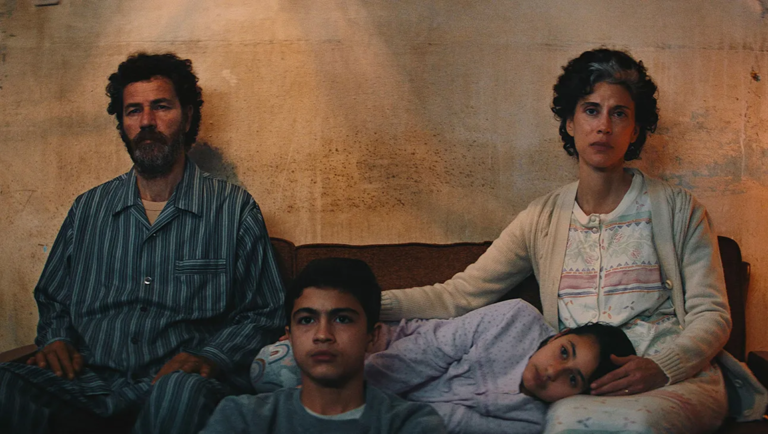
This portion of the film occupies close to 45 minutes of screen time, yet it effectively functions as a second prologue. The core narrative begins in the 1970s, with Sharif (played as an older man by the late Mohammad Bakri, Adam’s father) now living in the West Bank with his grown son Salim (Saleh Bakri, Mohammad’s son and Adam’s brother). Salim struggles to balance caring for his father, whose physical and mental health are declining, with parenting his children, particularly his son Noor, who idolizes his father until an episode of harassment and degradation by IDF soldiers causes him to lose respect for him. Noor grows into a teenager (Muhammad Abed Elrahman) with radical and idealistic politics, inspired by his grandfather — and as we see, he is the wounded teenager from the film’s prologue. The rest of the film follows Salim and his wife Hanan (Cherien Dabis) as they struggle to obtain urgent medical treatment for Noor in Israel, and reflect on the decades of forced expulsion, displacement, and state violence that have led them to where they are.
As a consequence of the film’s decades-spanning narrative, the flaws of All That’s Left of You are frontloaded, with an overabundance of exposition dominating early sequences. The 1948 section, while treated with brisk efficiency and appropriate tension, suffers from over-emphasis on explaining the events of history and consequently flat characterizations: Dabis struggles to portray any member of the family with depth or texture, instead only exhibiting how they respond to the cascading traumas they experience. The film’s second section, effectively a contained family drama, generally fares better, but its climax — with Sharif and Salim fighting to ally young Noor with their respective perspectives of moderation or resistance — forces its characters into narrow archetypes, resulting in a sense of contrived melodrama. It is in the aftermath of Noor’s shooting that the pieces Dabis has rigorously arranged finally fall into place. Saleh Bakri and Dabis deliver emotionally layered performances, transmitting the decades of oppression and violence experienced by their families in their evolving responses to their son’s precarious condition. In their rich characterizations, both evocatively channel unpredictable manifestations of rage, resignation, and untrammeled grief. In contrast to the nuance Dabis so effectively digs into here, the film’s epilogue — set decades later — feels overly pat and too tidily conclusive, but her and Bakri still land the film with grounded, genuine emotion. Through their deeply embodied performances, and under Dabis’ own disciplined direction, the director-star and Bakri communicate both the cumulative devastation wrought on the Palestinian people over generations, and their resilience in the face of occupation and displacement.
DIRECTOR: Cherien Dabis; CAST: Saleh Bakri, Cherien Dabis, Adam Bakri, Maria Zreik; DISTRIBUTOR: Watermelon Pictures; IN THEATERS: January 9; RUNTIME: 2 hr. 25 min.
Comments are closed.