
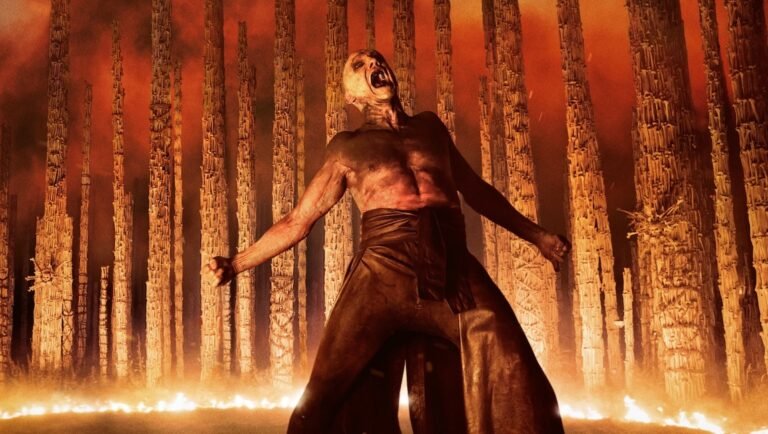
28 Years Later pushed the blockbuster forward by just as many years, shaking off the ubiquitous flat and sterile look forced down our throats by post-streaming Hollywood and casting light on a possible future that blends a true 21st-century style with classic movie storytelling. It has no right being as good as it is, and it reaffirms that the 28… Later franchise truly does belong to Danny Boyle. Yet one can’t accuse him of hogging all the fun for himself; he lets up-and-comers play in the sandbox, too. Juan Carlos Fresnadillo placed his own stamp on the material in 2007’s 28 Weeks Later (only his second outing as director), offering astute snipes at the American military industrial complex and diverging from the original’s vision while staying true to Boyle’s highly caffeinated spirit. It, in turn, showed that there’s a lot of room for unique voices riffing on the postmodern zombie formula, and 28 Years Later: The Bone Temple, a direct sequel to 28 Years Later, continues that tradition. This time around, Boyle hands the reins to Nia DaCosta, a newcomer relative to the aging and ossified old guard running the show, but in reality practically a veteran in Hollywood’s dog years with five films in the 2020s alone, most notably last year’s Hedda, her (for better or worse) staunch auteurist take on Ibsen’s play, and 2023’s The Marvels, the superhero movie she’d rather us forget she made. But invited by Boyle to play with him in the sand, DaCosta shows up only to kick it in his eyes, undoing 28 Years Later’s formal leaps and undermining the series’ rebel humanism the way only an embittered former Marvel director passive aggressively lashing out against the system that did her dirty could, and confirming suspicions that the mean streak prominently peacocked in Hedda is here to stay.
The Bone Temple picks up mere moments after 28 Years Later left off, reuniting us with young Spike as he fends for his life under the tutelage of Satanist Sir Lord Jimmy Crystal and Dr. Ian Kelson, as he experiments on the local Alpha Infected, Samson, like a benevolent Frankenstein. If you somehow forgot what the what, where, who, and stakes of a movie that came out six months ago, fret not: Ian explains, practically to the camera, who he and Samson are before trotting back into his bunker to listen to New Wave records. DaCosta’s narrative failure here should not go understated — the use of needle drops alone is so baldly manipulative and badly timed that it calls for a moratorium on the practice — but Alex Garland’s screenplay certainly shares complicity in the sabotage, turning 28 Years Later upside out and inside down only to reassemble it askew: Samson gets more pathology and backstory than all of the human characters combined, and Ian — ambiguous, moody, and larger than life in the first 28 Years — is reduced to a goofy uncle stereotype. The script is a far cry from 28 Years Later’s wise, moving, and inventive reckoning with grief.
So forget inventive, which flies out the window around the time the movie opens —The Bone Temple can’t even manage to make itself interesting. Sean Bobbitt’s clean frames are a cheap microwave meal when held against the never-ending buffet of Anthony Dod Mantle’s fleet and bellicose photography (as key to 28 Years Later’s success as Boyle’s sensibility), and scenes are long, aimless affairs — not even imaginative enough to call set pieces. During one, an atrociously drawn-out torture sequence wherein Sir Lord Jimmy Crystal peels the skin off a lineup of victims hanging on meat hooks, is so defanged and divorced from the narrative’s forward momentum that it feels placed there to deliberately antagonize the audience, only to double back upon its conclusion to lean on Jack O’Connell’s (regrettably) great Mike Meyers/Jim Carrey take on the Jimmy character to get us back on its side. The entire film oscillates between these two registers, at times cruelly shaming the audience for liking the franchise in the first place and inviting us at others to join in on the bullying. Its climax synthesizes these two modes, enlisting Ralph Fiennes (also great, also too game to go along with the vandalizing for his own good) to fake a communiqué with Satan that we’re never supposed to believe. It spoils an engagement with the wider 28… Later project, pointing out how phony these zombies and the people who fight them are — of which fighting, by the way, there is very little, despite DaCosta’s public declaration that her only note for Garland’s script was that there weren’t enough Infected — and congratulating us for seeing through the ruse. It fulfills the opposite of the director’s imperative: rather than immersing us more completely in the 28… Later world, DaCosta erodes it from within.
28 Years Later: The Bone Temple makes it easy for poptimists to abstain from appreciating the contemporary blockbuster after the format’s brief, bright resuscitation last year. We were lucky to be treated to a surge of great big budget fare in 2025, but The Bone Temple starts 2026 off keeling over to the headwinds of mediocrity and appealing to the goodwill of an audience it evidently hates through snarky humor and winking condescension at the material. The film is such a travesty, and the damage done to the property so profound, that it’s difficult to say whether we need Boyle’s part three to wash the gnarly aftertaste away or if we should just take 28… Later out behind the barn and put it out of its misery. Either way, the fact remains: the way things are going, it’s the blockbuster we deserve.
DIRECTOR: Nia DaCosta; CAST: Ralph Fiennes, Jack O’Connell, Alfie Williams, Emma Laird, Chi Lewis-Parry; DISTRIBUTOR: Sony Pictures Releasing; IN THEATERS: January 16; RUNTIME: 1 hr. 49 min.
Comments are closed.