
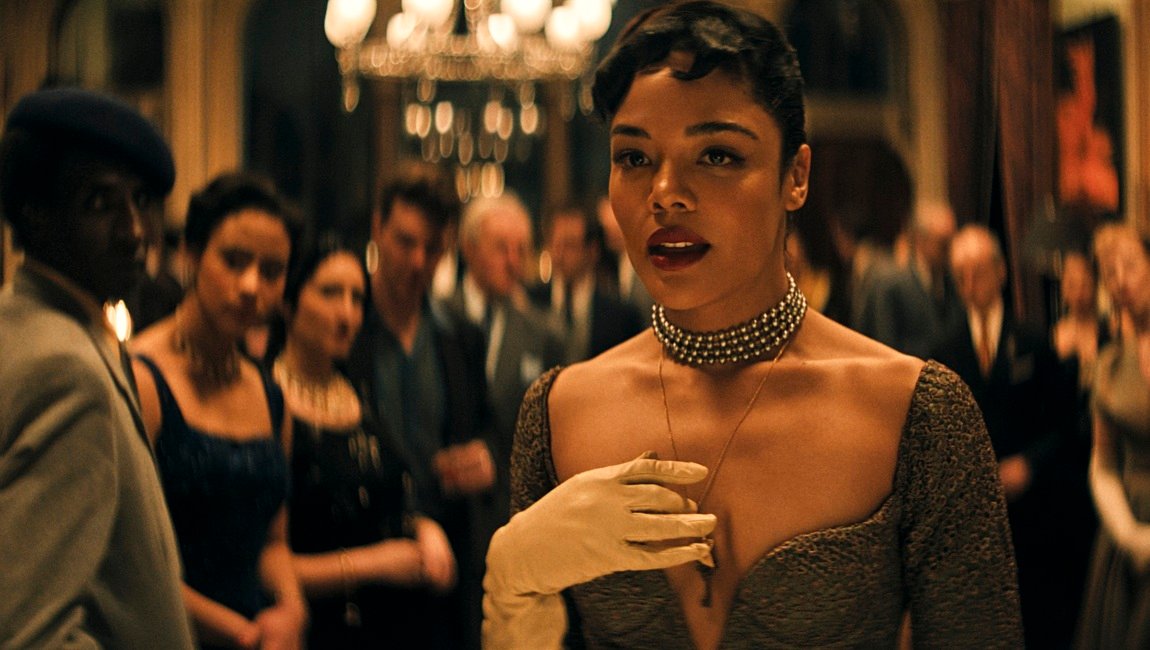
On its face, the concept of writer-director Nia DaCosta’s Hedda sounds perilously, excitingly ambitious: DaCosta has adapted Henrik Ibsen’s venerated drama of psychological realism Hedda Gabler, updated the setting from a bourgeois milieu of 19th-century Norway to the high society of 1950s England, switched the genders and races of several key characters to add new complications to the text’s social commentary, and set the entirety of the action at a debaucherous party hosted by Hedda herself. One can imagine any number of variables in this project going horribly awry, or, perhaps, the film coalescing into a thrilling work of adaptation that jolts a much-interpreted text back to life. Hedda, instead, occupies a well-appointed, glossy middle ground; its diversions from Ibsen are not too shocking, and its provocations are not overly provoking. DaCosta makes a respectable effort, but despite a seasoned cast and evident craftsmanship, Hedda feels like a missed opportunity, caught in an uncomfortable tug-of-war between Merchant Ivory-inflected costume drama and a bolder, freer interpretation.
Hedda (Tessa Thompson), in this incarnation, is the biracial daughter of a famed general and she has married the white historian George Tesman (Tom Bateman). Hedda is a creature of society, and that she has married a mild-mannered historian seems to have come as a surprise to those who know her well — including Judge Roland Brack (Nicholas Pinnock), a family friend who has given the couple the financial support necessary to move into a vast country estate. Hedda, too, seems uncomfortable with the match, given that in one of her first appearances onscreen, she is walking into a lake with rocks in her pockets. Yet an incoming phone call brings her back to shore — from Eileen Lovborg (Nina Hoss), her ex-lover, who informs Hedda that she will be attending a party that she and George intend to throw that very night.
The party is meant to introduce the couple to society in their new home, and to shore up a hoped-for professorship for George; the professor who has been evaluating his candidacy is officially the most important guest. To Hedda, though, no guest earns more attention than Eileen. Surprising Hedda, Eileen arrives sober with a new manuscript, an entourage, and a married girlfriend and co-writer, Thea (Imogen Poots), in tow. Eileen, in fact, has placed herself in contention for the same professorship George covets, and despite a past apparently tainted by alcoholism, she has regained her focus and published a successful book, and has pinned her hopes for her career on the new manuscript she has written about the “future of sex.” Hedda, stewing in a mixture of jealousy, boredom, and financial anxiety — George’s prospects will be much diminished if he cannot secure the professorship — makes a series of underhanded, and ultimately cataclysmic, maneuvers to alter the fates of Eileen, George, and herself.
The two most consequential alterations DaCosta makes to Ibsen’s text are Hedda’s race and Eileen’s gender — Hedda is a white woman in Ibsen’s play, and Eileen is a man named Eilert. These changes escalate the social commentary surrounding gender in Ibsen’s play, making them more salient for a 21st-century audience. Eilert becoming Eileen raises the stakes of the character’s attempt to regain her career; she must jostle for position and respect not only as a reformed alcoholic, but as the only woman in a male-dominated sphere. Hedda, as a Black woman, does not even have the extremely limited options Eileen does, and struggles to accept her position as a society wife — even, as Eileen tells her, she “has everything” on the surface. DaCosta also takes clear pleasure in creating a Sapphic love triangle between Hedda, Eileen, and Thea, adding an extra layer of secretive sexuality and social repression to the already-taboo implications of infidelity extant from Ibsen’s play.
These alterations are intelligent ones, and largely well-integrated, but DaCosta struggles to dig beneath their surface implications, particularly with the character of Hedda. For such a notoriously complex character, Hedda seems a bit too easy to pin down in DaCosta’s film. Bored, depressed, and constrained by a restrictive society, Hedda uses her considerable but untapped intelligence to manipulate her associates, seeing as this is her only way to take actions that could have meaningful consequences. This is all present in DaCosta’s screenplay and Thompson’s performance, and Thompson is especially effective in emphasizing the contrast between Hedda’s intimidating mask of imperious glamor and the gaping void underneath. Yet despite DaCosta and Thompson’s mutually thoughtful work, there is something missing in the depiction of this iconic character: a sense of true volatility, perhaps, of the character’s quicksilver nature that prompts her to take dangerous, inexplicable actions. DaCosta telegraphs Hedda’s inner life and motivations too clearly — characters are often called upon to make subtext explicit through dialogue, which in Hedda’s case, dilutes her character’s mystery — and Thompson’s finely-crafted performance is too polished.
If Hedda herself is not as compelling as she should be, DaCosta provides compensation in Eileen, expanding her character to the extent that she dominates the middle portion of the film with lengthy monologues that the formidable Hoss tears into. Because of Hoss’s blistering performance, full of raw emotion and untrammeled intelligence, Eileen becomes the real wild card of this Hedda, and while the Eileen-centric scenes are no doubt the film’s most compelling, it is nonetheless a major structural issue that DaCosta tilts the film so far toward a secondary character. The more enthralled the audience is by Eileen, the less Hedda registers in comparison.
DaCosta’s struggles to maintain the balance between characters in Hedda is paralleled in her and her creative team’s discordant aesthetic choices. As shot by Sean Bobbitt, wide shots of the vast manor abound at first, taking in luxurious rooms decked in green and gold décor and filled with revelers, and the camera roves incessantly. More intimate scenes, though, tend to be shot quite conventionally in medium close-ups with shot-reverse-shot editing. The former strategy is sometimes too much, with fishbowl lenses and swirling shots destabilizing the viewer in scenes without much dramatic import, and the latter not enough, dulling the pace and tension through uninspiring framing. Other craft elements grate against each other: Cara Brower’s production design and Lindsay Pugh’s costume design are lush and sensual, while Hildur Guðnadóttir’s percussive, atonal score jangles and crashes incessantly. The overall aesthetic does not cohere, nor do its mismatched parts generate any kind of productive ambiguity or tension.
But the ultimate issue with Hedda is that, for all its ambitions and revisions, it is overall too beholden to Ibsen’s play. The structure, despite swapping the chamber drama for a rollicking party, is largely the same, and some aspects of the thematic material are even thinner by comparison: DaCosta focuses on the thorny sexual conflicts between the characters and the restricted roles assigned to women, both present in Ibsen’s play, but mostly eschews the play’s more philosophical internal debates surrounding fate. The film’s discourses surrounding gender, race, and sexuality are astute and appropriately knotty, but the sense that DaCosta is holding back from a truly radical re-interpretation carries through to the conclusion which, in altering the original ending, reads less like an explosive surprise than it does a pulled punch. Hedda, particularly in Hoss’s performance and its carefully cultivated production design, has its merits, but the sum is never as bold as it could or should be.
DIRECTOR: Nia DaCosta; CAST: Tessa Thompson, Nina Hoss, Imogen Poots, Tom Bateman; DISTRIBUTOR: Amazon MGM Studios; IN THEATERS: October 22; STREAMING: October 29; RUNTIME: 1 hr. 47 min.
Comments are closed.