
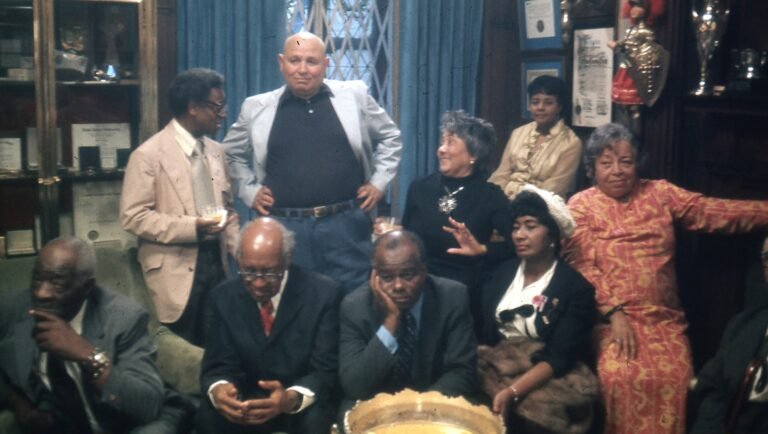
Time is an amazing thing. It eludes us as we write, as we speak, read, and breathe, confounding us even more when things don’t follow its rules, when its prerogative is contested. The cinema, as a time-based medium, invents time anew at will; it accelerates movement, slackens, suspends, and denies. This capacity spurs curious effects, and is on display in William Greaves’ Once Upon a Time in Harlem, a posthumously completed work whose release aims for Greaves’ 100th anniversary in October 2026. In what is described as Greaves’ “one last trick up his sleeve,” we are thrown back to a Sunday afternoon in the Harlem of August 1972. On that day, Greaves, already a prolific, though still far from canonical, documentarian, assembled the last living doyens of the Harlem Renaissance for a cocktail party at Duke Ellington’s New York townhouse, with the central question — what was the Harlem Renaissance? — looming above all. But was it even a “Renaissance,” or rather, as posited by the controversial writer and public commentator George Schuyler in one of the one-on-one interviews held in Ellington’s inexhaustible townhouse, an “awakening?” Whether one regards it as a movement, a set of politics, a time period, an aesthetics, a collective patchwork of popular and esteemed Black American voices, or all of those at once, Schuyler hits the nail on the head, for rather than a “rebirth,” the Harlem Renaissance is perhaps best understood without precedence.
Unbeknownst to Schuyler, whose anti-essentialist essay “The Negro Art-Hokum” spurred much frustration among progressive Black Americans, the idea of an awakening — an uncovering of what had hitherto been slumbering for too long in the minds of the convening Harlem luminaries — attains motivic quality in Greaves’ multifariously structured picture. As Greaves and his crew — including his son David as one of the cameramen — alternatingly shoot the goings-on at the cocktail party as discussions steam up, and take aside the notables for more intimate conversations, there is a dynamic back and forth that displays both the intragroup negotiations over what the Harlem Renaissance was and how it should be remembered today (i.e., in 1972 and, by extension, in 2026), as well as the intimate recollections on the individual level that highlight the arbitrariness of memory. In one of the many commanding scenes, for instance, we see the 95-year-old Leigh Whipper, actor and founding member of the “Negro Actors Guild of America,” recite the speech he gave as the Ethiopian emperor Haile Selassie before the League of Nations in Michael Curtiz’s Mission to Moscow (1943; Whipper’s role is uncredited in the film). For most of the recital — which, apparently deemed too long, is fast-forwarded by fade-out cuts — Whipper has his eyes closed, as if moving inward in an effort to pull back memories from days of yore.
The edits, meanwhile, are cleverly chosen, disrupting, though in a very delicate way, the lengthy scene while exposing the contextual absurdity at which Greaves, in his question whether Whipper had “ever played an African king,” hinted. The fact that Whipper, after all these decades since, still recalls the 1936 speech that was then transposed into the fictional realm of Curtiz’s pro-Soviet propaganda picture marks a strangely succinct encapsulation of Greaves’ boundary-blurring project of poetic nonfiction (Whipper’s portrayal of Haile Selassie, to ice this peculiar cake, earned him a special honor from the Ethiopian government in 1944). But there is also a thematic throughline that ties Whipper’s recital (and the underlying casting choice) to one of the central points of discussion on that late afternoon in 1972, namely Garveyism. Jamaican-born Marcus Garvey, an influential Pan-Africanist and founder of the “Universal Negro Improvement Association and African Communities League” (which he chaired as first “President-General”), advocated — notably against the DuBoisian notion of integration — for racial separation and a united Black diaspora. Having never set foot on the African continent himself, Garvey promoted the Back-to-Africa movement of African American slave descendants to Africa in the pursuit of Black sovereignty.
Much more historical and local color is tangible and evoked in Greaves’ footage. Socialist writer Richard B. Moore, for one, recalls the monumental efforts of public intellectual, educator, and political activist Hubert Harrison, whose street-corner talks and public lectures drew significant shares of the 200,000 Black Harlemers to the street and cultivated class consciousness at a time when white-on-Black lynchings were still happening. In reaction to these attacks, poet Claude McKay wrote the canonical poem “If We Must Die” in 1919, as well as the sonnet “The Lynchings” in 1922 — the latter of which we find, as one of the very few departures from Ellington’s townhouse, read by William Greaves.
Having compiled all this invaluable material proved — throughout his lifetime — a poisoned chalice to Greaves, who, sitting on it for over 40 years until his death in 2014, struggled to envision its definitive form. This burden passed on to his son David, who, having been present on that day, stepped in as co-director to close out this longstanding chapter with the help of the family-run studio William Greaves Productions. In the later decades of his life, Greaves was not only certain that what he filmed that day in 1972 was the most important material of his career, it also confirmed how indebted he was to these remarkable progenitors of Black America. And yet, watching the film, you wouldn’t be able to tell the struggles involved, so irreverent are Greaves’ continuous zooms in and out, so effervescent the atmosphere, so unaffected the faces of most, and so entertaining those who noticeably do put on airs. Rather than educational in a conventional sense — such a project Greaves accomplished in his 1974 half-hour documentary From These Roots, entirely composed of and told through a selection of archival photographs, narrated by Brock Peters, and underlaid by original music by Eubie Blake (who’s one of the party guests) — Greaves’ film plays much more as an experience that investigates itself as it unfolds.
Aware that this film project might be a last chance to get things right, the air is fused by potential: to speak one’s truth, to commemorate and foreground the forgotten, and to overwrite “wrong” notions of history, if necessary. And for all the inadequacies of history, whose writings, ultimately, escape the grasp of the individual, the allure of making a film such as Harlem might lie precisely in the potential of exerting this control over the uncontrollable, of getting things “right” — if only for 100 minutes. The New Yorker’s chief critic Richard Brody, who saw and reviewed a rough cut of Greaves’ final film months before its premiere at the 2026 Sundance Film Festival, wrote that “if Greaves had been able to complete the movie soon after shooting its footage, it would literally have changed the course of history, and for the better.” The mental gymnastics required for that kind of naïveté surely lie outside the purview of even most devout cinephiles. Nevertheless, if there is one lesson to be extracted from Greaves’ extraordinary document, it’s that history is malleable, is vibrant, is now.
Comments are closed.