
Director Isao Yukisada is something of a chameleon. Having gotten his start as an assistant director for Shunji Iwai, with whom he worked on five films, including Love Letter (1995), Swallowtail Butterfly (1996), and April Story (1998), before making the jump to directing himself. His debut, 1998’s hazy and gorgeously photographed Open House, could broadly be placed in the turn-of-the-millennium “urban loneliness” subgenre that was making waves at the time. There is significant overlap with the works of his mentor, but also the likes of Yoshimitsu Morita (1996’s Haru in particular), Wong Kar-wai, and even the gritty neon-lit noirs that Takashi Ishii wrote and directed in the early 1990s.
Only a few years later, he would look to the frenetic editing and loopy narrative structures of American genre indies for his 2001 coming-of-age dramedy Go, perhaps his best-known work. Throughout his career, there is a sense that Yukisada is always chasing something, always hitching his wagon to aesthetic trends that, for better and for worse, date his work to their specific time period. But where does this approach leave him in the dull, homogenous 2020s? Revolver Lily, which premiered at festivals in 2023, fits perfectly with the bland, prestige-y competence that dominates the middlebrow cinematic landscape. At a glance, Revolver Lily’s blend of broad dramatics, deliberate pacing, and action set pieces appear to resemble the work of Zhang Yimou (the historical context also invites specific comparisons to Zhang’s 2021 spy thriller Cliff Walkers), Cheng Er, and — in its more subtle moments, of which there are a few — Jia Zhangke (2013’s A Touch of Sin) and even 2015’s The Assassin, Hou Hsiao-hsien’s deceptively serene wuxia.
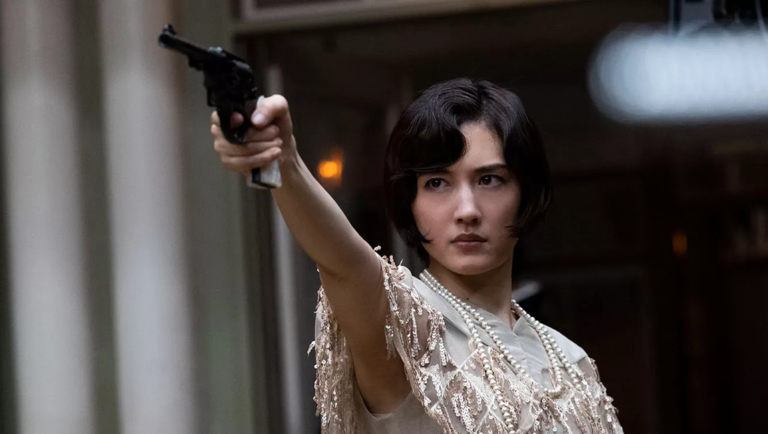
Closer inspection, however, reveals Yukisada’s sprawling historical actioner to be a rather flavorless cross between turgid film festival drama and rudimentary streaming-ready action filmmaking. Taking place during the later years of Emperor Taishō’s reign, the story concerns Yuri Ozone (a magnetic Haruka Ayase), a former spy who went underground and now works as a madam of a brothel. She comes out of her quasi-retirement when she reads about the supposed murder-suicide of a family she had previously lived with and decides to investigate it, not believing Kunimatsu Tsutsui (Renji Ishibashi), the man framed for the crime, capable of such a heinous act. While on the train en route to the house, Yuri runs into Shinta (Jinsei Hamura), the young son of one of the massacre’s victims who escaped the ordeal alive. Hot on the boy’s heels is an armada of uniformed and suited men (military personnel and members of a crime syndicate, respectively) who hope to extract information regarding the whereabouts of a large sum of money his father stashed away before his death.
Of course, it falls on Yuri to protect the innocent, and doing so entails going back to her old ways — though not quite. In her spy days, our heroine killed dozens of people, something she swore she would never do again. Ergo, the ensuing gun fights — and there are quite a few over the course of the film’s 139 minutes — see her taking great (and highly improbable) pains to make sure the rounds fired from her signature six-shooter only cause non-lethal injuries. It’s a silly gimmick that shows its limits fairly early on when defeated scores of opponents are seen writhing on the floor in pain from their shoulder and leg wounds after chaotic exchanges of gunfire like the henchmen in a Jackie Chan film.
Though these action scenes are competently mounted — barely a compliment to begin with — there is no spark of inspiration to Yukisada’s images. The middling drama could perhaps be forgiven if the film ever truly came alive during these sequences, but even with all the noise and ostensible excitement, it remains flat. Maybe that’s the point — the film views Japan’s pre-WWII slide into militarism and expansionism with a highly critical eye. The lack of visual panache could be seen as an extension of a broader pacifist sentiment. Problem is, the film, like so many before it, ultimately subverts its philosophical position by forcing its protagonist to break her one rule in spite of her steadfast commitment. Ideals are well and good, but sometimes you just have to give in to that ugly impulse inside your animal brain. It’s doubtful that this is what Yukisada had in mind, but it’s hard not to view it cynically when a major moral compromise doesn’t come with any real sense of seriousness. Instead, all we get is cut-rate melodrama.
DIRECTOR: Isao Yukisada; CAST: Haruka Ayase, Hiroki Hasegawa, Kavka Shishido, Kotone Furukawa; DISTRIBUTOR: Well Go USA; STREAMING: January 27; RUNTIME: 2 hr. 19 min.
Comments are closed.