
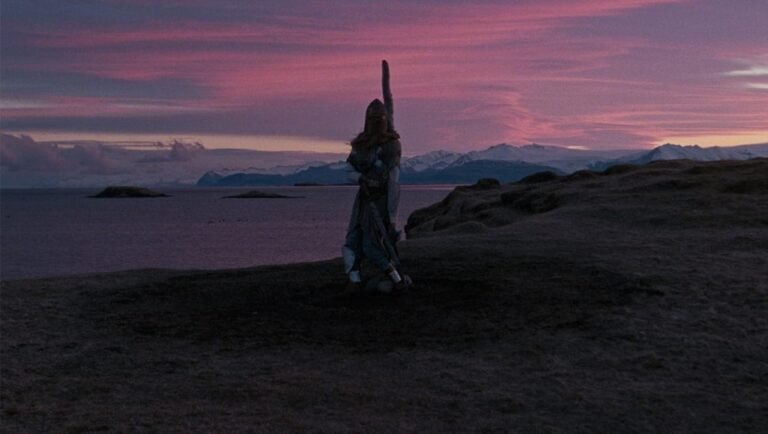
There is a motif at the center of Hlynur Palmason’s latest feature, The Love That Remains. A static camera, its gaze affixed to the seaside cliff behind the filmmaker’s house, observes three children, played by Palmason’s own, as they dig a hole, plant a wooden stake, construct a dummy, dress it up in shining armor, and, finally, shoot it with arrows. Documented across several seasons, the dummy’s state of increasing disrepair feels like a separate project inside the film’s primary domestic dramedy.
Now, Palmason has assembled this footage, and more besides, into a companion film, Joan of Arc. That it’s made at the director’s own home and stars his own children means it is quite literally a home movie, which might seem like a radical departure from his previous work. Take a closer look, however, and you will see that Palmason has been making home movies for more than half a decade — though in a less obvious sense. His daughter, Ida, was the star of his 2019 drama, A White, White Day, and featured in his religious epic, Godland. Along with Ida, his young sons, twins Þorgils and Grimur, also have central roles in The Love That Remains, as well as his 2022 short, Nest. With each successive film, the lines between reality and fiction have only blurred, revealing a career-spanning inquiry into the generative possibilities of intermingling the real with the fictional.
Palmason’s preoccupation with cycles of nature and life inspires a heightened awareness of evolution, repetition, and progress in everything he decides to film. But in this approach, he illuminates all of life’s paradoxes. A seemingly impassive landscape transforms in a split second, while his fast-growing children never really change. Perched, as the viewer is, a certain distance from the action, Palmason points to his own laissez-faire, yet highly observant, mode of parenting. Embodied by the static camera, he refrains from interfering in his children’s activities, and instead lets them speak, act, maim, and support each other on their own terms and in their own time.
Inviting us into this way of seeing is a vulnerable gesture, a sacrifice not only of Palmason’s own ego, but also of his children’s. We bear witness to their boundless, childlike imaginations, and to their mature, occasionally offensive language. Their knight in shining armor, christened Joan of Arc, is both victim and facilitator of youthful whimsy. Beyond the bows and arrows, which they fire with gruesome glee, they hack away at her neck with a sword that falls mysteriously from the sky. One day, though, one of the brothers sighs, “It feels like we’re done.” War is exhausting, pointless. More seasons pass. The knight collapses under the weight of winter’s ice and gale-force winds, a figure of limp defeat. In spring, it awakens, rips out the last arrows from its body, staggers to its feet, and tumbles off the cliff. Whether the kids will notice, or even care, is irrelevant. More certain is the knowledge that they’ll find a way to start over once again.
DIRECTOR: Hlynur Pálmason; CAST: Ída Mekkín Hlynsdóttir, Grímur Hlynsson, Þorgils Hlynsson, Elín Ósk Óskarsdóttir; DISTRIBUTOR: Janus Films; IN THEATERS: January 30; RUNTIME: 1 hr. 1 min.
Comments are closed.