
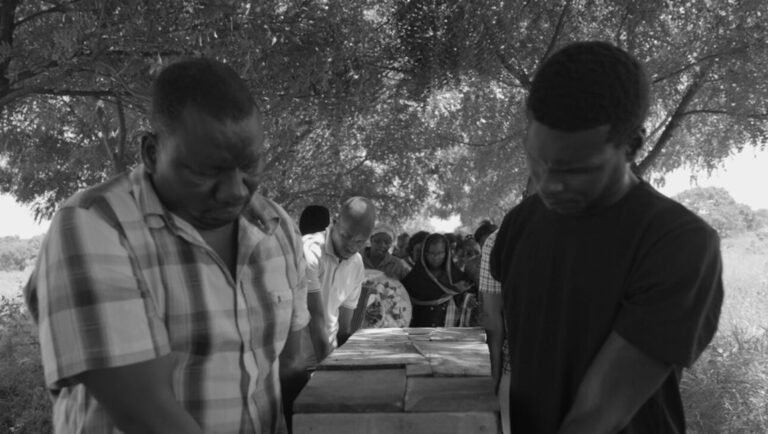
Long takes involving medium-to-wide shots of landscapes have nearly cemented themselves as festival-cinema staples, so it’s not surprising to see an IFFR Tiger competition film, O Profeta, open with that. But Ique Langa, the film’s director, already hints at something aslant in his symmetrical shot of trees swaying in the wind as a funeral procession gradually enters the frame. The height of the trees naturally dwarves the people absorbed in their rituals, but Langa accentuates this feeling further through his narrow aspect ratio, almost imprisoning his actors between the tree trunks. Langa continues to build on this tension in his following scenes, introducing his protagonist, Pastor Hélder (Admiro De Laura Munguambe), as an awkwardly bobbing head at the bottom corner of the frame. Leisured long takes are suddenly splintered by shots of Hélder’s quivering fingers as he reads the Bible, or cuts to eyes and hands during conversations with his wife (Nora Matevel). Within 10 minutes, Langa has established Hélder’s spiritual crisis just through minor disruptions in his long takes and displacements of bodies, setting the tone for the rest of this film on the clash between the relatively new religion and the timeless landscape. The walls are closing in on Hélder, with even his mundane actions, which Langa films in tight, claustrophobic shots, being burdened by a primordial void that is gradually enveloping him.
The rest of the film, however, doesn’t sustain this invention, opting instead for a grand allegory that unfolds as a cautionary tale. An acquaintance suggests witchcraft as a solution, and Hélder takes his advice by following the common path of using the old to revitalize the new. A treacherous tangle of weeds, vines, leaves, and thorns foreshadows the perils of his path to renewal, and the encounter with the “witch” flips the film into a rather one-note allegorical drama, decorated with attractive shots that increasingly dazzle rather than introspect.
Langa’s stark black-and-white shots, which initially are very effective in grounding Hélder’s helplessness, soon devolve into an exoticizing, elemental portrayal of witchcraft and its alluring dangers. Langa mentioned that one of his themes was on the dangers of opening new doors in an interview, and the procession of images and events following Hélder’s encounter are deployed merely in service of this theme, in spite of his assured virtuosity. Initially buoyed by his witchcraft-aided success that enhances his reputation and church attendees, Hélder is naturally tormented by frightening visions of this witchcraft and its charged histories. But instead of reflecting on the commingling of the “old” and “new,” Langa merely employs the myths of the land for arty, but empty, surrealism that reduces the witchcraft to mere caricature. The wide-eyed witch even cackles and grins with cunning glee as she lords her triumph over Hélder. Langa’s controlled pacing and his sense of conflicting temporalities brought about by weighted cuts and exquisitely crafted extended dissolves become rather stale as his overdetermined theme suffuses his frames, leaving little room for questions and contradictions that initially arose. His final shot, though rather explicitly emphasized by a voiceover, tries to correct for the lack of reflection by reframing the exoticism into something more radical, but after the relentless straitjacketing of ideas raised in Langa’s excellent initial sequences into a grand, but hollow, allegory, this is merely a limp resuscitation.
Published as part of IFFR 2026 — Dispatch 1.
Comments are closed.