
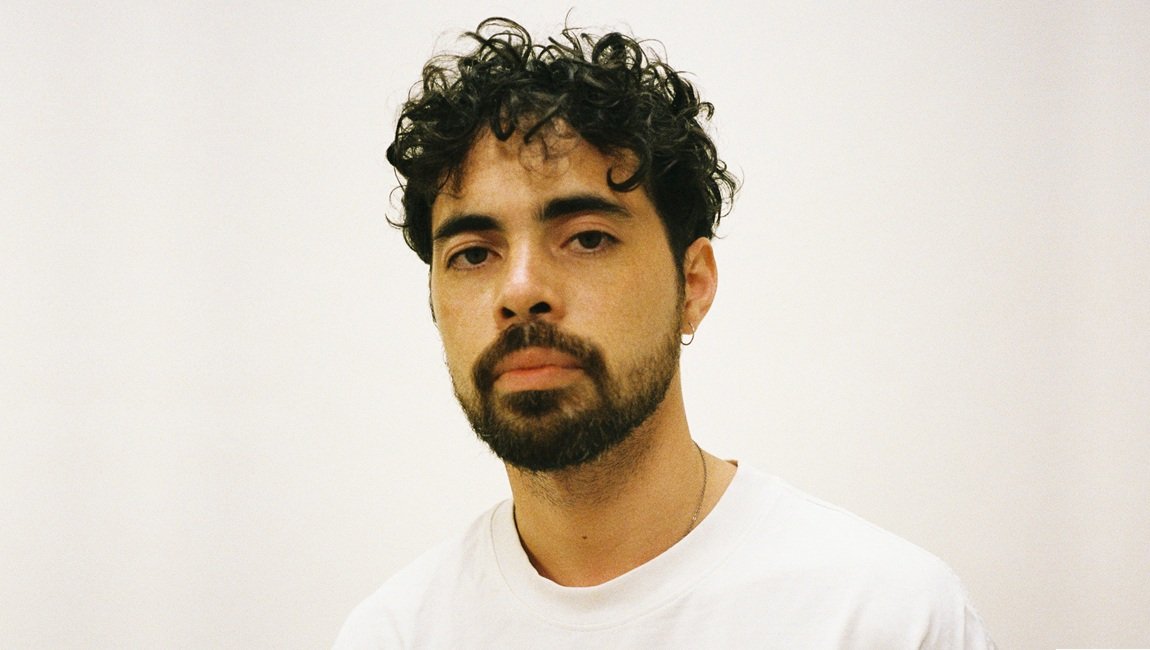
In his 35mm short documentary Inang Maynila, James J. Robinson explored the textures of girlhood under the tumult of living in martial law in the Philippines by revisiting and recreating memories of his mother’s friends as rebellious schoolgirls at a private Catholic school in Manila. Traces of this brief, pseudodiaristic portrait — the name of the Catholic school, religious idealism, and specters of a colonial past — still languidly loom over his first feature First Light, currently playing at the 55th International Film Festival Rotterdam, though not telling the same story in a much bigger canvas so much as thoroughly taking stock of the bigger philosophical questions that only ever linger in the short.
Whereas Inang Maynila is clear about its temporal specifics, First Light moves between the past and the present to slightly ambiguous effect, focusing its story on the religious shadows of the empire as placidly witnessed by a colonial community in the Philippine countryside, where a nun in her late 40s (played by Ruby Ruiz) contemplates her lifelong devotion to the Church following an awful accident involving a young man. Robinson takes us through the proceedings with a warmly observational style that luxuriates in the minutiae of everyday rural life. While his story promises no miracles, his closeup-averse shot-making says otherwise. The palette may be muted, but the images glow so poetically and hypnotically, like seeing daylight for the first time.
First Light is a distinct directorial debut, full of decay and divinity. Ahead of Rotterdam, I spoke with Robinson over Zoom to discuss the film in detail. Among other things, the intuitive director talked about a more sober understanding of spirituality and Catholicism, his Gothic taste, his work as a photographer, and the influence of the likes of Yasujirō Ozu and Andrei Tarkovsky on his becalmed, slow-burn cinematic language.
The following has been edited for clarity and concision.
Lé Baltar: First, I’d like to ask, have you arrived in Rotterdam yet?
James J. Robinson: No, I’m flying tomorrow. I was just saying to Robyn [Murphy, PR team member], I’ve got a crazy flight plan. It’s like Melbourne to Sydney, Sydney to Perth, Perth to London, then London to Rotterdam. So I’m going to be off the grid for the next 48 hours.
LB: I hope you have a great time [at] the festival.
JJR: Thank you.
LB: How did the concept of First Light evolve? How did you realize that it had to be your first feature?
JJR: I wrote the script in response to the religious discrimination bill, which is something that was being discussed here in parliament in Australia. Essentially, it was going to give hospitals, schools, or any kind of institution that had religious backing to uphold their values and the right to discriminate against people. So I went to a Catholic school and it would have meant that the school would have had permission to expel me. It would mean that hospitals would have permission to turn away queer people. And this was like a hotly debated topic in Australia, and there was a second there that it was looking like it was going to pass through. I started reckoning a little bit deeper with my relationship with Catholicism around this period. And I guess I kind of started to realize how deep the wounds are [from] being raised Catholic, but also being queer and realizing that it had kind of instilled Catholic shame inside of me that for probably the rest of my life I’m going to be unpacking.
So while that religious discrimination bill was being discussed in Australia, I was living in America. And, of course, in America this was a period where, and to this day, it’s gotten much worse, where the church and state have kind of become intertwined and it’s become this excuse for politics and religion to start controlling people’s bodies and getting very escalated at the moment. But then, at the same time in the Philippines where I’ve been spending a lot of time around that period as well, just looking at the way that my family had been Catholic and the way that they had instilled that Catholicism inside of me, [and] also realizing how much that Catholicism was a result of colonization.
And so as I kind of started thinking more about decolonizing, to me the story made the most sense to set it in the Philippines because my understanding of Catholicism is so specifically Filipino, because it was my mom who raised me in that way. And the churches that I went to were all the Filipino churches here. And so that’s kind of where the inspiration to start the script came from. And, yeah, from there, it just became a deep unpacking into my relationship with Catholicism through the story.
LB: I kind of relate to that. I mean, Catholic shame is still very much existent in the Philippines right now. But at the moment, are you still a practicing Catholic? And what was it like to sort of reconcile with that faith while putting this movie together?
JJR: Yeah, I’ve been on a big journey with that, and I actually would say that the film follows that journey. Like it starts off in this way where the character of sister Yolanda is so deeply connected to the earth and she’s this vision of what original grace looks like, what that core kindness at the heart of Catholicism looks like. That’s I guess where I was when I was young and a child, this kind of idealism that I had about morality. And then at a certain period, coming to realize that I was queer made me just very against the church and quite angry, which is kind of then when Yolanda realizes what’s happening in the story.
But the place that I’ve ended up since has been that I’ve realized there’s a difference between the beautiful core values of a religion and the institution that upholds it. And so when I kind of was able to differentiate between those two things, I was able to kind of stop being so against Catholicism and in fact celebrating the more progressive parts of Catholicism. I would say that my relationship to spirituality and Catholicism is [that] there [are] parts of it that I still definitely resonate with. There [are] other parts that I don’t. I think, like everyone’s relationship to spirituality and higher being, God — in any form that you call God — is very personal and should be fluid to who you are as a person. Like, I do believe in God, [but] I would say that’s a different form than what I was taught in Catholicism. But the core values of kindness and grace are still there.
LB: You just mentioned Yolanda. I’d like to know how you came to the decision to cast Ruby Ruiz in the lead role. Were you familiar with her previous work prior to working together?
JJR: Yeah, it’s funny. So I was writing the script, and I’m such a visual person. I need someone’s face to picture while I’m writing. It just helps me look. And so I was researching a lot of all the Filipino actresses and a lot of the ones that were in movies that my mom used to watch growing up, but no one really felt quite right. And then I actually stumbled across a video of Ruby when she had won a Best Actress Award at Cinemalaya for a film that she had called Iska. I hadn’t actually seen the film yet.
LB: Yeah, I saw that film.
JJR: I’ve seen it now. It’s on Netflix here. But I just saw her winning the award. And when she went up on stage, there was this quality to her where she has such a unique, interesting face; she’s so beautiful and she radiates this kindness. And so I started following her on Instagram, but I’m friends with the director Lulu Wang, who directed her in Expats, and I saw they were following each other on Instagram. So I messaged Lulu. I was like, “How do you know Ruby Ruiz?” And she was like, “Oh, like, we haven’t announced the casting yet, but she’s with us in Hong Kong. We’re about to shoot her with Nicole Kidman.” And I don’t know, I had a great testimonial from someone I knew and then also was picturing her. We started chatting and then, yeah, I just knew from the first meeting that Ruby had a quality that she could bring the character that no one else had ever shown me.
LB: Most of the cast are also television regulars.
JJR: Yeah, they are. I mean, it’s a funny mix, because yeah, we really wanted an exciting cast and to do it in the Philippines [and] we, you know, have Australian funding; it’s a very unique Filipino Australian film, in that it is international funding, but it is a purely Filipino story. And so our casting director really wanted to get us some of the crème de la crème.
LB: I also know that you shot the film across Northern Luzon and the Calabarzon region, and throughout I was actually curious about the actual church featured in the film. Ruiz’s character mentioned it briefly — Santa Catalina. But there are a lot of Santa Catalina churches in the country. I mean, there’s one in La Union, there’s another in Ilocos Sur and somewhere else. So which is it? Did you move between churches? I think that would also work since there are not a lot of closeups in the film.
JJR: So there’s the church we ended up shooting in for the convent — Baras Church. It’s not actually called Santa Catalina. That was just the name that we gave it in the film. Then the church in the film, like not the convent, I think, oh gosh, I forget the name of that church now. I can research that one for you, but that one was in Morong, that church. And it was beautiful. I mean, to be able to shoot in these churches was incredible. It wasn’t an easy ask because we had to do a lot. You know, we had to flood it in one scene and all this stuff. But I think the beautiful thing about the story is that while it is questioning parts of Catholicism, it is still very much a thing that a lot of Catholic people that we’re reaching to about the story could understand, that we were trying to do something quite nuanced and we weren’t ever being critical of Catholicism. We were just bringing up questions as to how it relates to politics.
LB: The scenes in the convent, especially in the first few minutes, actually unfold as though the characters are inside a dangerous cave. I mean, that’s how it felt to me, with all the bats and rainwater rushing from the ceiling. It kind of added to the atmosphere. Was that intentional on your part?
JJR: Yeah, I love Gothic literature. And I liked the idea of bringing in a couple Gothic signposts from the very beginning of the film, something that was important to me and my production designer and to my cinematographer. We liked the idea that this story of Yolanda coming to question Catholicism is a story that has been told many times before, even in the Bible as parables, you know, it’s essentially the story of this character who is surrounded by people who have a different version of faith. And there’s someone who still holds on to their core values, despite the fact that everyone around them is telling them that they’re wrong. And so there’s a universality and there’s a history to this story.
So when we first open it in that opening shot, we liked the idea that it was kind of never really entirely clear what time it’s set from that second that she lights the candle and you see them in their habits. For all you know, it could be set in the 1800s. And we liked that idea of opening the film up to being in a conversation with just like every era of the past. So opening that scene up and bringing all these Gothic references, I think, calls to a time of Gothic literature, which is a period where they were questioning the church again, like in the 1700s and 1800s. And so by kind of constantly referring back to these times in the past, that this story has already been told in different forms, I guess it was my way of questioning how much further we have to go and that this story and the relationship of the church and the state is something that is historical. And this isn’t the first time that we’ve had to deal with what it means when people take advantage of religion.
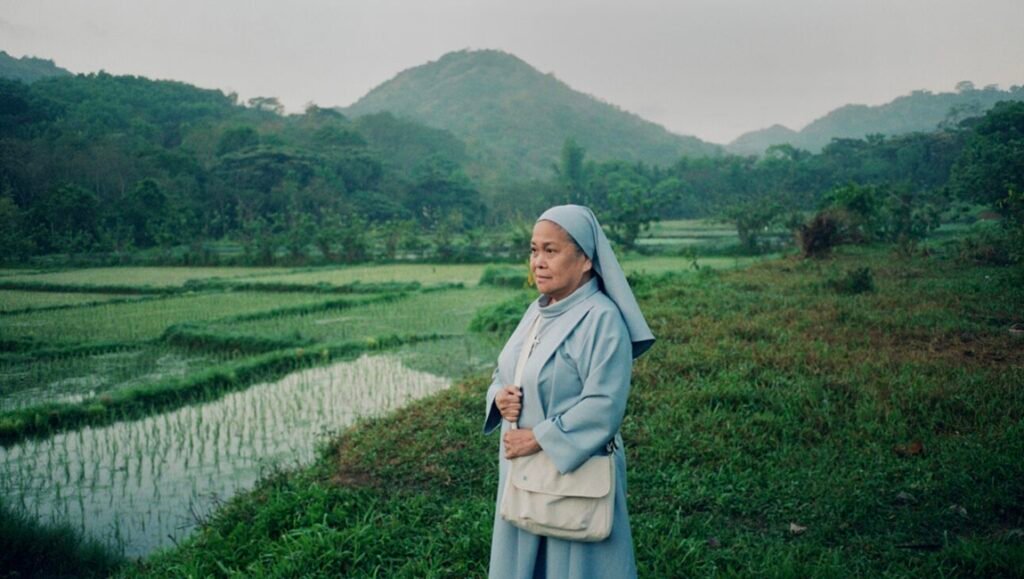
LB: And were you always specifically keen on having your first feature shot in the Philippine countryside? Was this your first really immersive journey through the country? I mean, outside of Manila, of course. And what was that like?
JJR: I didn’t set it in advance [for] my first film to be in the Philippines. I knew I always wanted to shoot something there. And there’s so much to it as well, where part of the decision making was, you know, we’re getting Australian government funding. And the idea is to be able to bring that kind of money to the Philippines and to pay people properly. You know, our producers would talk about how a lot of the international productions that would come to the Philippines would take advantage of cheap labor and relaxed labor laws. We did the opposite; we were coming in like people are to be paid properly. Because there are so many layers in the film about decolonization. It’s like, how can the practice of making the film itself uphold the kind of values that we’re trying to unpack in the film? And so for me, part of the decision to do it in the Philippines is also like, “Okay, cool, we can give a boost through Australian government funding into the direct Filipino economy by making this film.”
And then when it came to getting outside of the city, I mean, I’ve been to Manila a few times, of course, like for family, but we hadn’t really gone much out into the country. You know, maybe we would go down and, say, we have one family member in Batangas who would sometimes go visit, but we’ve never really stopped off inside the natural landscape. And so when I started developing the film, [when] we got development funding, it was very beautiful because we got to reconnect with parts of my ancestry that draw back to Igorot roots. And we could actually connect with Indigenous groups there and learn a little bit more about pre-colonial Filipino history. And that to me has just been the most beautiful part of the journey, in that making the film was almost an excuse to have money to pay me to go and reconnect with these ancestral roots. So, yeah, it was a beautiful process. And it’s definitely not going to be the last time that I come to the Philippines and shoot things.
LB: It’s really important, like it’s really nice to hear that you’re mindful of the labor laws and the working conditions in the Philippines since now, I think, international co-productions have been a regular fixture in the local industry. And, yeah, it’s nice that there are actual productions mindful of these things.
JJR: Yeah, it’s tricky ‘cause my producer works for a company [where] she had been in charge of when they shot parts of the Avengers up around the North. Back in the day when she was a production assistant, she was [also] working on Apocalypse Now. And for those projects, it’s like everyone wants them to shoot in the Philippines, but when they come, they can be very extractive. And, I mean, one of the things that we did from the very beginning is, like, we wanted to ask permission to be shooting on the land. So we had done ceremonies and rituals to kind of welcome us. And ever since we did that, it rained on days we needed it to rain. It was sunny on days we needed to be sunny. There was definitely something in the air about us just being welcomed to shoot there, which we took as a sign to film it in a particular way. We got very lucky.
LB: You mentioned Apocalypse Now. I just thought of another film. I don’t know if you’ve seen it, Apocalypse Child. It’s a Filipino film that sort of references how Apocalypse Now was shot in the Philippines. It’s kind of a film about Apocalypse Now lore. I don’t know, maybe you might want to check that out.
JJR: I want to check it out. Who directed it?
LB: I forgot the [name of the] director, but the title is Apocalypse Child. I mean, it’s pretty popular here.
JJR: [Looks up the film online] Mario Cornejo.
LB: Yeah, Mario Cornejo.
LB: Prior to reading anything about the production, the film that immediately registered to me while watching was The Wind Will Carry Us by Abbas Kiarostami, in that while you shoot your actors from a distance, the experience it generates is not exactly at a remove. And, of course, there’s the philosophical aspect to it. Can you speak more about that approach and your other influences?
JJR: Yeah. Oh my God. It’s so funny you say that because I was watching Kiarostami as we were shooting. Every night I was watching a different film in that Koker trilogy that just blows my mind every time. I think the approach to that is that there is a risk when I’m making something that’s stylized, that it can feel like it’s removed too far from reality, if that makes sense. You know, I’m telling this story about nuns in the mountains and the production design and lighting and cinematography are all very important to me. But there is the risk that pushing it too far in that direction, it almost makes it feel like it exists in its own world. And one thing that I love about Kiarostami and one thing I was getting when I was watching his films every night is [that it] feels so rooted in place. It walks that balance between being almost fantastical, but it’s still very clearly set and so realistic.
And so when we were shooting, a lot of it, like getting wide angles and everything, I was just like, we just need extras. I need the world to exist as much as possible. I always said to my production, I know we’ll set our character there, but if there’s any chance we don’t need to change any of the background, or we don’t need to tell extras not to walk through the shop, if we can just set the camera up across the road and just roll as much as possible — which was possible in some places, not possible in others — but as much as possible, I wanted this story to clearly be rooted in reality. Because it obviously is like a very lived experience for a lot of Filipinos. And so if I were not to do that, it would be disrespectful to the fact that these are lived experiences for a lot of people. So, yeah, that was the influence behind that more kind of Kiarostami documentary-type angle to certain cinematography.
There was a lot of inspiration for me, a lot of it came from novels. I’m quite a big reader. I love the author Hermann Hesse, who writes a lot about characters who kind of go through this process of becoming themselves in some way. And then directing wise, Andrei Tarkovsky is always my number one; I don’t think I could ever even try or attempt to make something with his specific language, but his ability to invoke the spiritual somehow through the medium is something that I’m going to spend my whole career trying to do. And then, yeah, I guess on top of that, Lav Diaz, of course, a major inspiration.
LB: [Points to Zoom background] Yeah, my background.
JJR: Oh my God, I didn’t see him there. [Laughs]
LB: His interview for In Review Online.
JJR: Well, okay. I didn’t see it. The maestro. I mean, of course, like it’s so difficult to ever think about Filipino cinema for me without diving into him. And there’s something about his approach to time and temporality, where he’s existing in his own kind of pre-colonial sphere. To me, I wanted to push it more and more and more in that direction. And then, I also have this Australian stance, so it was actually quite nice trying to be like, how can I maybe try and bring the things that I love about certain directing styles of people like Lav Diaz and bring it to somewhere where Filipino funders would be happy with it. Sorry, Australian funders would be happy with it.
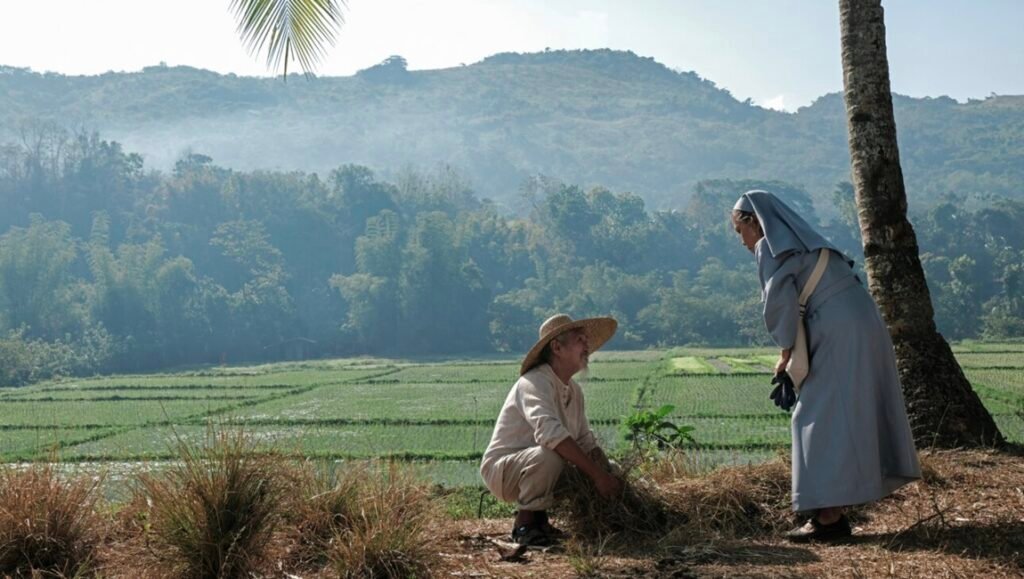
LB: I also learned that you paid a visit to the grave of Yasujirō Ozu before filming.
JJR: Yeah, I was in Tokyo doing an exhibition. It was when Japan was still closed, the borders, for COVID, but I was doing an exhibition there, so I was allowed to enter and there were no tourists and it was very relaxed. And, yeah, Ozu, like, oh, if I could talk about Ozu forever, if I ever had to pick one director whose lineage I am obsessed with or like who I just respect forever, it’s Ozu. And I think I say that because it’s just his attention to everyday moments and finding beauty in things that people generally overlook.
There’s so much philosophy from Japan that radiates through him, and there’s [the] concept of mono no aware, which is, you know, that everything is going to end and everything is impermanent, which isn’t a bad thing. It’s finding a beauty in that impermanence and his concepts around ma, which he has on his gravestone as the Japanese character for ma, and that is the word for negative space and the power of negative space. And one of the common metaphors they use is like, when you think of a vase, it’s like the vase itself is, you know, physical object, but like the actual, the real energy of that vase is the emptiness inside it, because that’s where the flowers go. So that negative space is what makes it.
And so to me, Ozu’s approach to ma and negative space is something that was big for me. That’s why there are so many cutaways in my film. That’s always been a big inspiration for Hayao Miyazaki as well. And so in a lot of the Studio Ghibli films, you see [those] same kind of cutaways and pillow shots that Ozu kind of, I guess, has been the master of. So, yeah, he’s my number one. And I went to his grave to ask for his blessings before we started shooting. It was a very beautiful day.
LB: I’m also really fascinated with how languid and slow-burn the film feels like, but it’s also not stripped of events or actions. I mean, before you know it, something else has happened. Was it something you really aimed for?
JJR: Yeah, I think so. That slower pace is important for me. I think, when I watch films, I love things even slower because I feel like it’s giving me time to process what I’m seeing. Like when I watch these fast films or like these Netflix films today, of course there’s a world where sometimes I love them, but when there’s so much happening and it’s quick, quick, quick, quick, it’s just feels like I don’t actually get a chance to have an emotional reaction to things. For me, I wanted to give the audience the space to have those emotional reactions. And I think in my career, I’d love to continue trying to push that slowness further and see where I can take it.
At the same time, the reality of getting funding and marketplace for me in Australia, anyway, has been that we do need to keep things looking a certain way. But I don’t see that as a challenge. I see that as an opportunity to try and develop my voice and that I can pull from the Tsai Ming-liangs and the Hou Hsiao-hsiens and see where I can put that in a place where I can still connect that with a story that people can follow for the purpose of marketplace, and I guess throughout my career I’m going to continue exploring that dichotomy.
LB: I look forward to that. I also loved how you effectively harnessed sky and storm blue as part of the visual palette. How was it to work with Amy Dellar as your cinematographer?
JJR: I can’t even tell you how incredible she is. We’ve been working together since I was in university. She shot my short films, my graduate film. Amy and I just understand each other so intuitively that we just know exactly what each other’s thinking. But, yeah, I think I was really excited to like, knowing this story, it’s about nuns, and the second I was chatting with her about things, there’s this certain feminine gaze that she was bringing to the story that I just could never even possibly come up with on my own. And so I just had so much trust in Amy and, you know, there were times where she would just have these ideas that at first felt wrong to me because when I’m writing the script, I’m picturing it, and she’s pitching something that doesn’t fit my vision sometimes. And then, you know, I’d relax and trust her. And then now some of my favorite shots in the film are some of the shots that Amy had put forward for me. And, yeah, she is incredible.
And we both kind of decided on what the language of the film was going to be from the beginning. It was going to be reserved like the mindset of a nun, which is so much about being meditative. It’s gonna be pulled back, not too much cutting. And we knew we wanted to give our actors their full bodies to perform with, because a lot of them have theater backgrounds. You know, like characters can say one thing, but then their bodies can say something different. We wanted to give all of our actors the chance to use their bodies in a way to tell a different story that’s happening in the subtext.
LB: And I think the movie really benefited from natural light. But I wonder what it was like on set if the weather wasn’t really something you were hoping to shoot with or if the sky was cloudy in a certain way.
JJR: Whenever possible, we just learned to go with it. I think it goes back to this approach that Tarkovsky actually has when he talks about in his book Sculpting in Time, where it’s like if the world is there and the world is giving you something, you need to roll with it, because those are the rhythms of life and nature. And if we’re trying to capture that in a film, we should roll with it; so whenever, you know, it was cloudy on the day that we didn’t want it to be cloudy, which generally didn’t happen, which is very lucky. Maybe that’s why I’m so optimistic about it. But, yeah, we would just go with it if it was a bit darker than we had intended. The only problem that came up, of course, is when that affected continuity between scenes. So when that happened, we did need to throw lights in or put up certain things to make things flow a little bit better. But yeah, for the most part, working with natural light was a very deliberate decision between Amy and I. Again, we wanted things to look slick and polished, but we didn’t want to push it too far into this other world.
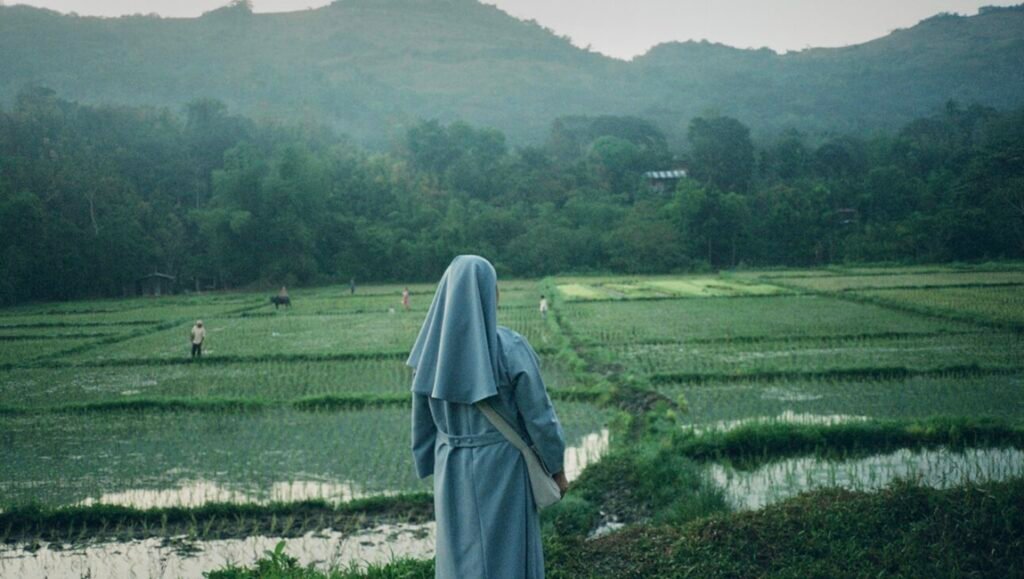
LB: The act of translation also plays a significant role in the screenplay. And I assume, I mean, based on your previous interviews, that you don’t speak fluent Tagalog. I was actually shocked that the film was entirely in Tagalog. I didn’t expect that. How did you go about that? I mean, did you first write the script in English, then have someone else translate it for you?
JJR: I wrote the script in English first. And, yeah, you’re right. Like, you know, my mum grew up speaking Tagalog around the house, but she never spoke it to us because she didn’t want us speaking Tagalog growing up in Australia, which is a shame. And me and my sisters have been so angry about that, but, you know, we understand more than we can speak. Like I can tell what people are saying, especially when they’re angry at me. I can understand it a bit.
I wrote the story in English and then we had it translated. But then it was kind of always being translated because as I then brought in my actors and we would rehearse the scenes, we would constantly be rewriting the translations to make things more casual or to respond to other people’s different ways of speaking things. So the translation was an ongoing thing. Something that I did find beautiful about that though was, you know, I trust my first AD and second AD, [and] they were very much paying attention to the Tagalog and letting me know anytime there were any ad libs or anything.
But, yeah, for the most part, I was watching the acting purely as movement and how they would use their bodies. And I think knowing that this is a film I wanted to bring to international audiences, a lot of people who don’t speak Tagalog were going to be watching the film. So I was looking at things in their performances that [weren’t] so specific about what they’re saying, but what they’re communicating in other ways. So it was a privilege to be able to direct from that sense and then to have my first and second AD kind of on top of the language. But yeah, translating was so beautiful, and now I have fluent Tagalog when it comes specifically to lines in the film. I’ve seen it so many times now that I [already know] those parts.
LB: So was there a lot of improvisation on set — I mean, at least when it comes to the translation of the script and how the actors would deliver it?
JJR: Yeah, there was. I think when I’m writing these characters, I kind of try to keep them as open as possible, because I like the idea of bringing the actors into the character rather than dragging the character into the actors, if that makes sense. So rather than Ruby, for example, trying to act like a nun, I was like, how can I write a nun that is like Ruby? So as we’re rehearsing and as we’re translating and coming up with things, a lot of those rehearsals are trying to find things that are unique about my actors and bringing them to characters. Like Ruby stands in a certain way, she walks in a certain way. And so I change the script and bring all of that stuff in there. So the rehearsals were so beautiful because everything was always kind of changing. I look up to a lot of directors as well who just don’t even have scripts and they just figure out the film in rehearsals and figure out the film in the day. I’d love to be able to work like that sometime in the future when I’ve got a bit more confidence and the confidence of financing. But yeah, for the most part it was kind of always being translated and the story kept feeling like it was always being fluid as to what felt right in the moment.
LB: One of the welcome sights in the film is National Artist Kidlat Tahimik. I was genuinely surprised when he appeared in the film. He also appeared in another Rotterdam entry this year, Sari Dalena’s Cinemartyrs. I don’t know if you’ve heard of that.
JJR: I want to see it, yeah.
LB: How did you get Kidlat involved in the film?
JJR: My actor Emmanuel Santos, who plays the father of the boy who dies, he’s one of Kidlat’s best friends. They grew up in Baguio [around the] same time together. And Kidlat is just someone who I’ve met by spending time up in Baguio with all of them. And I don’t know, for this character, who may exist or doesn’t exist in [Yolanda’s] old childhood home, I knew I wanted someone who carried some kind of symbolic weight. It is almost bigger than the screen. So Kidlat was definitely the right choice, and I’m so grateful to have his time.
LB: How did you arrive at the music for the movie with composer Ana Roxanne Recto? I could hear some guitar or cello throughout, but what other instruments are used in the film?
JJR: Yeah, I’ve been a big fan of Ana’s work for a very long time and her ambient music. She is just like one of the greatest artists, I think. And it was an honor to be able to work with her. But we had to try and figure out a language that felt right for the film and her ambient music. We both kind of reached the conclusion that it was feeling like it was taking the film into two different directions. So she was really excited at the chance to be able to [work with different instruments]. We had an oboe, we had a cello, we had a guitar. We had all these different instruments, which we were trying to make the language with. And so, yeah, it was beautiful being able to work in the music in that sense, and to have her voice in some way kind of like over the film. She is just one of the most spiritual, incredible people I’ve ever met.
LB: And comparisons between your amazing work as a photographer and your cinematic language are, of course, unavoidable. But I’m certain that you’re well aware of the difference between working on a magazine shoot or advertorial and making an entire movie. How would you describe that shift into a more cinematic sensibility? I mean, any particular breakthroughs in terms of your shot-making?
JJR: I think photography, for me, it’s never been my dream to do it. I kind of just ended up falling into photography and I just was doing well at it. And I enjoyed that I was learning all the time. I’m a lot less precious about my photography career than I am with the film career. I think one thing that I really learned, though, is that through photography over the last 10 years, you can tell an entire story in a single image. And then all of a sudden, when I’m working with a film and I’ve got like 24 images a second, it blows my mind. There’s always too much to choose [from]. But it makes me realize that I can practice restraint and I can have confidence in that restraint that, yeah, just showing people images alone is going to evoke some kind of response. And so to be able to bring that then to my film career has been [fulfilling]. I’m really glad that I’ve had the pathway I’ve had into doing feature filmmaking with photography.
LB: I also looked up your website prior to this conversation, and I particularly loved your personal work. I mean, they feel more loose and fun and spontaneous. Is that a way for you to decompress?
JJR: Yeah, I think so. Like with film, it takes so long to write things and to get everything up off the ground. And then with taking photos, I’m like, I can just grab my camera and grab a light and shoot something with my friends when I’m feeling it at the moment. That fluidity and that spontaneity, that means everything to me. And I think that it is really just a chance to decompress, but also to rehearse what it means to create things on the spot. And I think that’s an important muscle to have when you’re on a film set and things are always changing last-minute, that you can come up with things on the spot that feel right. And so, yeah, with my personal work in the film world, it’s in the photography space. It’s why I started shooting. It was fun. And I loved working with friends. And so I want to continue bringing that to the rest of my films.
LB: Are you already working on a sophomore film at the moment?
JJR: Yes, I’ve got a number of projects in the works. I’m excited to expand on some of the themes I began exploring in First Light, and look forward to continuing to navigate the world of international co-productions.
Comments are closed.