
Every threat to a sane and healthy life posed by AI is a continuation of some already existing social and political deterioration. Our societal tipping point from AI skepticism to acceptance (or, helplessness) was only fluid because our lives have already become so siloed, automated, and precarious. Technocapitalism decided humans are most valuable as a mass expression of processed, packaged, sellable data, a sea of targets for gambling ads and unmanned drones alike; everything deplorable about the AI movement was already made unstable by the gig economy, extractivism, and the Internet-endorsed normalization of fascism. This did not come from a vacuum; we equally cannot return to those previous contexts and circumstances.
Utilizing a similarly skeptical historical gaze but a deeper scope, Ghost in the Machine is a documentary that connects today’s AI “hype” with the genesis of studying and measuring intelligence — an ugly, colonial history of eugenics and unchecked fascism at the foundations America’s most wasteful industry. Premiering in the experimental NEXT strand of this year’s Sundance Film Festival, director Valerie Veatch’s film draws on the insight of sociologists, philosophers, and historians to argue that measuring intelligence is inseparable from colonialist practices, specifically eugenics, and the echoes of colonialism that persist in Silicon Valley’s infrastructure today. For about an hour, Ghost in the Machine is robust and compelling, but as the film catches up to the present day, the sloppiness (no pun intended) of its construction starts to snowball, with baffling editing choices that aim for a high-pulse Alex Gibney exposé but often settle for a paranoid YouTube explainer.
By the time Ghost in the Machine shows us wealthy AI zealots discussing the inevitability of machines reaching “Artificial General Intelligence,” a hypothetical type of AI which could match the cognitive and imaginative function of the median human being, the film’s early discussion of eugenics is ringing in our ear. As one academic tells us, the crude tools of measuring intelligence were originally a way of justifying the control of the majority of the world’s resources. Diligently and convincingly, Ghost in the Machine explains how deeply embedded race science was in the sciences and studies that built up to Silicon Valley’s dominion — a continuum from “g factor” coiner Charles Spearman, to Social Darwinism extremist Karl Pearson, to influential Stanford professor William Shockley, to that Microsoft chatbot “Tay” from 10 years ago that quickly became racist.
In our post-woke moment, masculine hero worship and the debasement of women and minorities is the single most appealing path for the grifters of the world, and the AI hype machine is an appealing way to make an unstable return on investment. Silicon Valley’s obsession with creation, with “giving birth” to new technologies, comes under particular scrutiny: a desire to remove women from the process of creation, where post-human means that new, powerful life will belong to its single masculine creator. It’s an offhand psychoanalytic observation with an evergreen literary precedent — Mary Shelley’s Frankenstein.
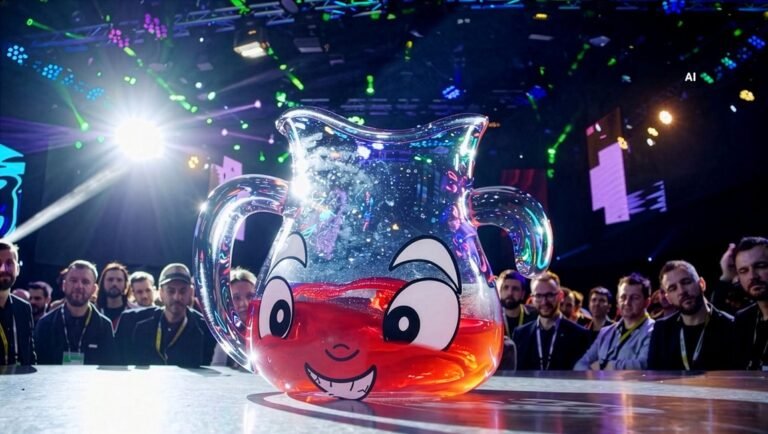
The question of Ghost in the Machine’s aesthetic value is a tricky one, as the majority of its visual textures have some degree of unattractive jankiness that, intentionally or not, feel in conversation with one another. Archive footage of John McCarthy taking part in the 1973 Lighthill debate has the warm, fuzzy glow of videotape, while the array of interviews with academics and experts are all crummy recordings of Zoom calls. Low-res cell phone clips intermingle with 4K quality video podcasts where tech gurus icily preach about their altruism, and most baffling is Veatch’s repeated use of AI-generated videos to give visual reference to the locations and metaphors mentioned by her interview subjects.
These AI images have the familiar uncanny, quasi-cartoonish sheen of something we’d scroll past on Twitter or Facebook, but not without a small shudder at its algorithmic ugliness. Simply put, why include images like these? The film is firmly critical of AI hype, and in its later stretches, it implicates the staggering environmental cost of consumer AI software as neo-colonialism in practice. The film’s use of AI-generated imagery is marked by a small caption that says “AI” in the top-right corner of the screen, which switches to “not AI” for every other piece of footage, but this classification is not entirely thorough — at least once, a clearly AI-generated video of a hand holding a wine glass is labelled “Not AI.”
Veatch establishes a juxtaposition between the pixelly grain of her interviewees and the impeccable gunk of AI content, where low-res webcams and tinny audio may be ugly, but does have a recognizable human touch. It draws our attention to the pursuit of aesthetic perfection in generative AI, which necessarily demands a fixed, limited definition of what a “perfect” image is. (According to tech gurus, it means shiny, fascistic kitsch.) But the film’s closing argument — that every act of resistance against the social and political domination of AI will only grow more and more meaningful — feels especially limp considering that the filmmaker did not, in fact, resist using the technology themselves. Perhaps the modest resources available to Veatch made this compromise more tempting, but it reads more like dubious complacency on the filmmaker’s part, and Ghost in the Machine’s sloppy craft undermines its swings for probing, valuable historiography.
Comments are closed.