
Renaud Després-Larose and Ana Tapia Rousiouk, along with their frequent collaborator Olivier Godin, represent an alternative stream of Quebecois cinema, one that is both shoestring and grandiose, and that flits between extreme doses of whimsy and self-involved seriousness. The duo’s work is at least partially fueled by French cinephilia, but this passion is filtered through an academic need to cite, defend, and categorize even the most inconsequential idea, even as this deliberate processing of experience stagnates and runs in tension with an artistic project that aspires toward a sense of formal and character-driven freedom.
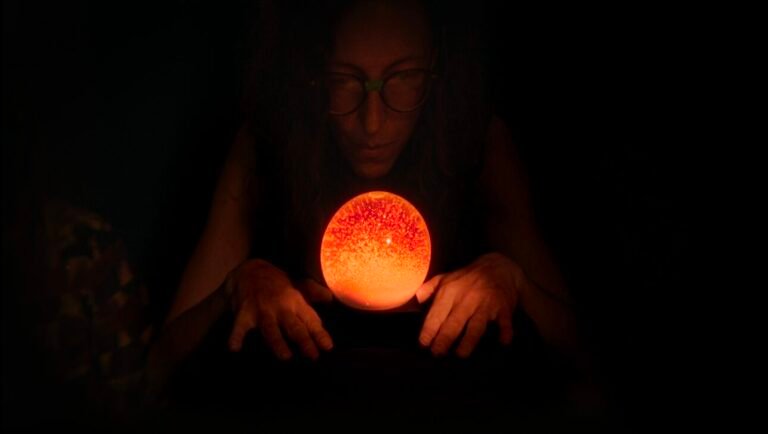
The first section of Nightmare’s Advice is, in contrast to what follows, a pure game of mystery. Lucie (Marie Ève Loyez) is a grad student whose PhD funding is running out. She shares an apartment with an older woman who imposes strict rules on her comings and goings, and seems to have no friends. Her routines involve a lot of travel time on her moped, and by foot when she occasionally disappears into the woods. Hypnagogic cinema is often used as an embrace of psychological effects in genre films, but here this state is achieved through theatrical blocking and an absence of context. We don’t know whether we are seeing dreams, memories, Lucie’s typical excursions, or the nightmare of the title. (Like Després-Larose and Rousiouk’s first feature, The Dream and the Radio, their camera sensor’s murky detection of low-level light and nightfall is put to constant use as an obscuring effect.) The most unsettling aspect of these scenes might be their total acceptance of chance, with characters entering the frame or hiding within it to little acknowledgement from Lucie or the camera; perhaps this is normal behavior in Montreal, or maybe there is something half-imagined about these briefly-glimpsed figures.
The film’s early rupture from this mode undoes any potential confusion and clarifies its intentions. Lucie is said to be a sleepwalker. It turns out that the thesis she has stalled completing is about “play,” and she has experienced a total onset of anxiety that she is simply not a natural enough participant in any playful attitude to be the rightful author of such a text. Even her conceptual approach is compromised, as she has been forced to choose between strict disciplines: either critical anthropology or phenomenology, each with their drawbacks. The filmmakers’ way into this intractable problem involves an extended, belaboured homage to Jacques Rivette, particularly his Céline and Julie Go Boating. There is something novel in this, perhaps, if only because Rivette is a perpetually neglected figure next to the dozens of independent acolytes that have taken up Godard, Rohmer, or their Left Bank contemporaries Varda, Resnais, and Marker as models. So incorporating dance and clowning, and pairing two women together as investigators with transferrable personalities, is a clear and somewhat unusual way of reinterpreting Rivette outside of his Parisian context.
Accordingly, Lucie meets her kindred spirit Béatrice (Geneviève Ackerman), and is changed by the encounter. But the plot is no political and psychogeographical conspiracy; she’s stuck between two bad romantic options: a failed actor and her thesis advisor. We never see these romantic developments; they are exhibited as autopsies of mostly-dead connections. In all this, Béatrice exists as little more than a sounding board for long, digressive monologues, and has no problems of her own; she is basically imaginary, and the film always comes back to Lucie’s academic writing block and emotional degradation.
Like Rivette, the film does invoke magic, myth, and ritual, but only in a cursory, unsubstantiated way. It’s not just that “Athena’s helmet” is only a name for a costume piece, and that the duo’s most transformative act is a bonfire — hardly an unusual activity for post-grads in Montreal. It’s that Rivette’s purpose, across films both more and less successful, stemmed from a total vision of how play becomes a different way of understanding and crossing public space in a city full of ghosts. There’s no way that Després-Larose and Rousiouk aren’t aware of this idea, but their film is so obsessed with its minor concerns that it ends by collapsing into a black-box theatre soliloquy, in which Lucie laments her uneventful flings. While Rousiouk’s collagist approach to the film’s music is complex — classical and modernist compositions vie for space — it often functions as a wall of sound. Després-Larose’s cinematography is similarly “active” without finding the kind of mysteriously affecting and disorienting images necessary, perhaps, to carry off the film’s conceit. This problem of superfluous detail and over-explanation is perhaps more than anything a model of frustration. Obviously, the duo’s films are pointedly small and depopulated partly by choice and partly by contingency. And the model is also chosen because it keeps their production within a trusted circle.
This scale could be what makes their spirit of improvisation possible at all. But it’s also what keeps their improv-as-action from feeling fully considered or effective. “You’re playing with boundaries,” one character says in the film. As a matter of academic description, this is accurate; the boundaries of relationships and art practices and studies identified in the film are sketched out to leave an uncannily detailed resonance for a contemporary like-minded audience. But it’s telling that the film relinquishes the power of its opening stretch, in which little is stated outright, and the slippage of boundaries — still clearly situated within a hyper-specific milieu — is left open, unexplained, and powerfully felt.
Published as part of IFFR 2026 — Dispatch 3.
Comments are closed.