
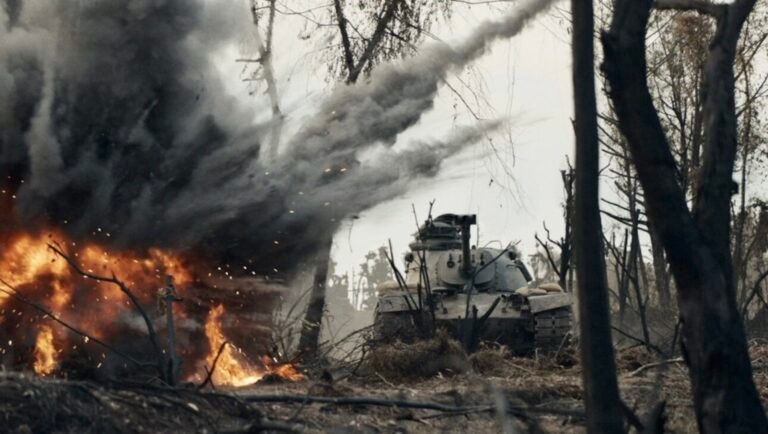
Tunnels: Sun in the Dark is a rarity in the West: a film about the Vietnam War told entirely from the perspective of the Viet Cong. Of course, it’s much less rare in Vietnam, but Vietnamese films almost never make it to our shores. And when they do, they usually star Veronica Ngô. Tunnels might be read as a propaganda movie, as it’s about the heroic resistance of the VC against the American invaders, and the longest speech in the film is a defiant one about how long the Vietnamese have struggled for freedom and how determined they are to fight and die for their cause. But if you’re sympathetic to their cause, or really just know anything at all about the Vietnam War, that’s not propaganda, it’s just spitting facts. On the contrary, a film like Tunnels lays bare exactly how almost every American film about the war is itself propaganda.
The plot is simple: essentially a reverse-angle view of Oliver Stone’s Platoon, which revolved around a lengthy American siege of a Vietnamese tunnel complex (with a detour into a My Lai-style massacre and lengthy meditations on whether Charlie Sheen should kill innocent unnamed civilians or Tom Berenger). We join a band of guerrillas as they occupy a large underground (literally) network. Their mission is to protect an intelligence communications center at the base of the tunnels, three stories down. The character types are familiar: the grizzled veteran leader in charge of too-raw recruits; the man of mystery in charge of the intelligence unit; the hotheaded young soldier too smart for their own good (in this case a woman, all-too-rare in a Western war movie but not at all in a Communist one); the stranger who joins them and who may or may not be a spy; and an array of other character types that would be just as familiar to the audiences of The Sands of Iwo Jima or They Were Expendable.
For the most part, these characters and their stories are well-drawn though, confined as they are almost entirely to action rather than melodrama. There is a bizarre subplot about a sexual assault that doesn’t make any sense, as well as perhaps the most poorly-timed sex scene since Munich. But by and large the film rolls along with classical precision: the first 45 minutes is spent introducing the characters and the geography of their world, while the last hour details their increasing desperation as the Americans close in and the people we’ve come to know meet their fates. Director Bùi Thạc Chuyên has a careful eye for spatial coherence, laying out the complex and its environs enough that we always know exactly where we are when things start getting blown to hell. And things do get bad: we get snipers and tanks and snakes and rocket launchers and floods and fire and all kinds of deadly mayhem. At times, the action even nods to something like the existential horror of the tunnels of Andrzej Wajda’s Kanal.
But Tunnels most resembles the war movies recently coming out of the PRC, films like The Battle of Lake Changjin, Snipers, The Eight Hundred, and many more that the Chinese regime feels are valorizing statements about the Party and its warriors, all of which are derided in the West as propaganda, works of concession by once great filmmakers (names like Tsui Hark and Zhang Yimou) to the power of the state. Most of the Chinese ones this writer has viewed are more complicated than their reputations, however, presented a clear-eyed view of the cost of war, not just its honors and glories. The losses in Tunnels too are deeply felt, but there’s never any question that the individual sacrifices for the collective cause will ultimately be worth it. Tunnels concludes with newsreel and documentary footage of complexes like the one depicted in the film, along with comments from the men and women who served in them. It is unabashedly proud of the Viet Cong, but does that make it propaganda?
One of the interesting things about war movies is that while they’re one of the most popular genres of propaganda, movies that governments and cultures produce to instill nationalistic virtue in their citizens, the movies themselves are basically all the same. The only real difference is the ideology expressed in the speeches the characters deliver to each other (but really to the audience). Even then, however, if you move around a few words here or there (“imperialist,” “capitalist,” “communist,” “fascist,” etc.), even those speeches are basically the same, hitting similar notes about, say, a small group of heroes standing together against a common foe, or the need to defend the homeland from the foreign invaders, or how war is hell and the bosses don’t care about the everyday soldier so the folks in the trenches have to just fight for each other.
Which is not to say that we shouldn’t ever call a particular war movie a work of propaganda. Rather, what we usually mean when we call a movie that is that the movie isn’t very good. Its exposition is clunky and preachy, or the film is racist in its depiction (or in some cases, complete erasure) of the enemy, or it isn’t sufficiently anti-war for our tastes. François Truffaut famously claimed that it was impossible to truly make an anti-war film because the cinema glamorizes everything it captures. Samuel Fuller, who should know, called Full Metal Jacket, a movie that most of us experience as a horrifying picture of both the military and the war, a recruiting poster. Relying on production money isn’t a reliable indicator of propaganda either: many countries subsidize their film industry with, more or less, supervision over the movies that get made. Some countries, like present day China, have strict, if ambiguous, rules about what can and cannot be depicted about the wars of the nation’s past. Others, like the U.S., are governed by corporate interests that are mostly aligned with the political power structure. In both cases, there are things one simply cannot do in a mainstream war picture. And in both cases, ingenious filmmakers always find ways to express meanings contrary to the system, while working within its rules. Tunnels is in no way contrary to the system, but it’s still a damn good war movie.
Published as part of IFFR 2026 — Dispatch 3.
Comments are closed.