
Charlotte Zhang’s docu-fiction of contemporary and prospective Los Angeles, Tycoon, contends with events both real and imagined, intimate and global. In it we follow Lito and Jay (Miguel Padilla-Juarez and Jon Lawrence Reyes), two grifters always hunting for their next score. Theirs is a story of conspiracy and care, hoisted up and shattered just like Los Angeles, which, in Zhang’s imagination, is a city of pent-up rage and political corruption thanks to a devastating livestock crisis in the lead up to the 2028 Olympics. In this way, Tycoon is reminiscent of Gary Indiana’s truish-crime novel, “Resentment.” Surveying every strata of Los Angeles society, from criminal underworlds to the cultural establishment, it alights upon the same details and observations as Tycoon: the desperate among us gamble big, the biggest among us consolidate power, and the rest scurry about like cockroaches trying to make sense of it all. Told in conjunction, these parallel stories of grifting run amok reveal Zhang as an astute synthesizer of the moment, whose relative youth neither overstates her anger nor undercuts her analysis.
Adapting to change is hard, especially for stubborn young men like Jay and Miguel. The opening scene elucidates how the general listlessness with which they move through their lives competes with their active imaginations. Parked in an empty lot, they munch drab vegan fare, the only food available to them in a post-meat society. Zhang renders their meal in an effectively miserable light. Miguel sniffs suspiciously at a falafel, and Jay throws away his pre-packaged tub of brussel sprouts, which scatter onto the concrete in a pathetic arc of green and yellow. In the distance Jay points out a camera-equipped streetlight in the distance that he says emits a mind-controlling frequency undetectable to adults. Jay mumbles his way through a half-baked explanation of the technology, cracked, but lucid enough to keep our attention. But Miguel isn’t convinced. The scene finishes with the boys no closer to, but no further away from, consensus; the circular trajectory of their conversation befits the moment in which they’re mired — entrenched, halting, empty.
When they’re in hustle mode, Miguel and Jay scuttle around the city like cockroaches, searching for a new way to exploit the large-scale corruption wreaking havoc on Los Angeles. One night they boost a shipment of insect protein supplements from Ootheca Inc., a new mega corporation that has spawned opportunistically, and to lucrative ends, from the ongoing livestock crisis. Miguel and Jay aren’t underground political operatives engaging in direct action, nor are they mere hoodlums looking to wreak some havoc of their own. Instead, Zhang’s documentary-like visual style reads between the lines, and in Miguel and Jay we see two young people trying to strike an appropriate, or at least sustainable, balance between concern for the world-at-large and for their immediate futures.
Miguel, however, quiet and introspective, isn’t so sure how sustainable his and Jay’s criminal exploits can be. How many cars can they boost, how many shipments can they hijack and scalp on Instagram, before their luck runs out? Jay isn’t nearly as concerned — in fact, he thrives in that crack between the certainty of danger and slim chance of success. Besides, his new girlfriend’s dad is worth $5 billion, and soon he’s moving with her to Amsterdam. This modern Barry Lyndon is just along for the ride. Zhang is alert to the conventions of drama enough to leave ample room for contrast. The care with which Jay regards the subtle fade along Miguel’s temples as he gives him a haircut one afternoon, and the care with which Zhang regards them both, fortifies, if just for a moment, a Los Angeles that seems at all times to be crumbling around them. That care is the film’s unspoken strength. One senses, too, that it’s kept Miguel and Jay together through even greater conflict, likely in spite of the self-preservationist impulses that later drive them apart.
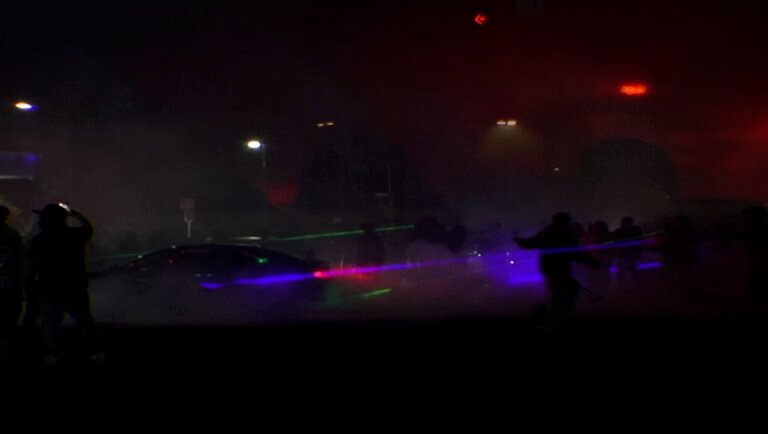
Tycoon wears its DIY bona fides on its sleeve. Shot over weekends on various filmmaking apparatus (mini-DV, iPhone, Super-8, night vision), its improvisatory, patchwork construction hints at the vibrancy of its makers’ own lives. Zhang weaves sequences of the real world into her imagined one, the kinds of events you imagine the crew captured during their own downtime or on the way from one location to another, like impromptu drifting exhibitions in empty intersections, or the jubilant celebrations over the Dodgers’ World Series victory. Others capture the past, but bear jolts as contemporaneous as anything else in the film, like the 1992 uprisings, the 1987’s Operation Hammer, and other violent, militarized crackdowns before the 1984 Los Angeles Olympics. The feeling they inspire isn’t one of gawking detachment — though, at one point producer Kenneth Andrew Sarmiento Yuen stares awestruck at those ecstatic baseball fans — but of admiration. Participant, observer, or interpolator: everyone has a part to play in this saga.
Published as part of IFFR 2026 — Dispatch 3.
Comments are closed.