
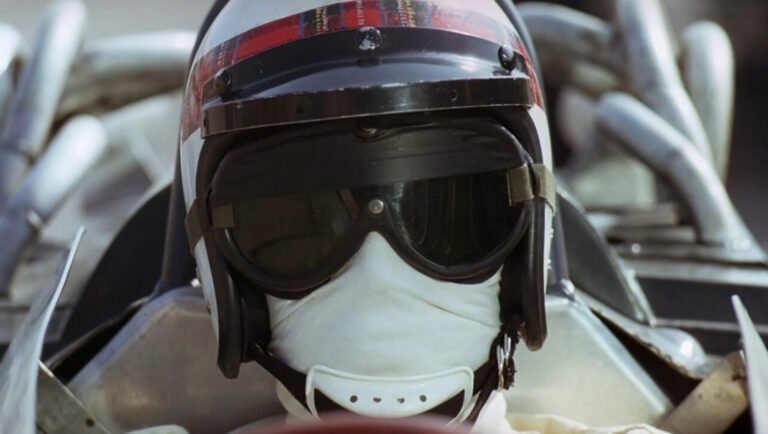
In any competitive race, the relevant agents can be organized as such: the spectators, who traditionally stay rooted to the spot and view its proceedings as snapshots; the cameras, which assume an omniscient, televised view of start and finish; the corporations, which manufacture and sell the stakes; and the competitors themselves, who live eternity in the moment. Applied to Formula One racing, this organization becomes the spectacle of grandeur writ large. Winning is the textbook objective, but there can only be one winner, and the audience’s jouissance necessarily requires a perverse outlet, captured dutifully by the cameras and secretly coveted by the suits — in crashes, near misses, flames, fatalities. Joseph Kosinski’s F1 (2025), nominated for four Academy Awards, sells the perversion to a consumer base long desensitized to sporting brutality; no shot, for the most part, is more than a few seconds long, and the sheer vulgarity of star-powered endorsements qualifies it as a maximalist IMAX hit more than any lasting hint of violence does. When, some 60 years before, John Frankenheimer filmed Grand Prix (1966), the novelty had a less polished sheen, but the obsessions weren’t drastically different. At the heart of the racing drama lies — and continues to lie — the expression of legacy, more fundamental than humanizing the greats and illuminating their rivalries. With legacy and posterity come their dialectical opposites: death, humiliation, and oblivion.
Serving almost as a counter-thesis to F1, Norbert Pfaffenbichler’s re-edit of Frankenheimer’s Grand Prix mounts a grand deconstruction of the former’s watered-down illusions. More accurately, a re-assembly of all the sequences within Grand Prix from shortest to longest, ADGIN PRRX proves challenging by virtue of its formalist trappings. It’s a found footage film par excellence, structured around an empirical organizing principle and bound by certain laws of necessity; its montage, then, centers around the seemingly arbitrary arrangement of discrete units in violation of the original’s continuous, passionate narrative. Arbitrary, too, is the film’s notion of authorship: one wonders how different the output might’ve been had another director (or AI) processed it. Yet in some way, the film both endorses and resists this ensnarement, its anagrammatic modus operandi not far off from the disjointed algorithms of TikTok consumption. Beneath the hot wheels lies a cold, impersonal calculus dominated by metal and machine; from this calculus now springs an unadulterated freedom from the dictates of linear representation.
Pfaffenbichler’s oeuvre has largely been rooted in structural cinema, and even his more narratively conventional 2551 trilogy traverses an outwardly gaudy path toward inner negation. The masked ape-man protagonist of this trilogy exists in an unspecified underground dystopia, marked by signifiers of silent Expressionism and strewn with the images of totalitarian excess amid an ever-squalid darkness; his incursions with and futile subversion of the Law mark, somewhat despondently, an underlying logic of cruelty at the core of civilization. In Grand Prix, crucially, a similar logic is at play. An amoral whirlwind of “speed and spectacle” courses through the fictionalized staging of the 1966 Formula One season, staffed by a celebrity ensemble and interspersed with racing footage of actors and professionals alike. The four main personalities jockey about the racetrack, each with a certain fixation on the sport: for Sarti (Yves Montand), its burdens are many, while the likes of Barlini (Antonio Sabàto) and Stoddard (Brian Bedford) doggedly pursue their fame and legacy, respectively. Aron (James Garner), faulted and sidelined for an accident that hospitalized Stoddard, seizes an opportunity to represent the industrialist Yamura’s (Toshio Mifune) newcomer team. The women of Grand Prix fulfil their spousal and narrative duties accordingly: sickened by his recklessness, Stoddard’s wife considers filing for divorce; Sarti and Barlini, meanwhile, each get involved, romantically, with outsiders (an American reporter; a French nymphet) to the racing industry.
Grand Prix’s interwoven pieces find themselves shattered, then rejigged, by Pfaffenbichler’s hand, as ADGIN PRRX splices sound and image wholesale, forgoing the mythology of the original’s 70mm Cinerama presentation for a creeping exercise of movement and inertia. The audio’s reverberations are carried, on occasion, across shots, their abrupt truncation now intrusive to the viewer’s perception of coherence. Assuming the existence of shots with the exact same length, one might posit some creativity to their mutual organization, whether by chronology or character, or some other association. Gradually, however, a radical sense of contingency begins to assert itself. The recurrent shots reveal the story’s prospective meat: the mountains; the lake; Stoddard in crutches, confronting his wife; the races themselves, propelled on the circuit with a steady, bewitching hum. Celebrations, commiserations, long and extended dialogues are broken up; only faces and impressions remain through the shards.
Had ADGIN PRRX begun with the film’s longest shot and collapsed into a flurry of intense action, one might glean a materialist account of the legend and events. The converse belies something more sentimental but also arguably more candid. As the length of each sequence rises, the façade of continuity paradoxically comes apart. The racing genre’s engines are oiled with seamless repetition, shots tracking briskly from one to another without distraction; by this new design, they sputter at the onset of motive and emotion, swapping the blur of movement for the fog of narrative. Who wins becomes less of a puzzle than a peripheral event, just as the monumental tragedy of Sarti’s death — a stain on the closing frame of Grand Prix — vanishes in the thick of smoke. Incidentally, the film’s final shot is not of the eternal triumph of movement, but a romantic intermezzo between Aron and Stoddard’s wife. Into this comes the afterthought of Sarti and his beloved, entering and exiting the frame momentarily. With it, ADGIN PRRX poses the age-old question — why race? — before jettisoning it, along with man and machine alike, in a heat death of entropy and disarray.
Published as part of IFFR 2026 — Dispatch 4.
Comments are closed.