
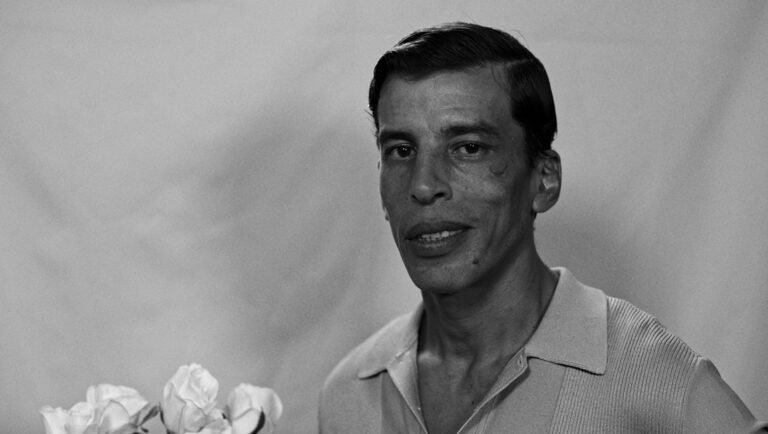
Despite being so nondescript, the title of The Arab actually communicates quite a lot. In the singular nominative, it reduces a specific man or woman to their ethnicity. (“Here comes the Arab.”) But as a collective, it speaks to an entire civilization. (“What is to become of the Arab?”) Algerian director Malek Bensmaïl’s new film explores the complicated slippage between these two identities, and in particular the ways they have haunted the Western imagination.
The Arab is loosely based on the 2013 novel Meursault, an Investigation, by Algerian journalist Kamel Daoud. In the film, Dali Benssalah plays a journalist named Kamel, understood to be the fictionalized avatar of the book’s author. The novel could be called a work of meta-counter-fiction, in the sense that Daoud revisits a canonical text from a radically different point of view. Like Jean Rhys’ Wide Sargasso Sea, which reconsidered Jane Eyre from the perspective of Bertha Mason, the “madwoman in the attic,” Meursault is a speculative novel written in the margins of Albert Camus’ The Stranger. What, the novel asks, if Camus’ story of the Frenchman Meursault, who murdered an anonymous Arab on the beaches of Algeria, were actually adapted from a true event?
Kamel’s story occurs in the Algerian civil war in the ‘90s. Socialists and secularists like Kamel are under threat from Islamists, and exist mostly underground, meeting in various liberal speakeasies. It’s there that Kamel meets Haroun (Ahmed Benaïssa), a retired civil servant who approaches the journalist with a story he is compelled to share. “The Arab” in The Stranger was in fact his brother Moussa, and he was murdered by Meursault over their mutual love of a woman. But in Camus’ telling, Moussa is rendered nameless, lost to history.
Bensmaïl and co-writer Jacques Fieschi explore the broad canvas of Algerian history through the lives of Moussa and Kamel. In flashback, we see Moussa as a young boy and then as an adult, grappling with the aftermath of his brother’s murder against the backdrop of the Algerian revolution. As the French are expelled from the country, Meursault’s unpunished crime keeps Moussa and his mother (the great Hiam Abbas) psychologically stranded within colonialism, a debt that can only be paid with more spilled blood. Although French racism may have destroyed Moussa’s family, it was his mother’s obsessive mourning that ultimately destroyed his own future, leaving him a miserable drunk.
The Arab deftly moves between Moussa’s past and present, with the revolutionary period depicted in black-and-white and Academy ratio, while the civil war of the present day is in color and widescreen. In one dramatic moment, after Moussa’s mother has forced him to slaughter a different Frenchman (Raphaël Thiéry) in Meursault’s stead, her “war” is over, the aspect ratio expands, and color fills the frame. Bensmaïl’s classicism recalls the work of Rachid Bouchareb, taking in the broad sweep of history and turmoil without sacrificing emotional intimacy. While The Arab is fairly conventional in structure, it is a quietly powerful examination of the persistent scars of colonialism. In the last analysis, even Camus’ gesture of literary defiance proves wanting.
Published as part of IFFR 2026 — Dispatch 4.
Comments are closed.