
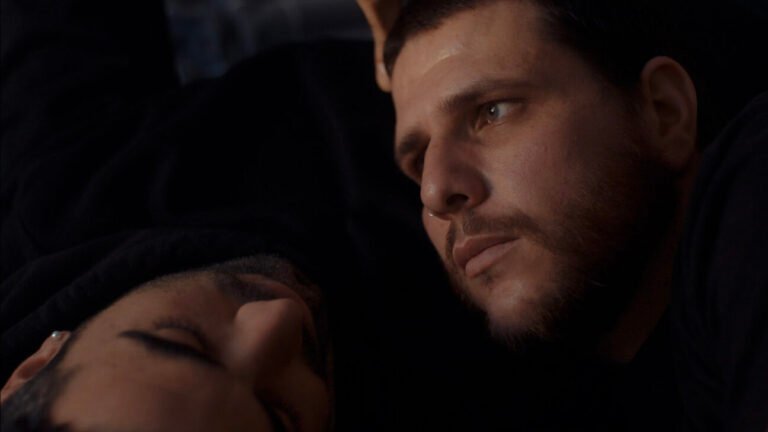
What happens when an act of resistance evolves from a single event into a living condition? In her debut feature, Why Do I See You In Everything?, Syrian filmmaker Rand Abou Fakher explores this question through a hybrid film form, bridging archival past, uncertain present, and a future that lives largely in dreams.
The story follows two men, Qusay and Nabil, who have known each other since they were five years old. From exploring the fields of Syria together as little boys, to joining the protests at 16 and later living in exile in Berlin, two friends intimate a deep connection that transcends uncertainty. The political context appears briefly, resurfacing here and there, but remains largely in the background, functioning more as an atmospheric state than as a sustained space of inquiry.
“I was kidnapped when I was four hundred years old,” says the voiceover, as the archival footage of olive trees being taken out of their home soil appears on the screen. Breaching the idea of a natural right to peace with obliterating violence, Fakher instantly prepares the viewer for a lyrical, yet unapologetic journey.
The inability to separate memory from perception is not a failure; it’s the main circumstance in Why Do I See You In Everything? Especially felt in the personal archive parts of the film, the idea of a memory turning into a pixelated stroke of pain is persistent and haunting. Slowly dissolving in the fogs of reminiscence about spaces and places that now exist only as an echo, two friends coexist in a reality both lived and acted out.
Passing the camera to one another as an intimate gesture of trust, from hands to hands, from eyes to eyes, from screen to screen, the two friends and the film’s director roughly maneuver the points of view. Inhabiting various visions, the film jumps locations and timelines as much as mood shifts. From a pro-Palestine protest in Berlin, resulting in another onslaught, to a peaceful bike ride, from the alluring Syrian landscapes, to its streets filled with weaponry, the film puts emphasis on a vicious instability.
“They want us to lose the capacity to see the truth, how harsh they are,” says Nabil to Qusay, “we should keep seeing and remembering.” Fakher’s film itself acts as a conductor of this remembrance, not shying away from being poetic but direct about police brutality, civilian massacres, and collective punishments of local populations. Side to side with the gentleness of taking shelter by the olive trees or collecting the ripe harvest, bearing “the horrifying” appears especially harsh.
The viewer begins to succumb and inhabit this liminality, just as their vision becomes altered by violence on the screen. The brutal black-and-white footage from the CCTV cameras contrasts with the grainy and soft sequences of nature in the same way dreams and nightmares might clash in fever. The images are no longer neutral, as they arrive already wounded.
The shaky camera movements during moments of stress and the fixed, almost suspended frames during moments of calm work as an effective emotional grammar. At times, Fakher might lose the viewer in rough transitions, relying on a drifting logic that feels closer to intuition than orientation. Yet the film unfolds like a beautiful walk that occasionally forgets to tell the viewer why it turned left instead of right.
During the tender scenes of intimacy, in words of support, it’s hard to say whether Qusay and Nabil are aware of the camera’s presence. Once in a while, the viewer could catch a glance at the camera; another time, the camera is openly discussed and manipulated, creating a quiet, contemplative presence. Perhaps the act of recording became an inseparable part of their lives as much as a continuous reimagining of survival.
In a continuous state of tension and resistance, in both the film form and the human condition, radical care seems to be a method of perseverance. Kindness, together with love, serves as a firm direction and a deliberate choice against all the painful changes or traumatic events. Care becomes a way of staying perceptually alive. Qusay and Nabil search for each other in protesting crowds, console each other during the hardships, and create peaceful moments for each other in times of complete turmoil.
The film begins with poetry, and ends with it, too. “There are roads we walk with our soul, and despite the pain… the time… the experiences… and despite places and distances, we will always find each other,” states the voiceover in the end, as Qusay and Nabil peacefully sit together under an olive tree.
Why Do I See You In Everything? offers a special approach to resistance. It opens itself to the viewer through unashamed fragility, giving space for visceral reactions as much as compassion. Rand Abou Fakher doesn’t answer the question posed in the title directly, instead only suggesting. In moments of turbulence, when remembering is altered by violence, one might see the other everywhere as an act of resistance and care.
Published as part of IFFR 2026 — Dispatch 4.
Comments are closed.