
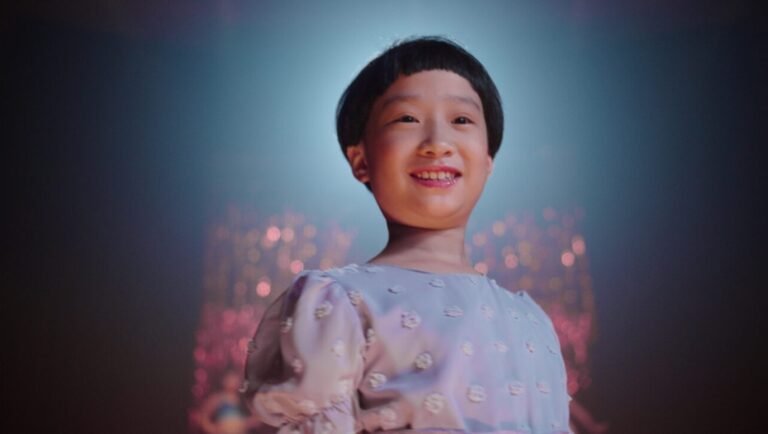
The haze of childhood offers considerable dwelling space for joy and grievance alike; forceful then but mostly latent now, these emotions nonetheless bear the transformative power that frequently molds children into the adults they love and fear most. For seven-year-old Swee Swee (Ong Xuan Jing), the effervescent protagonist of Ang Geck Geck Priscilla’s Ah Girl, imitation is the sincerest and only form of flattery she knows. Her parents are no luminaries of character: her laidback father (James Seah) hawks seafood but is frequently wanting for money, while her mother (Carrie Wong) labors industriously as a tour guide, absent and away for large swathes of time. They are also going through a divorce, which leaves behind its own farrago of emotional and administrative hurdles, both for Swee Swee and her boyish little sister Ah Tian (Sydney Wong). Their hapless grandmother (Doreen Toh), who does most of the childcare and shepherding to and from school, can only manage the fallout from a distance.
No fallout, in particular, occurs throughout Ang’s pleasantly bittersweet feature debut, but its candy-colored frames imprint a sobering if sometimes didactic sense of disconnect for her young characters. Caught not between an age of innocence and one of full-blown awakening, but in the throes of a burgeoning consciousness of their immediate family and environment, Swee Swee and Ah Tian are fighting to stave off the great fear of displacement, even if they do not know it. Their father’s roster of girlfriends, mostly fat and somewhat kind, injects a creeping disequilibrium into a family on the cusp of breaking apart. At school, Swee Swee refuses her English name — nothing quite binds her to it — and seeks time after time to impress her nerdy crush. But when her mother introduces her tattooed boyfriend, and her father hints at giving away Ah Tian to ease up the coffers, an acute rupture forms, shattering the idyllic pretense upheld for so long. Even when it’s patched back, something has shifted; “why do adults,” she laments, “always lie?”
Ang’s subtle portrait of parental neglect and incompetence might recall Shu Qi’s directorial breakout last year, in which a Taiwanese schoolgirl endured a torrent of abuse and utter despair amid the sweltering eighties. Whereas Girl’s lush palette served, perhaps, as an ironic yet hopelessly romantic counterpoint to its grim compositions, the luminescent pastels of Ah Girl invoke a comparatively nostalgic sentiment for the nineties, staged within the outwardly peaceful confines of the Singaporean heartland. The film’s autobiographical roots are credible, honed from Ang’s own tumultuous childhood; less so are its adult characters, resorting on occasion to stock profiles of neatly detached empathy. Yet if Ang relies generously on various markers — references to the era, including the country’s then-nascent ban on chewing gum, provoke knowing chuckles — to sketch the whimsies of the past, she tacitly acknowledges their loss to the present. Perhaps remembrance forgets even the haze of things past; only a miasma remains, and through indulgence is purified anew.
Published as part of IFFR 2026 — Dispatch 5.
Comments are closed.