
Ashish Avikunthak’s films, like many Asian and African avant-garde films, unfortunately find themselves caught in a tangle of categorization problems when playing in Western festivals. Too avant-garde for regional cinema and too specific for avant-garde cinema, these films cannot be easily assimilated into a rubric of recognizability. The easiest solution is often to discard them for being this hermetic, which sadly often happens, for there is often no exotic allure nor visual aids for Western viewers to grasp the images and visual language that is unfolding on the screen. But the reverse is never assumed to be true for non-Westerners interested in Western avant-garde films, as even in the case of niche subjects, those who possess the means of discourse often end up establishing the law, even if not intentionally.
Though seldom screened in his home country, Avikunthak’s feature films in recent years have thankfully found a home at the Rotterdam Film Festival, and his stock as a filmmaker is slowly growing thanks to retrospectives at The Asia Society in New York and Mubi. This year, he’s back at IFFR with The Killing of Meghnad, an adaptation of a poem by the colonial-era Bengali writer Michael Madhusudhan Dutt, which itself is a retelling of an episode from the Bangla version of one of India’s most renowned epics, The Ramayana (literally, journey of Rama). The Ramayana has been subjected to multiple iterations, reinterpretations, and commentaries across different cultures (even outside India and Hinduism), time periods, and languages, with the “original” source written in Sanskrit by Valmiki before the 3rd century CE, though the original date remains unknown and can also be much earlier. Dutt’s version of this story, however, is extremely unique in its usage of blank verse, bringing an imported, Western form to a familiar, Hindu text. By foregrounding Dutt’s poem, with all its dialogues and verses recited by his actors, Avikunthak also brings out the contradictions associated with Dutt’s English poetry aspirations (he was initially an English poet) and the radically different forms of Hindu poetry and storytelling.
The broad narrative of The Ramayana involves the story of Rama, the embodiment of virtue and an “avatar” of the God Vishnu, born in a kingdom on Earth. Without giving away too many details, for this is a rather large epic, his wife Sita is kidnapped by the king of Sri Lanka, Ravana. Rama, along with his brother Lakshmana, aided by an army of monkey men, must fight with the mighty Ravana to rescue his wife. The episode that The Killing of Meghnad focuses on is the killing of the titular character, who is the son of Ravana and vanquisher of the devas, or demi-gods. Considering his formidability in combat, Lakshmana defeats him using deceit and magic, all while being aided by the Gods. This episode is narrated through the multiple perspectives of heroes, gods and villains, who also end up raising philosophical questions along the way.
Many adaptations, including cinematic ones, of The Ramayana exist, and they tend to focus on lionizing Rama’s virtue and emphasising the battles and supernatural forces at play. Rama is one of the most worshipped Gods in the Hindu pantheon, and in the past 30 years or so, his name has become a war cry brandished by the Hindu right and now enshrined in government by the prime minister and his party to establish a Hindu nation in India. Therefore, these films are imbued with a mystical, mythological aura from the first shot that often tends to flatten any questions that arise from and outside the text. However, many Hindu epics proceed through what the avant-garde filmmaker Mani Kaul called the epic form, which might seem a lot more meandering to viewers used to tighter, dramatic plots that possess a forward momentum. Here, intervals, break points, and philosophical meditations are as crucial to the narrative as the plot development. The story is stretched by multiple perspectives and commentaries from characters and the gods themselves, each of whom mull over the consequences of past and future actions, sometimes even bringing the plot development to a halt in order to centralize an emotion, dilemma, ritual, or question. Avikunthak’s film not only revives this forgotten tradition, but he also doubles down by only showing his actors discuss and debate their emotions and dilemmas, while relegating the spectacle of action and magic, the centerpiece of so many Hindu epic adaptations, to narrations by an actor playing Dutt himself (Sagnik Mukherjee). This rather postmodern device is a lot more common in Hindu epic literature, with even Valmiki inserting himself in the story, but Dutt throttles these forms with his colonialist inflections in poetry, something which Avikunthak visualizes through Dutt ambling along in abandoned colonial buildings. The use of music, though sparing, is striking in its familiarity and unfamiliarity to both Indian and Western viewers, where a cello, an uncommon instrument in raga music even in a sphere where Western instruments have been naturalized, plays a Hindustani Raag. Avikunthak’s commitment to remain faithful to Dutt’s vision brings about the competing influences in the poem, but he shows a sharp awareness of the charged history and significance of the urtext, layering this adaptation with the spirit of that history as well.
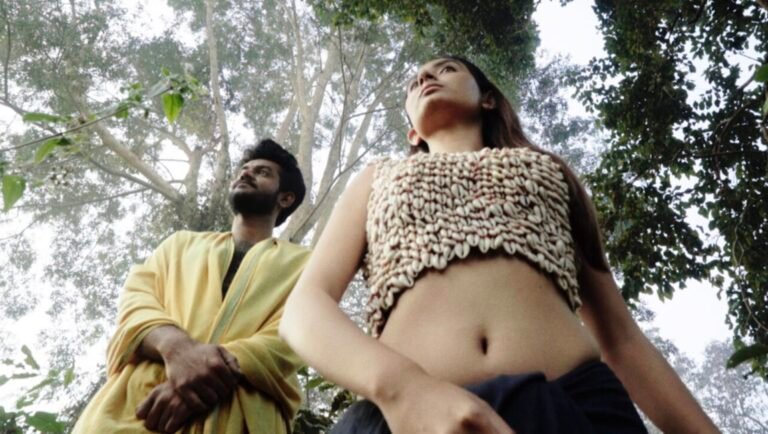
The actors recite the text in the film, but the landscape “acts.” Avikunthak constructs his films through a series of scenes set in disparate landscapes of groves, coasts, mountains, and ice sheets, with his actors reciting the text either in stylized gestures and poses similar to tableaux-vivants, an aspect which Avikunthak has termed as “infra-realism,” or as they walk along the landscapes in a tracking shot. Avikunthak’s landscapes suggest volumes when interacting with the recitations, such as the waves of the sea, almost functioning as the containers of Rama’s journey when Ravana and his wife lament Rama’s attack on Lanka as an outsider who crossed the sea from India. But the mental states of the characters and the diversity of perspectives from the two different realms of heaven and earth, each possessing a different temporality according to the Hindu belief, are also mapped onto the physical landscape, with the sounds of nature (wind, waves, rain) freighted with a sense of foreboding and landscapes being subjected to seasonal variations that muddies all sense of time, even if the event was supposed to have taken place in a period of seven days.
While all this sounds wonderful, and that indeed is the case, The Killing of Meghnad still seems forbidding for those less familiar with The Ramayana or Hindu epics. Since Dutt’s poem is Avikunthak’s focus, we are forced to follow the flow of the characters without any contextualizing information on why Rama and Ravana are fighting in the first place. But if cinephilia is viewed as a process of discovery rather than a position of certainty, there will be cases where we need to go against the idea of received wisdom to try to imbibe the rhythms of seemingly alien cultures and forms. As an Indian myself, watching the films of Straub-Huillet, who themselves foreground the text in some of their films, was a revelation, but only when I displayed a willingness to let my ideas and impressions flow around their structuring logic. One hopes that non-Western avant-garde films will also be viewed with a broader mind by both cinephiles and programmers, as only by confronting the unknown can we open ourselves up to new ways of thinking and seeing.
Published as part of IFFR 2026 — Dispatch 5.
Comments are closed.