
One of the difficulties of navigating the Rotterdam Film Festival as a cinephile is the sheer sprawl of its sections, both in terms of older and newer works. While there is the overarching sense that the festival does go for quantity over quality, there remains the possibility of coming across cinemas and filmmakers that are generally sidelined at the more famous and glamorous festivals. Festivals are far more welcoming to ArthouseTM cinema and middlebrow fare, which means that a country’s commercial cinema and avant-garde traditions — the two extreme poles of cinematic consumption — are often swept under the rug. In this regard, IFFR, for all its flaws, can be quite refreshing, as it exposes one to a country’s cinematic histories and auteurs which, at their best, not only expand our worldview, but also clarify certain influences and modes of that country’s arthouse darlings whom we rather carelessly, and even condescendingly, deem as the country’s best filmmakers.
A filmmaker being spotlighted this year is Egypt’s Marwan Ahmed, a rather acclaimed filmmaker in his own country, and whom this writer has unfortunately never previously encountered. To commemorate the release of his recent film, El Sett (2025), IFFR has organized a retrospective of all his works. Ahmed comes from a filmmaking pedigree, which is a more refined way of saying he’s a bit of a nepo baby, with his father, Wahid Ahmed, being one of the most acclaimed screenwriters of the ‘80s (a mere retrospective spawns so many threads to explore) and the screenwriter of his first film, The Yacoubian Building (2002). Critic Joseph Fahim describes Ahmed’s The Originals (2017) as the director’s most “atypical” and “philosophical work” in the program notes, and while a lack of fluency prevents this writer from testifying to its atypicality, Ahmed’s film certainly displays an ambition in its scale of ideas to complicate canonical philosophical questions on free will through distinctively modern lenses of surveillance and smartphones.
The opening shots themselves immediately address this, with a voiceover talking about poultry farming and the taming of the birds, while showing packets of chicken stored in a supermarket freezer. Sameer Aliwah (Maged El Kedwany) picks this chicken up, and Ahmed frames him between the product aisles. In case the parallels weren’t entirely clear, Ahmed swiftly details Sameer’s life as a banker and family man who daydreams of becoming a singer when watching a singing reality show, but is a slave to his routines and habits, where even the pizza place knows exactly the pizzas his family wants; in short, a typical bougie seeking upward mobility. Sameer continues to be framed within “naturalized grids” such as roads, aisles, and doors, until his boss fires him from his bank as a cost-cutting measure. At this time, he’s contacted by Rusdy Abaza (Khaled El Sawy), a member of “The Originals,” an organization that claims to be “the guardians of the spirit of Egypt.” Them surveilling him and other people doesn’t seem to trouble him at all, and faced with sustained pressure from his family’s desire to maintain and upgrade their lifestyle, Sameer accepts a job offer to work with them. He’s tasked with observing Soraya Gallal (Menna Shalabi), a PhD scholar whose research involves a mystical lost drug of the Egyptian civilization called blue lotus.
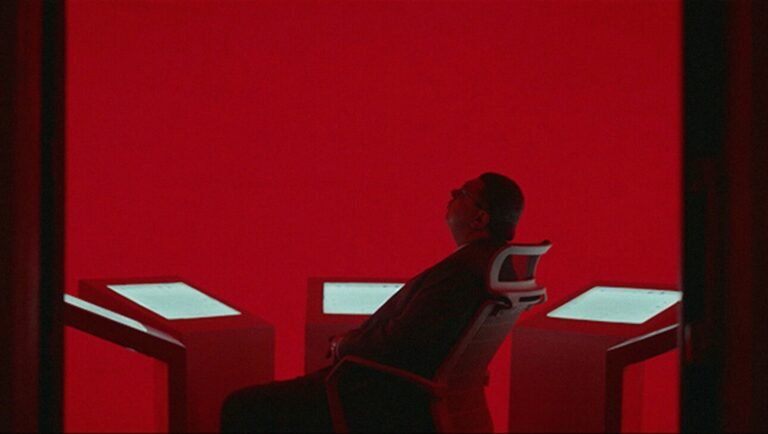
Quasi-authoritarian, fascistic, and even some good old-fashioned liberal governments in the third world are marked by their affinity toward some kind of nationalistic neoliberalism, and Ahmed immediately plunges into all the contradictions and conspiracies that sprout in such a style of governance. Conspiratorial whispers abound at night, in the form of hushed conversations in cavernous cafes, secret passages in cozy antique shops, hidden houses and narrow alleys, but are contrastingly normalized in the form of media surveillance during the day, covered for by towering corporations that offer futuristic rooms teeming with screens and blinding red lights. The “hidden” and the “normal” continually intrude into each other, and Sameer is less concerned, at first, with their implications, until his fascination for Soraya goes so far that he attends one of her lectures, in which she bombards her listeners with mystical, glamorous images that she intersperses with the slick narrative style of advertisements. Over the course of the film, Sameer wrestles with the choices made for him, either by his mother or societal expectations, across the years, along with the moral dilemmas of privacy and control.
Though Ahmed was already interrogating questions and feelings that Cronenberg successfully harnessed in The Shrouds (2024), he frequently undercuts his filmmaking smarts with a pounding score thumpingly asserting that a hidden, grand conspiracy is afoot. The recurrent sound of ping-pong balls, memories from the glory days of Sameer’s youth, grows louder and louder whenever Samir has a dilemma, and this unwillingness to let the themes percolate not only belabors the points Ahmed has made using his poultry metaphors, but also gives some credence to both Soraya and Sameer in their attempts to unravel a conspiracy to explain the seemingly mystifying vagaries of modern life. Perhaps this was done due to a commercial contingency, but Ahmed overcorrects and even undermines his own ideas in the process. This does take a good portion of the sting by the time we reach the conclusion, especially because it does a disservice to the talent on display. But watching such filmmakers and films reminds us how global themes can be so seamlessly wedded with local specificity, and perhaps we ought to be a lot more careful when we make sweeping statements about films from a particular country. One only needs to lift the veil of markets to discover more interesting filmmakers, of whom Marwan Ahmed, despite my reservations for this film, is one.
Published as part of IFFR 2026 — Dispatch 5.
Comments are closed.