
It’s a classic conundrum: a documentary focuses on advocacy on a very important topic, and manages to some extent to communicate meaningful information about that topic. But the film is deeply flawed on a formal level, to the point where it ultimately undermines its own power. Do we thank the film for drawing attention to a worthy cause, or do we take it to task for not doing a better job? This is where we find ourselves with Unerasable! The issue is complicated by the fact that the film’s maker has suffered individual persecution and is taking a certain amount of risk by simply making and disseminating the film in question. This only adds to the frustrations Unerasable! provokes.
The film is pseudonymously credited to one Socrates Saint-Wulfstan Drakos, and the exaggeratedly aristocratic, European name suggests a level of wry irony. However, the film sorely lacks whatever sense of humor the director’s assumed name might suggest. This is a documentary about authoritarian oppression in Vietnam, a subject that is sorely in need of examination. One gets the sense that the longer an authoritarian regime is in power, the more normalized their reign becomes on the global stage, and indeed, the repressive Communist government in Vietnam is not as high on our radar as it probably should be. But this also makes painfully clear just what a missed opportunity Unerasable! represents.
The subject of the film is a young filmmaker and refugee who goes by the rather ironic initials “CP.” Since both he and Drakos maintain anonymity throughout the film, it’s not even possible to discern exactly who is who. Are they one and the same person? In any case, CP was a young film student in Vietnam who received a political education in his home country while studying sociology in the Philippines. Upon his return, he made a short film about the imprisoned Vietnamese dissident Nguyễn Ngọc Như Quỳnh, better known by her blogger name “Mother Mushroom.” She was arrested in 2016, although she has since been released and now lives in exile in the U.S., where she and her family were granted asylum.
CP’s short film, While Mother’s Away, focused on Mother Mushroom’s own mother and two children, conceived as a way for Nguyễn to see her children growing up while she was kept from them. We see very brief clips from When Mother’s Away, and although a text at the end of Unerasable! tells us it has screened internationally, it does not appear to be available. (Web searches typically direct us to a Vietnamese feature film from 1980 with the same title, directed by veteran helmer Nguyễn Khánh Dư, so presumably CP’s title is an homage to the earlier work.) The short film places CP in the government’s sights, and after being arrested and severely beaten, he narrowly escapes to Thailand as an illegal immigrant. He eventually gains asylum in Sweden.
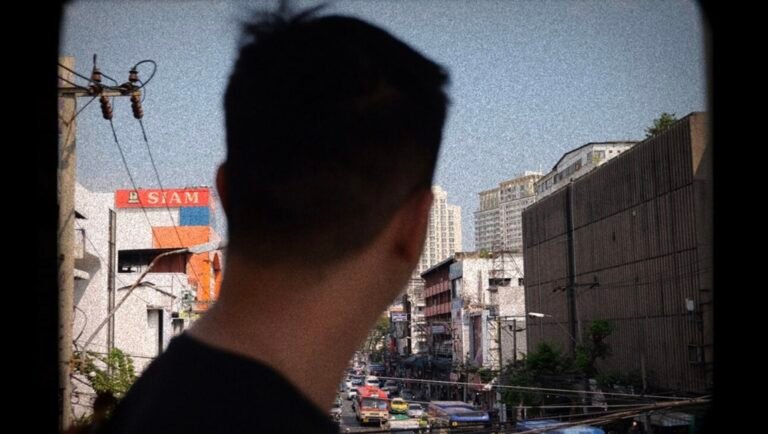
Unerasable! uses numerous visual techniques to obscure CP’s identity, from blurring and distressing the film’s surface to replacing his face with the digitally applied hole punch. Drakos does employ many signifiers of experimental film, including a tendency to enclose the image with the tight, rounded edges of Super-8 film stock. However, there is no consistent application of these methods, and rather than communicating on their own, they seem to just be simple solutions to the problem of keeping CP unseen. At the same time, the first 15 minutes or so of Unerasable! find CP talking about his awakening as a filmmaker, a discussion Drakos pairs with a collection of seemingly random early film clips: Méliès, de Chomón, Buñuel, Fritz Lang, and others.
The most obvious parallel one could make to Unerasable! is probably Flee, the animated Danish film about a gay Afghan refugee whose identity is similarly obscured by the filmmaker. But Unerasable! is not as successful for several reasons. First, Flee was structured as an interview, which permitted director Jonas Poher Rasmussen to frame the specific events of his subject’s life as emblematic of the general plight of international refugees and dissidents. By contrast, the personal digressions in Unerasable! are underdeveloped. CP is telling his story, but neither he nor Drakos can step back and allow the viewer to understand the broader implications of that story.
This film operates on the premise that everyone’s personal saga is inherently noteworthy, and this means that the film often fails to provide a context for understanding what is happening to CP and why. The history of French colonialism in Vietnam, and the subsequent U.S. invasion, are addressed in an opening onscreen text, but these vital elements should have been woven throughout the entirety of Unerasable! The difficulty of making this film, and the risks involved, naturally make it significant that Drakos and CP were able to do it at all. That is laudable. But it also makes Unerasable! feel like an unpolished first draft. One of the most fascinating aspects of the film is CP’s use of Post-it notes wherever he lives. We see him using them in Thailand, to help him learn vocabulary in Thai. He repeats this process in Sweden, as he tries to master yet another language. He and Drakos might have used this notion of translation, organization, and reorganization as a trope with which to help us gain a greater understanding of CP’s experiences. Instead, it’s just one of a number of tangents Drakos leaves hanging there.
Published as part of IFFR 2026 — Dispatch 5.
Comments are closed.