
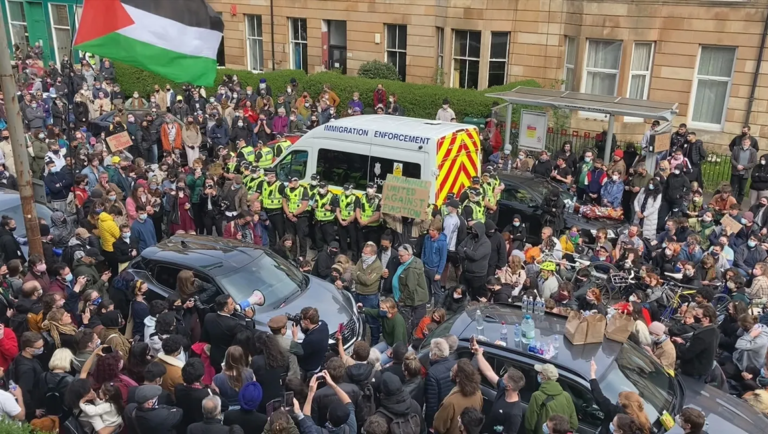
In 2021, a residential area in the southside of Glasgow, Scotland, exploded into an impromptu stand-off against police and deportation officers. Early on May 13, a unit from the UK Home Office’s immigration enforcement taskforce staged a dawn raid on Kenmure Street that abducted two Sikh men — longtime residents of the area — and ferried them into their van. This is as far as the “prisoner removal service” ever got, as locals quickly milled onto the street to livestream and protest the deportation. This was the first day of Eid in an area of Glasgow with a strong Muslim presence — the anti-immigrant raid felt especially callous. The word got out, and soon the van couldn’t move an inch; not just because a valiant protester had lodged himself under the vehicle, but because the street was packed with Glaswegian protesters refusing to let their neighbors be carted away by the state.
A widely shared photo taken by photojournalist Jeff Mitchell shows Glasgow’s iconic sandstone tenement flats looking down on bodies encircling a deportation van encircled by masked Police Scotland officers. There’s the sense of confinement, of extreme immediacy, of how the same ugly national policies have been steeled and modernized across history, and how community action has been so underestimated in recent years. It’s apt that Felipe Bustos Sierra’s documentary Everybody to Kenmure Street uses a rallying cry as a title; drawing on Glasgow’s history of imperialism and community action, the director turns his blow-by-blow account of the day-long protest into a compelling, accessible look at the political tensions underpinning life in Scotland’s most populous city.
By mid-2021, protests and vigils in solidarity against police brutality had been held across Scotland and the rest of the UK; coverage of the murder of George Floyd in May 2020 and the rape and murder of Londoner Sarah Everard in March 2021 by a Metropolitan Police constable make their way into Everybody to Kenmure Street to highlight the increasing fraughtness of how police powers were being viewed in Britain and abroad. But Kenmure Street honors its affecting tale of solidarity with a local specificity: in montages of archive material, Bustos Sierra points to instances of social injustice and collective action in Glasgow’s recent history: the Glasgow Girls, who began protesting in 2005 against inhuman immigration policy at high school after the detention of their classmate; the 140-day occupation of Govanhill Baths after the public bathhouse was announced for closure in 2001.
But if Everybody to Kenmure Street is a film about community, it’s also about culpability, and Bustos Sierra traces Britain’s revived furor against immigrants to Scotland’s colonial history. Glasgow is just as much built on empire as Britain’s other industrialized cities, a significant port in the triangular Atlantic slave trade and a major importers of tobacco from plantations. Scotland’s complicity in Britain’s machines of oppression and atrocity are in direct conflict with its mainstream, popular nationalism, which mostly ignores that the country replicates the same tools of class and racial hierarchies that can be seen in England and other former seats of empire. Even though these worthy historical digressions sometimes interrupt the gripping momentum of the Kenmure Street protest, the film connects them insightfully to the present day. Prior public demonstrations in Glasgow, such as the Govanhill occupation, were recklessly escalated by police officers. And although the Scottish Government clarified that the deportations were ordered by the UK Home Office, the same could not be said for the waves of police officers guarding the van — Scotland has control over its own national police force and criminal justice system.
In assembling a visual account of the day’s events, Bustos Sierra has an embarrassment of video riches; hundreds of cameras were pointed the same way that day, with activist livestreams and national broadcasters cramped into the same finite space to try and catch the police and Home Office’s next move. Bustos Sierra and editor Colin Monie cut between claustrophobic iPhone close-ups of residents’ confrontations with obstinate cops, grainy livestreams, and social media clips from the top floor windows of the Kenmure Street flats, to long-lens news cameras honing in on megaphone-using spokespeople demanding answers that Police Scotland and the Home Office refuse to give, even as the wall of law enforcement becomes more of an ugly intrusion with every passing minute. The clear hierarchy of image quality that distinguishes one camera from another contributes to the film’s communal momentum: different devices, different hands, different voices with a shared clarity of voice with one central, immovable subject.
The recency of the protests — and, presumably, the trust that the subjects have in the film’s director, who previously honored Scottish factory workers who refused to work on Chilean Air Force parts during Pinochet’s dictatorship in the film Nae Pasaran — allowed Bustos Sierra to interview an impressive range of the Kenmure Street residents and activists. Everybody to Kenmure Street captures the spectrum of solidarity — some are journalists and lawyers responding to a serious situation, or students who find the injustice of their social media feed materializing in front of them.
Most memorable are the actors who perform the testimonies of protesters who chose to conceal their identity: Emma Thompson and Kate Dickie respectively play the roles of a man who quickly lodged himself under the Home Office van and the nurse who tried to help him against the wishes of the police. As the only scenes of acting in the film, the presence and pathos of Thompson and Dickie disrupts the edge of real, forthright candor found in the talking head interviews. But two actresses only addressing the camera and never sharing the screen, despite playing people two meters apart, brings a strange tension to their perspectives: in the film, they are scene partners restricted from speaking to another, as if Bustos Sierra has dramatically replicated the punitive conditions that the police used to isolate the van protester from outside help.
Watching the film in 2026 makes it, inevitably, an ominous precursor to the widespread ICE kidnappings and killings across the U.S.; both Renee Good and Alex Pretti were shot by ICE agents the month of this film’s Sundance premiere, and in contrast to the stony-faced, immobile, and tense presence of police officers in Kenmure Street, ICE enforcers are reckless and flippant about showboating their lethal aggression in full view of onlookers’ cameras, before a state-supported campaign of denial and suppression kicks in against witnesses’ widely shared evidence.
The triumphant resolution of the Kenmure Street standoff relied on conditions that included the design of the street itself — protesters could lock in the invaders as the nation cottoned on to what was happening, and before long the Home Office and Police Scotland could not act without millions of eyes reacting instantaneously to every micro-decision. It’s what makes the telling of the Kenmure Street story exciting, as it’s packed with granular obstacles and escalations, but there’s a symbolic power that Bustos Sierra digs into, too. Maybe this collective expression of resistance had to happen here, on this street. Here was where they discovered the line could be drawn.
Comments are closed.