
“Look at its body,” Melanie Griffith commands with a bawdy dip in vocal tone. The ‘80s icon, star of capitalist fable Working Girl and voyeuristic spectacle Body Double, is a disembodied voice, and the object of her attention is a simple, elegant chair, all lacquered wood grain and symmetrical structure. Griffith’s narration pervades Amanda Kramer’s fabulistic feature By Design, and it’s just one of many meta-cinematic touches Kramer weaves into her tale of objectification and jealousy. A defining movie star from a period of rapacious consumerism and conspicuous consumption, whose cinematic image made her into an object of public fantasy, Griffith, unshackled by the limits of visual representation, now spins a story of the desire to be flattened into decoration.
Kramer’s film follows Camille (Juliette Lewis), who, as Griffith’s narrator relates, is a woman free of the jealousy and resentment that plagues her two best friends, Lisa and Irene (Samantha Mathis and Robin Tunney), but still struggles with the complications and disappointments of being human. Browsing a furniture showroom with her friends after a lunch where, as usual, she has patiently listened to their problems, she spots a chair that becomes her instant object of devotion and envy: the chair could be someone’s “favorite thing,” a status which Camille herself longs for. She returns to buy the chair the following day, only to find that it has been sold. Camille, devastated, embraces the chair one last time, and makes a wish to be the chair, rather than herself. Her wish is granted. Camille’s soul enters the chair, and her body is emptied of consciousness.
The chair’s buyer, the chic Marta (Alisa Torres), passes it on as a parting gift to her pianist ex-boyfriend, Olivier (Mamoudou Athie). Olivier devotes himself fully to the chair, and Camille’s silent soul rejoices to be so admired and loved. Camille’s body, meanwhile, lies flaccid in her apartment, where an array of visitors project their own wants and fears onto her unconscious form, unaware or uncaring that the body is no longer “Camille.”
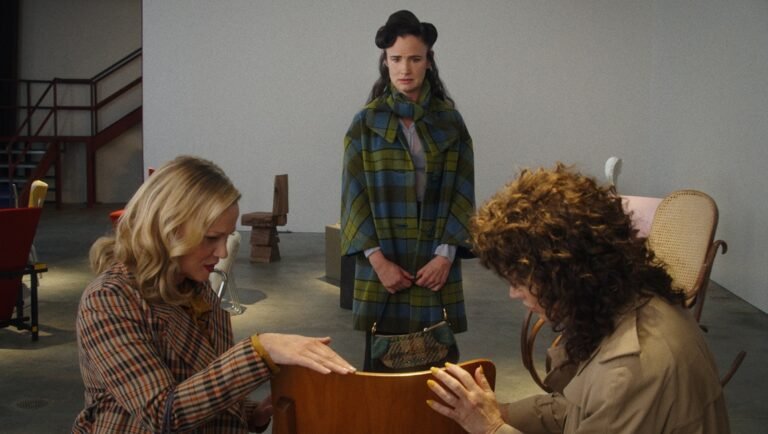
Kramer is a singular stylist, with influences that range from classical Hollywood cinema to experimental theatre. Her immaculately arranged frames echo Wes Anderson’s aesthetic precision, but Kramer’s whimsical visual style otherwise has no easy points of comparison. Take, for example, the apartments of Camille and Olivier: Camille’s is sparse, all pastels and beige, with décor and appliances including a wireless landline phone, mid-century modern furniture, and beach-themed wall art and mantlepieces. Olivier’s apartment is even emptier, in shades of grey and silver, with sleek Art Deco furniture and lighting fixtures. The costume, makeup, and hair design — by Sophie Hardeman, Anouck Sullivan, and Nevada Raffaele, respectively — are as eye-popping and un-tethered to any specific time period or location as Grace Surnow’s production design; the first showroom scene, for instance, features Lewis decked out in a blue-green plaid peacoat and Victory curls, while the furniture floor manager she speaks to sports a neon-orange bob and two parallel lines of thick, angular eyeliner.
Kramer submerges the viewer into an off-kilter world not only through quirky aesthetics, but also a distinct narrative approach that combines stylized, epigrammatic dialogue, monologues of searching emotion, and hypnagogic dance sequences, all within the self-contained structure of a fairy tale. Griffith’s narrator speaks with omniscient authority, matter-of-factly reporting on the characters’ desires and disappointments, while they are stuck within the muck of their own conflicted subjectivities — illustrated with sneaky depth through a series of scenes between characters who experience full emotional arcs when communicating either with the chair or a motionless Lewis. Athie, Tunney, and Betty Buckley as Camille’s mother are particular standouts, each displaying bravura emotional range within the film’s strict stylistic confines, and each revealing different facets of one of Kramer’s key thematic tenets: people use one another to reflect and burnish their own desires and self-conception, often to the extent that utter passivity is preferable to true interpersonal engagement. A “favorite thing,” after all, cannot talk back.
Camille is blissful as the cherished chair, her friends and family are happy to spend time with a silent Camille (who, after all, is a wonderful listener), and Olivier comes to prefer worshipping his chair over engaging with other people. By Design, always pleasurable and charming to watch, nonetheless puts forth startling ideas. The chair that Kramer’s film revolves around is a universally adored fetish object; beloved, claimed, and fought over. Camille is so dismissed, even by those who purport to care about her, that the cleaving of her soul and body initially occasions no conscious notice. Is it any wonder that Camille would rather inhabit the immaculate, static chair than her own living body?
DIRECTOR: Amanda Kramer; CAST: Juliette Lewis, Mamoudou Athie, Samantha Mathis, Robin Tunney; DISTRIBUTOR: Music Box Films; IN THEATERS: February 13; RUNTIME: 1 hr. 32 min.
Comments are closed.