
Allow this writer to save you some time: Baz Luhrmann’s EPiC, a concert film made in the wake of the eponymous director’s newfound (and lucrative) fixation on Elvis Presley, ends with a poem written and recited by Bono. It’s called “American David,” and it unravels over myriad disjointed images of the King: “Elvis, white trash/Elvis, the Memphis flash/Elvis, under the hood/Elvis, with Cadillac blood,” it begins, and only digs a deeper hole from there. It’s a perfect microcosm for the movie that precedes it — well-intentioned, pretentious, and totally enervating. But if you’re anything like this writer, a Baz Luhrmann hater-turned-truther following the out-of-nowhere triumph of 2022’s Elvis, that won’t be enough to dissuade you. You’ve had your fill of Luhrmann’s nonsense, and still you’re hungry for more. You need another hunk, a hunk of burning love.
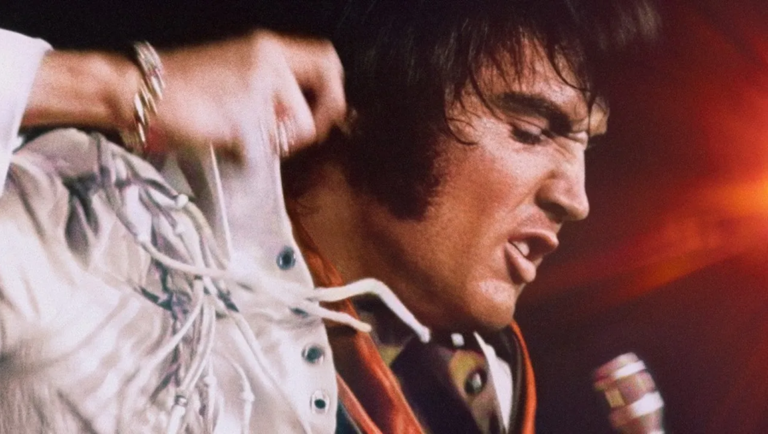
But a concert film is not a conventional biopic ripe for outside-the-lines scribbling; it’s a tender creature. Where Elvis is behooved by Luhrmann’s restlessness — fleet and lightly tagging perfunctory narrative beats on its way to the next jaw-dropping sequence — EPiC is hindered by it. On paper, Luhrmann’s maximalist sensibility primes him for success with the form, but in practice his penchant for rapid-fire cuts, the commingling of formats, styles, and colors, and an affinity for sweaty close-ups do him no favors. Luhrmann gets so distracted by the preponderance of footage he was granted access to (and it is great footage), he neglects in any way to let it breathe; instead, EPiC lurches between snippets of live performance and biographical archival material. As a result, all of the story Luhrmann mercifully abbreviated in Elvis is regurgitated, and all of his camp and pizzazz is reduced to pedantry: Elvis is asked point blank if he’s contributing to juvenile delinquency; Colonel Tom Parker is introduced in a whimsical montage set to “(You’re the) Devil in Disguise”; the Presley family intrudes in psychedelic superimpositions and cutaways to home movies that have nothing to do with the song being performed over them. There’s no art to the juxtapositions, and there are no unearthed discoveries about the life of Elvis; the only revelation to be found is in seeing how limited Luhrmann’s relationship to Elvis truly is.
Which is not to say Luhrmann needed to be intimate with the contours of Elvis’ experience in order to make a good concert film. Quite the contrary: Denis Sanders’ far more joyous and creative Elvis: That’s the Way It Is (from which, along with Elvis On Tour, EPiC forms its foundation) shoots the King from a middle distance — it’s more interested in the performer and the ecosystem that sprouts up around him than grinding an axe and inserting superficial observations. It also understands that the concert film requires patience and a very carefully crafted dramatic arc, the likes of which we find in a classic example like Stop Making Sense or in a more recent masterpiece like Beyonce’s Renaissance. There’s an implicit story being told by the setlist, lighting design, pacing, and physical performance — a game of tension and release. EPiC is all release, and in that sense pure pornography. To wit: at one point in both That’s the Way It Is and EPiC, Elvis stops the show to kiss a brigade of adoring fans. In That’s the Way It Is, the moment follows a blistering rendition of “Patch It Up” and a witty monologue as he works his way through some technical issues onstage. In EPiC, it’s a nonsensical flight of fancy deprived of context — Luhrmann cuts between isolated shots of Elvis kissing fans and moves on to the next unmediated explosion of feeling.
Yet as with all Luhrmann films, even the worst, His Bazness inevitably dillydallies his way into some provocative and genuinely scintillating filmmaking. In the rush to summarize his entire life before the Vegas residency, Luhrmann highlights Elvis’ time in Hollywood with a series of match cuts between shots of Elvis behind the wheel scored to a hip hop beat and cleverly chosen scraps of interview. And elsewhere, during a performance of “In the Ghetto” toward the end of the film, Luhrmann cuts to a press conference with Elvis in which he declines to comment on the Vietnam War, after which Luhrmann reverses the tape in high speed and implies that Presley was political in his music despite being hamstrung as a public figure not to be. Despite a handful of intriguing essayistic flourishes, though, the film manages the inconceivable: it minces the King of Rock & Roll into bits of meaningless trivia.
Baz Luhrmann is a man who lives without fear (he tells us as much on his title cards), and it’s a fearlessness that grants him a great and terrible freedom: the freedom to bring the Elvis back from pop culture purgatory, and the freedom to send him back there with a halfhearted concert film-cum-biodoc. But Elvis has been down and come back countless times, and Luhrmann’s mischief is merely a detour on his long road to music Valhalla; his power as a performer shines through no matter the circumstances. For the pleasure of seeing him 30 feet tall, nearly any documentary about him is worth at least a cursory look, but if EPiC finds you once its theatrical run has left the building, there are dozens of more coherent and interesting options to choose from.
DIRECTOR: Baz Luhrmann; CAST: Elvis Presley; DISTRIBUTOR: NEON; IN THEATERS: February 27; RUNTIME: 1 hr. 36 min.
Comments are closed.