
Content warning: this piece mentions Imperial Japan’s sexual violence.
In Yasuzo Masumura’s Black Test Car (1962), the director revisits ideas from his earlier Giants and Toys (1958): the absurd ruthlessness of post-war Japan’s corporate everyday. Where the former has its standout image of Hideo Takamatsu coughing up blood over an ill-gotten contract, the latter offers Eiji Funakoshi leaping from a window; the shot lasts long enough to capture the disgraced company man smashing into the concrete below. Nothing is sacred; friendships are cheap; business is expensive. People chewed up and spat out. On to the next business venture.
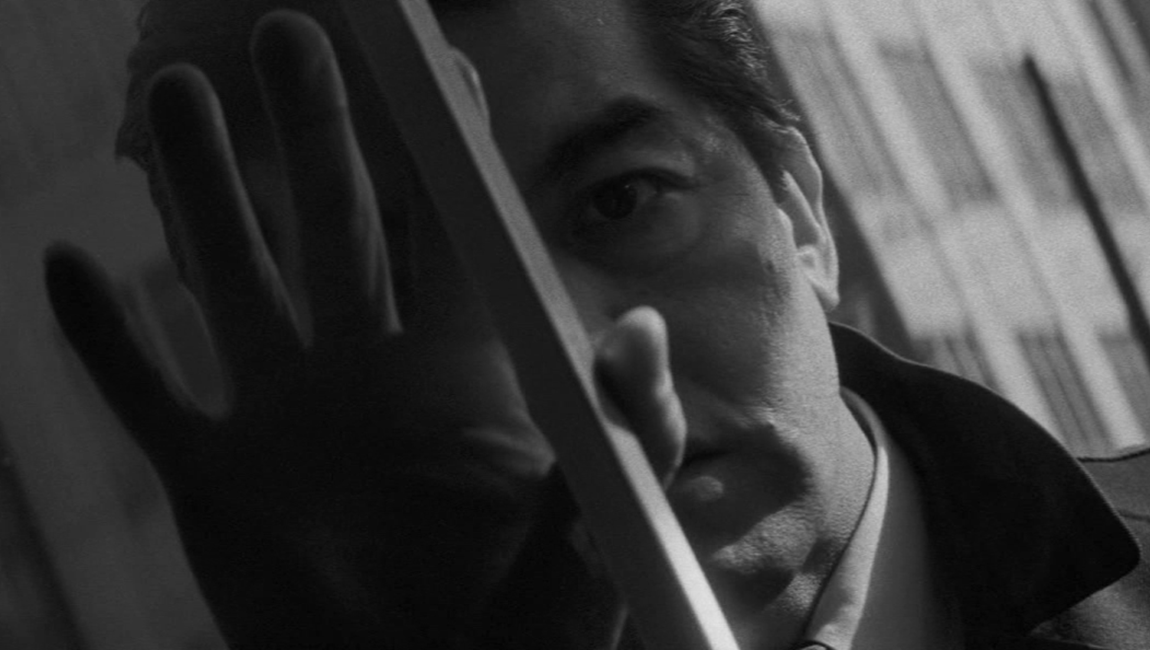
Kinji Fukasaku’s The Threat can be placed in conversation with these predecessors, taking the empty salaryman home, where the violence that structures the post-war recovery he and his colleagues oversee is turned on his family. This is delivered via Misawa (Rentaro Mikuni), accounts manager for an advertising agency. He has a home with two television sets, a refrigerator, electric race cars for his son, and a car of his own. Having returned from the wedding of a colleague that Misawa helped to arrange (understood to be a self-serving work of corporate maneuvering), he and his family are beset by two escaped convicts who quickly use Misawa to fulfil a ransom setup, brandishing a baby they’ve kidnapped.
A recurrent examination across Fukasaku’s work is how empty the images of prosperous post-war Japan were. If You Were Young: Rage (1970) shows youthful aspirations of post-war possibility swallowed whole by the enforced impoverishment that undergirds its images of affluence; in Under the Flag of the Rising Sun (1972), seeking answers from the war is to face both the fragility of memory and the forces of hegemony which have deliberately buried the past to construct the present; Fukasaku’s landmark Battles Without Honour and Humanity series similarly tells an inverse story of Japan’s post-war recovery through warring Hiroshima yakuza families, with the fourth and fifth entries showing these clans fully subsumed under its narrative as well. The Threat is an earlier part of this filmography, but Fukasaku’s thematic pre-occupations are already firmly in place: the shape, contradictions, and dishonesty of Japan’s post-war constructions.
Indeed, the contradictions of post-war society are raised early in the film. Not long after entering Misawa’s home, the older convict, Kawanishi (Ko Nishimura), observes that the salaryman appears to be doing well for himself, inferring that he must be paying everything off in monthly instalments. “That’s how it is for office workers nowadays,” he remarks. His words immediately hit upon one of the core tensions structuring Misawa’s life, for nothing in his life is actually his; not his television, not his car, not his home. His affluence is conditional and therefore can be taken away should he fail to pay, emphasizing the illusory nature of the supposed stability offered by the post-war economic recovery. You can have it all — “it” being a life of luxury goods which, invariably, are themselves the result of labor exploitation — provided you submit to the nakedly cutthroat precarity of the corporate hierarchy.
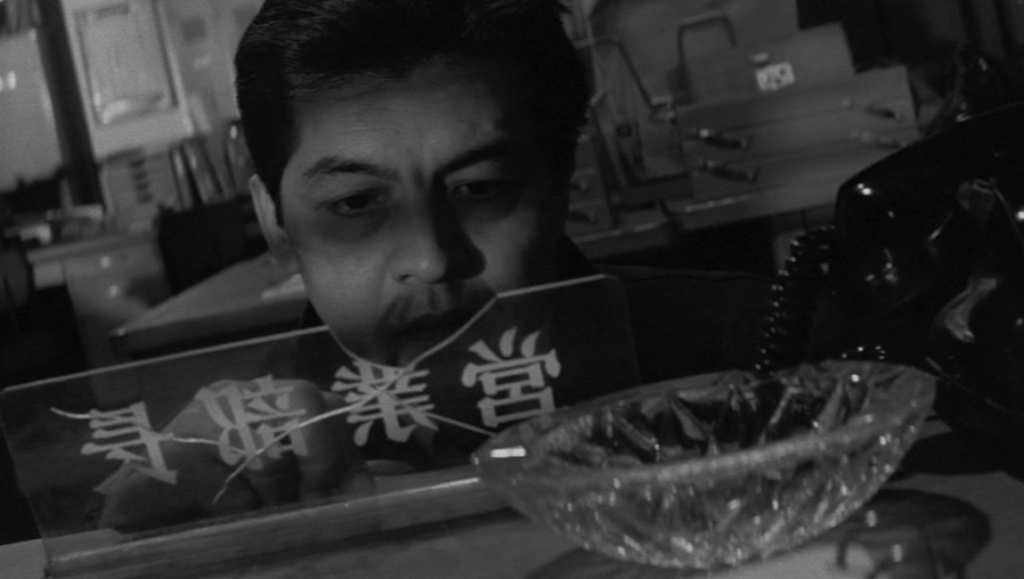
Within these contradictions, Fukasaku also identifies the many continuities and connections to Imperial Japan that run through the supposed post-war transformation. An early moment in the film is illustrative of this point: Misawa drives along at night as Kawanishi feeds him instructions. The older man probes Misawa, and the salaryman reveals that he fought in the war but didn’t kill anyone. Kawanishi then “supposes” that Misawa didn’t rape any women, either. And when Misawa turns the question back on Kawanishi, the convict disturbingly suggests that it’s better if he doesn’t know. When the two men return, Misawa finds that the other convict, Sabu (Hideo Murota), had tried to rape his wife, Hiroko (Masumi Harukawa). Misawa slowly approaches and then hits her repeatedly. Later that night, their home still under control of the two men, Misawa rapes his wife as Kawanishi listens and grins.
In these moments, Fukasaku raises the horror of Imperial Japan’s rampant sexual violence, showing that it is still very much alive. Misawa is meek, unable or perhaps unwilling to fight back against these men who’ve invaded his home and threatened his family, but all too able to attack his wife after she was assaulted. Misawa attacks her as if trying to contradict the implications of masculine inadequacy that Kawanishi framed through Japan’s wartime sexual atrocities. With Kawanishi’s horrid implication that he had committed sexual violence during the war hanging in the air, the post-war salaryman commits it against his wife to prove himself — either to himself or to the men who now run his life. In Misawa, the film locates connective tissue between “past” and “present.” The violence of the imperial “past” is reembodied and reasserted to assuage a fragile post-war identity, one that is both the product of and has become reliant on the Japanese state’s obfuscation, avoidance, and outright denial of its war crimes.
In Masumura’s Black Test Car, a young woman is offered up to a car company director in a covert act of industrial espionage. He sexually assaults her, and later “apologizes” by saying that older army guys like himself can be rough. It’s a sharply chilling comment that firmly reiterates these continuities. All the officers, the sergeants and soldiers who committed terrible atrocities, have become the sales directors, company executives, and corporate managers who now administrate the post-war economic miracle. Masumura and Fukasaku’s works depict the violence that had structured the imperial project readjusting itself within the new post-war confines, now underlining the ruthless profit pursuit of the executive, or seething beneath the lowly salaryman’s veneer.
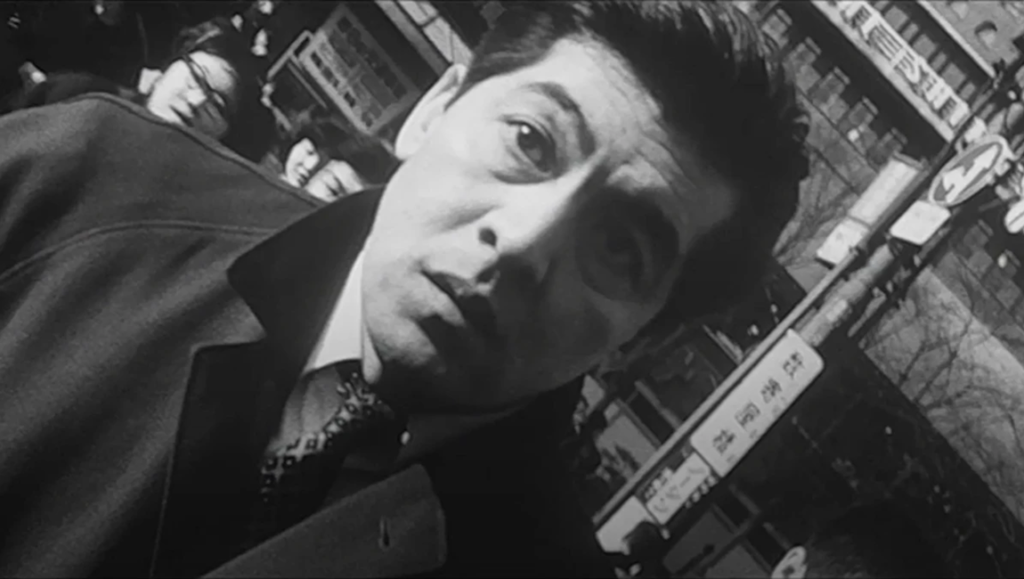
And what of wider society? Again, Fukasaku provides a possible answer. As Misawa struggles with the tasks set forth by his new handlers, he slips into the subway, considering running away. As he descends, he passes a barely conscious man clasping a bottle. Next to him is a little boy, his son, watching silently with tears in his eyes. A crowd watches them with blank faces, occasionally offering useless questions. Misawa also watches briefly. And so do we. Fukasaku’s handheld camera — a forceful staple of his filmography — implicates us as spectators, too. We observe someone else struggling, someone in need of help. But nobody helps.
In her liner notes for the film’s 2024 Blu-ray release, writer Hayley Scanlon describes how this moment on the steps (and a subsequent scene in which Misawa boards a train and sees a mother breastfeeding her child) pushes the salaryman to finally fight back, choosing between his “spineless selfishness and paternal responsibility.” However, Scanlon also identifies that this decision sees Misawa ultimately reasserting himself via another construction of masculinity that is “still very much defined by patriarchal values.” Where previously he was a hollow provider of luxuries which were never really his, controlled by more powerful men (be they the convicts or his company bosses), Misawa now asserts himself as primary protector of the family unit. But how significant is this reasserted self, arriving when it does after so much brutality has already been inflicted against his wife and young son, much of it his own? After all, it is actually Hiroko who predominantly protects their son physically throughout the film, and who consistently rebukes, challenges, and defies Kawanishi and Sabu’s aggression in ways that her husband does not. Perhaps Misawa’s change is another slight readjustment, another reconfigured continuity. The unease felt at the film’s close sits in conversation with all that precedes it; what has actually changed?
The violence contained in The Threat permeates much of Fukasaku’s filmography, consciously recalling the director’s adolescence in the aftermath of Japan’s wartime defeat when survival amidst ruin was the priority. Speaking of the violence depicted in his yakuza films, Fukasaku explained in an interview (included in a 2004 DVD boxset) that the “in-the-ruins generation” of which he was a part was alienated by the face of Japan’s reconstruction. The violence that had structured the world of Fukasaku’s peers was covered up, and those of the “black market generation” could not accept the cleaned-up, rebuilt cities that replaced both the literal and emotional rubble. Depicting that violence on screen in his yakuza epics was a means of channeling those memories and feelings.
The Threat conjures similar notions whenever it forcefully strikes at the cracks in Japan’s post-war imagery, when it scrutinizes the rank hypocrisy of its narrative, or when it questions its ultimate direction. Misawa the soldier, Misawa the salaryman; myriad continuities rather than genuine change. In a filmography as consistently sharp and resonant as Fukasaku’s, The Threat asserts its convictions compellingly. And amongst its contemporaries like those of Masumura, it is a valuable piece of a wider post-war tableau that screams aloud at the absurd cruelties of Japan’s recovery. No less striking than Fukasaku’s later works; no less charged than its peers.
Comments are closed.