
Ever since Terrence Malick pretty much pulled it off with The Tree of Life, every few years another auteur — usually in the sci-fi idiom — takes it upon themselves to encapsulate the entire sweep of human experience. The Wachowskis and Tom Tykwer failed valiantly with their adaptation of Cloud Atlas, and other films, like Interstellar and Everything Everywhere All at Once, attempt to do so within the confines of their own directors’ personal (brutalist and pop-culture obsessed, respectively) sensibilities. There’s no one right way to go about it, and evidently it’s Andrew Stanton’s turn to take a crack at it. In the Blink of an Eye, his second live-action effort following the industry-reshaping failure of John Carter, is his entrance into the subgenre, and it’s ostensibly an “everything is connected” ode to the perseverance and sensitivity of the human race. Stanton is an odd choice for the job: a talented animator, his best works depict fish and robots with more humanity than the grotesque, bug-eyed humans they interact with. And while In the Blink of an Eye certainly pays lip service to life’s grand meaning, it is in fact a testament to humanity by someone who hates it, a spiritual photo-negative of Yorgos Lanthimos’ recent nihilistic romp Bugonia with all the visual ingenuity and thematic ambition of a corporate seminar. In the Blink of an Eye is not only not humanistic, it’s an affront to humanity.
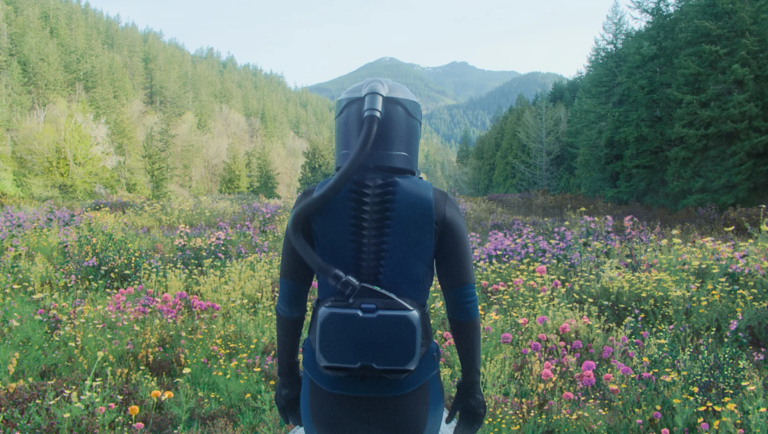
The film is split into three parallel (really, perpendicular) storylines. One is set in 45,000 BCE and follows the caveman from the GEICO commercials and his family as they discover civilization; one is set in the present day and follows an archaeologist more at home with the bones in her climate-controlled Princeton digs than with the people in her life; and one is set in 2417 CE and follows a space traveler whose best friend is her onboard AI system and who is tasked with populating a distant planet with lab-grown babies. The sets are different, the costumes change, but — *puffs joint* — they’re all really the same, you know? Every moment is really the present. Right now is right now. Just ask Sylvia Plath, who’s quoted in the film’s opening.
All of the disparate narrative threads are total nonstarters, clawing at cloying capital-T Themes like Sickness, Aging, Death, and Love throughout the ages, with broad, literally life-encompassing compressions of narrative time (suffice it to say, Stanton is no Griffith). The caveman plotline is the closest the movie gets to being about the actual experience of being human simply because there’s no technology there to encumber the interpersonal relationships depicted, but Stanton draws a direct line between the empathy (barely) evinced by these buck-toothed neanderthals and the companionship found in the company of a computer in the distant future. Listen carefully, then, and you can hear a canary from deep within the pseudo-philosophical coal mine: the arc of humanity bending away from interpersonal interaction and toward a celebration of alienation and isolation.
There are a couple of cuts early on that send the canary’s chirp up to the surface. The first is a J-cut between two cavepeople making love into the present day where two academics fail to get it on. Shortly thereafter, archeologist Claire (Rashida Jones) kicks statistics professor Greg (Daveed Diggs) out of her apartment and turns on her vibrator. That sound then carries us into the future — yes, the future is introduced accompanied by the buzz of a vibrator — where astronaut Coakley (Kate McKinnon), alone, awakens to the alarm programmed by her ship’s intelligence system. The gambit may ring a bell: Kubrick started and ended things with his match cut between a bone twirling in the sky and a space station floating in space in 2001: A Space Odyssey, and here it’s reduced to a limp joke.
These are only the most ludicrous in a series of badly misjudged juxtapositions, but the real punchline is found in the fact that none of the connections made or the cliché-riddled dialogue spewed (“Life finds its meaning in the fact that it ends”) are even enthusiastically pursued. At 90 minutes and with three stories to tell, most filmmakers would pack things in so tightly that the movie would be on the verge of bursting, but Stanton glides along at a leisurely, aloof clip. In the Blink of an Eye is airy and lowkey, as if Stanton is afraid of the real insight he would find if it chose to follow the argument he’s making to completion: don’t worry, be happy — technology will save us all. In the film’s only moral quandary, for example, Coakley must choose to sacrifice herself to save the artificial embryos on her ship or shut off the ship’s A.I. But she doesn’t have to shut it off, because the A.I. selflessly volunteers to sacrifice itself for the sake of the babies. “Take good care of the children,” it says, enveloped in blue light.
In the Blink of an Eye is only the latest in an ongoing attempt to normalize and manufacture consent for a tech bro plutocracy wherein all political problems are tidily swept away and those pesky questions of dignity and personal autonomy are resolved by the conveniences of so-called innovation. Stanton committed filmmaking malpractice with this one: it is not just freakish, boardroom-approved mandatory optimism — it’s actively evil. Whatever you do, though, don’t blink. Keep one eye open at all times, be on the lookout for similar Faustian films, and expect In the Blink of an Eye to be fed into your local LLM forthwith.
DIRECTOR: Andrew Stanton; CAST: Kate McKinnon, Rashida Jones, Daveed Diggs, Jorge Vargas, Tanaya Beatty; DISTRIBUTOR: Hulu; STREAMING: February 27; RUNTIME: 1 hr. 32 min.
Comments are closed.