
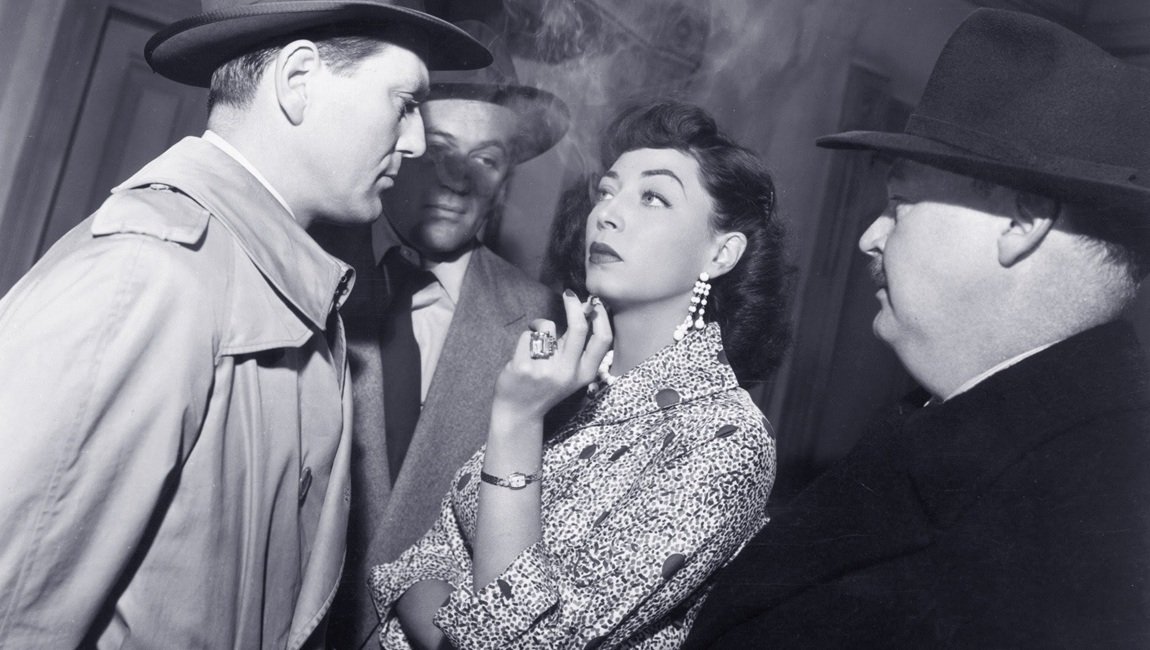
Richard Fleischer’s 1952 thriller The Narrow Margin is a tough, taut little gem, a masterclass in narrative economy and tight, claustrophobic mise-en-scène. Clocking in at barely 72 minutes, the film hits the ground running, cramming more narrative incident into its brief runtime than most contemporary movies can manage at two-plus hours. We sometimes bemoan how “they don’t make ’em like this anymore,” and The Narrow Margin is exactly what we’re thinking about when we say it.
The story begins practically in media res. Grizzled Detective Walter Brown (Charles McGraw) and his older, jocular partner Gus Forbes (Don Beddoe) are careening through the mean streets of NYC. Their mission: to escort gangster moll Frankie Neall (Marie Windsor) from her apartment in New York to sunny Los Angeles for a grand jury appearance. Neall’s recently deceased husband was a big-time gangster, and she has in her possession a list of names of everyone who was on his payroll, including public figures and cops getting payoffs. It’s a dangerous gig, with plenty of powerful people anxious to make sure that Frankie doesn’t make it to her destination. Straight-and-narrow Brown can’t stand dames like this, and he’s running her down to Gus before they even get to the apartment (“cheap, flashy, strictly poison under the gravy” is his flowery description). Once there, Frankie doesn’t do much to disabuse Brown of his negative opinions, needling him and pushing buttons. She gives as good as she gets, and isn’t going to take any attitude from a copper. But there’s already an assassin waiting for them as they exit the building, and poor Gus Forbes doesn’t survive the pickup. Apoplectic with rage at the murder of his partner, Brown strongarms Frankie into an empty compartment on the train and locks her in. He figures if he can just keep her location a secret, any potential assassins will simply waste their time rummaging around the train in a vain search.
Of course, all manner of complications erupt; Brown meets Ann Sinclair (Jacqueline White) and her precocious young son, Tommy, who threatens to blow up the whole charade when he spies Brown’s gun holster. There’s a gregarious fat man named Sam Jennings (Paul Maxey), who literally and figuratively impedes Brown at every encounter with his bulk. And a couple of tough hoods on the hunt for Frankie make their presence known very early on: Densel (Peter Virgo) is the sleazy smooth talker, while Kemp (David Clarke) is the muscle. Fleischer and screenwriter Earl Felton turn the train into a sort of moral crucible for Brown; he hates gangsters and the women that leech onto them for money and status, and his partner and best friend has already died for the mission. So when the hoods offer Brown a hefty bribe to simply look the other way, there’s a brief moment where we suspect he might actually take it. But Brown also has a moral code, an old-fashioned type of guy who believes in doing the right thing not only because it’s right, but because he said he would and his word is sacrosanct. He and Frankie bicker every time he sneaks away to check in on her (sample dialogue: “you make me sick to my stomach,” “well use your own sink!”). But a sort of begrudging mutual respect materializes once she realizes he might not sell her out to the highest bidder.
McGraw was a bit player in numerous Anthony Mann films, finally graduating to a leading role in Fleischer’s Armored Car Robbery (1950) and catching the big part here, two years later. He plays Brown as a sort of human-sized clenched fist, all scowls and grimaces and furrowed brow. He’s not the smartest, or the best, but he believes in right and wrong, and his ramrod-straight way of moving through the confines of the train is a source of constant visual tension. Fleischer and cinematographer George Diskant (himself a veteran of several Mann and Nick Ray productions) shoot the earliest scenes of The Narrow Margin like a classic noir, with Frankie’s apartment full of cigarette smoke as the gunman hides in the shadows at the base of a stairwell. When Brown chases the gunman through an alleyway, crisscrossing clotheslines and drying laundry fill the screen with bric-a-brac.
Once the action moves onto the train, Fleischer and Diskant use the long hallways and windows of the train compartments to create frames within frames, boxing in figures wherever they go. It’s all very geometric, the tight corridors and doorways partially obscuring bodies and allowing actions to take place partially off-screen. When one main character is shot, we see only the person holding the gun, the gun firing, and then a disembodied hand grasping the edge of a doorframe as the victim slides down to the ground. When the famous “twist” happens — Frankie is a decoy, a female cop impersonating the gangster’s wife, and Ann Sinclair is actually the gangster’s widow who knows all the underworld secrets — Brown is thrown for a loop. He’s quite smitten with Ann, and can’t believe he could fall for a woman who would marry a hood. Of course, all of this character development happens in passing, any psychological underpinnings only glanced at indirectly. The film is a narrative juggernaut, careening through plot as it maneuvers everyone into a final showdown.
It’s telling that Jason A. Ney’s upcoming biography of Fleischer is titled, very simply, Richard Fleischer: Journeyman. Nicolas Tellop’s critical overview of the filmmaker, unfortunately only available in French, is also a straightforward, declarative title: Richard Fleischer, a Work. Here is a filmmaker known for cool, calm professionalism, a man who worked for multiple studios over a five-decade career tackling every genre Hollywood could throw at him. And yet he seems curiously under-known; Andrew Sarris labelled him with the dreaded “strained seriousness” designation in The American Cinema, although even he was careful to single out The Narrow Margin for praise. Writing on Compulsion, Manny Farber called Fleischer “a directing unknown,” a curious turn of phrase given that it was something like his 20th feature, but also calls him “an ingenious fireball in composing the huge horizontal screen.” James Naremore doesn’t mention Fleischer once in his classic noir study More Than Night, and David Brodwell once wrote an entire article about 1949’s The Clay Pigeon without once mentioning Fleischer’s name (he refers only to a generic “the filmmakers”).
The son of beloved animator Max Fleischer (best known for bringing Betty Boop to the screen and creating the Rotoscoping process), Richard began his career on shorts and documentaries for RKO Pictures, eventually moving his way up to B-films, and finally graduating to “A” pictures for Disney and then 20th Century Fox. Fleischer worked across all genres and budget levels, and famously directed the epic boondoggle Dr. Doolittle for Fox. That notorious 1967 flop is one of several films generally considered to be the low-point of the once classic, now aged studio system, which would give way as the new American cinema of the ’70s was born. But Fleischer would adapt to these new artistic norms, his style fitting surprisingly well with the mood of the era (1971’s The Last Run is one of Fleischer’s greatest works, a moody European crime drama that showcases both his knack for geometric precision as well as Antonioni-esque ennui). Fleischer’s great gift is his ability to situate characters within a specific milieu, then figure out ways to visually constrict or otherwise turn the screws on them. As critic Patrick Preziosi has noted, “his fingerprints are detectable all across American cinema, even if he himself has unfairly receded from view,” a patron saint of sorts for low-budget auteurs who must use ingenuity in place of unlimited resources. It’s no wonder the great Kiyoshi Kurosawa is such a big fan of Fleischer — he recognizes a kindred spirit of sorts who made his name scribbling in the margins of an industry.
Comments are closed.