
After A New Love in Tokyo, Banmei Takahashi turned beyond the mortal realm. Japan was fine. His films — whether through home video as V-Cinema or the erotic underground of pink film — had championed women. Sex work was not shamed. Instead, these women were human and searched for love (Girl Mistress, 1980), or could entrap men into crime (Prostitute Young Wife, 1980). They varied in body type and age, even allowing for mature women to play sadistic roles or femdoms. In Takahashi’s worlds, women knew true pain and wielded the whip. Housewives, working women, high school girls — none were shamed or seen as beneath each other. Roles could be reversed. It was men who didn’t come out on top.
A New Love in Tokyo offered a culmination of those women through its two female leads. Sawa Suzuki as the dominatrix Rei and Reiko Kataoka as the call girl Ayumi work, find love, and wander the city with newfound hope and freedom. They have earned it. Candles and piss; knives and cross-dressing. They entertain the fantasies of male clients yet never succumb to them. Show up, look good, lie or perform. They are paid for these fantasies and are allowed to live real lives outside of them. Takahashi’s career could have proudly ended with this film, but he instead went reflective, deconstructing the image of a woman. Rather than a new love, Takahashi called upon a “new half.”
Seraphim Night follows Ryoko Kamijo, played by Itsumi Ohsawa. The character is revealed to suffer from the condition “testicular feminization syndrome,” which affects the development of genitals in XY births. Today, Ryoko likely would be diagnosed with “Complete Androgen Insensitivity Syndrome” (CAIS), where the external genitalia are typical of a female. In the words of the film, she is “male in body but female in appearance.” Ryoko is also stalked by her colleague and artist Hiroyuki Oshima, whose trans panic upon her reveal leads to a dramatic stabbing of nude portraits of her in the vagina. The reveal recalls an intersex character of the same condition from the book Ringu (1991), the basis for the film of the same name. By contrast, Takahashi doesn’t wallow in sensationalism.
But Seraphim Night wanders beyond horror and such small-minded men. Like painting, gender was an open canvas, but Japan made it art. Its pioneers were working girls: the cross-dressers (or “okama”) of gay bars and trans women like Maki Carrousel, who had been active in bars since the 1960s, even getting name-checked in the film Funeral Parade of Roses. With Nikkatsu’s Roman Porno, Carousel would even become the rare trans actress to lead a major studio film. That representation expanded over the years into the new Adult Video market of the 1980s. Actor Ryuji Yamamoto would find success directing a four-movie series of Adult Video titles with “new half” (or shemale) titles, and in those movies, trans women could have sex with men and women, teach straight men the joys of sissyfication, and win the Shemale Olympics: Monsters Gather! Pervert World Cup. One’s journey was limited only — and simply — if born a man.
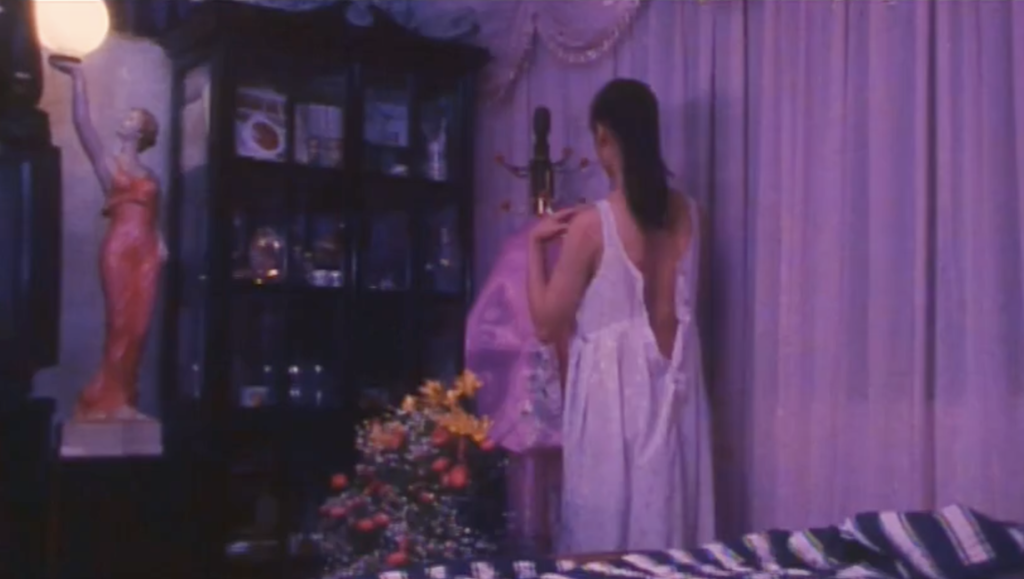
Itsumi Ohsawa was an inspired choice to play the lead Ryoko in Seraphim Night. She was a veteran singer and actor who debuted in 1982 in a singing contest. Her early music career highlighted her androgynous image and boyish hairstyle. Take, for example, her debut song, “James Dean-like Girl,” which featured chants about “boy or girl, girl or boy, boy or girl,” as well as the proclamation, “I’m a girl like James Dean.” Her career expanded significantly into TV, with acting roles on scripted shows and movies, and even appearances on variety shows. Notably, she has thanked the daytime drama Promised Summer (1992) — where she played a woman torn between the love-hate relationship of two men — for giving her confidence as an actress. But Takahashi’s film called back to her early androgyny, perhaps forgotten like a lost painting or holy relic. At 30, she was no longer the young star. She had shed her former hair and image, and had even released the nude photo book CAST just three months prior to Seraphim Night. She was a new woman and searched for a film or project to redefine her.
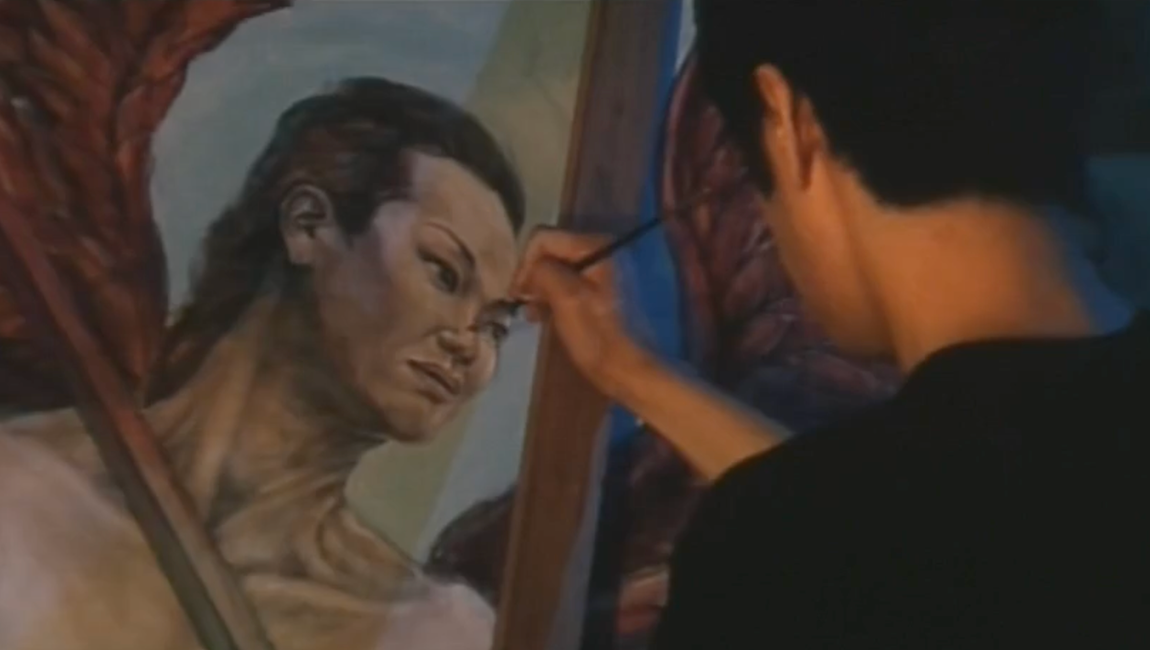
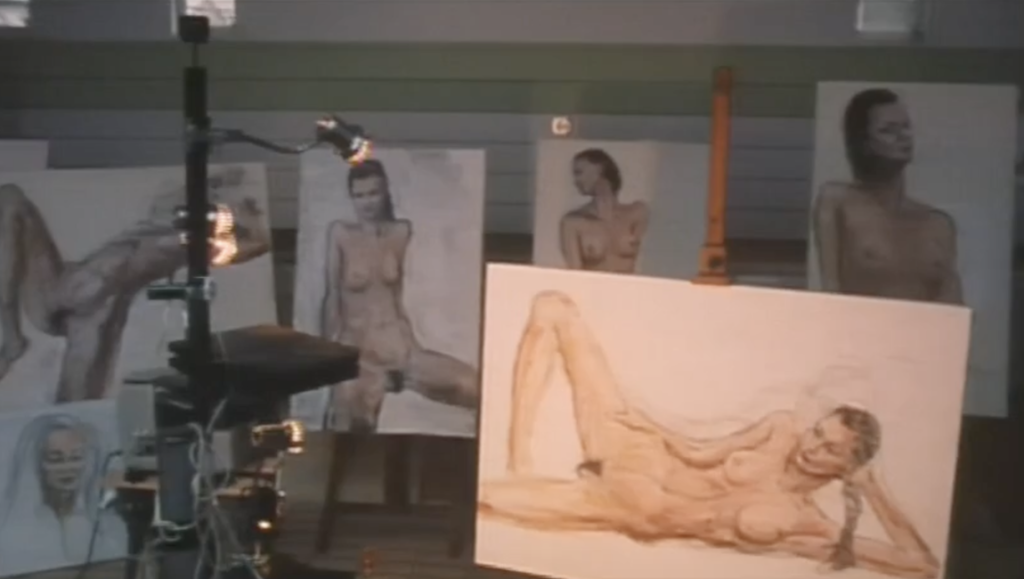
Takahashi’s film opens with Ryoko attending a kendo club practice that she attended during her time at art school. Does she still hold nostalgia for this past? For these moments and clashes of swords, she is human — unaware of her own body or power. Ryoko reunites with her junior, Hiroyuki Oshima (played by Hidetoshi Nishijima of Drive My Car), and is invited to his studio, soon learning that he holds a secret obsession for her — Hiroyuki paints nude images of Ryoko. He, for one, has not forgotten the past; rather, he has made erotic altars to it. Her image is burned into the surrounding canvas, and it seems she has entered a hell, or his chapel of paint, sweat, and flesh. Beautiful images summoned as horror. Beyond this mainstream, theatrical film, pink film held a similar obsession for art. Hisayasu Satō’s Uniform Virgin: The Prey (1986) featured an assault scene with paint, increasingly layered over a woman’s body like a Jackson Pollock painting. This would later be mirrored with Kazuhiro Sano’s painter character for Promiscuous Wife in Heat (1991). But when compared to those looser brushstrokes, Hiroyuki paints within the lines. He wants to not only capture Ryoko’s image, but also to define her. He cannot handle fluidity or ambiguity. Hiroyuki’s art has rules, long-studied from school and labored in obsession. He is initially unable to accept Ryoko’s complex gender reveal, and this resistance is similarly seen in the hostility he has for accepting his half-Japanese, half-Korean brother Tatsuo. To Hiroyuki, his brother is “failed Japanese.”
Although Seraphim Night calls upon angels, it is more similar to the duality of the figure Baphomet. Ryoko represents the unification of man and woman. The paintings (of her as an angel) establish her as something between human and God. She is powerful. Ryoko subsequently finds herself drawn to the rational Tatsuo, who bridges the cultural gaps between “animal” and human. Given the anti-Korean sentiment in Japan, his heritage would likely be viewed by some as animalistic; in Seraphim Night, he represents the discrimination of Koreans in Japan. Facing discrimination in work and housing, many Zainichi Koreans turned to employment in pachinko parlors, construction, and blue-collar jobs. While Korean-Japanese representation in the yakuza is overblown, Tatsuo lives on the fringe.
The obsessed Hiroyuki does eventually accept Ryoko, but he is drawn to her image, willing to embrace and repaint her. She thankfully does not give into his delusions, and instead stabs him to death. The knife is her brush. Tatsuo then helps her hide the body, fleeing to Korea with her. Their journey has begun: beyond Japan, reality, and their past ideas of the self. Can he rekindle his Korean past? Is she still a woman? But their escape is not uncomplicated. Tatsuo’s right-wing group hires a hitman, a fellow Korean-Japanese, to pursue him. Played by Jun Kunimura, the hitman holds resentment for Tatsuo’s attempt at Japanese naturalization and his quick turn to Korea. And so, Tatsuo and the hitman will face each other for a final battle of broken men and failed dreams. Earlier in the film, a sex worker notably tells Tatsuo, “This is not your hometown.” Whereas Ryoko observes and is open to the new possibilities of her body, Tatsuo has clung to his past. There is no home for him to return to. His efforts have been in vain. Instead of staying in Japan or embracing the new possibilities of a life with Ryoko, he has entangled her in a doomed voyage. His Korea becomes less of a physical place than an idea beyond time — to enter this country is to leave reality. Korea is an Atlantis — an Aztlán. The hitman doesn’t just seek to kill Tatsuo, but to destroy the fantasy that he himself could not obtain as a fellow person with mixed ethnicity.
Men of many halves… but none can fill a dream. And so, it is Ryoko who ascends. Freed from her past life, lovers, and gender, she feels like both an observer and spiritual guide. Ohsawa initially plays her as reserved, somewhat detached, and fearful of others, but she soon awakens. There’s a new energy to her body. Stirred by the rhythms of sex, or even the joy of clothes, Ryoko stands more confidently. By the end of the film, she holds both men — two children suckling at a mother. More aptly, they recall the Alchemist character from Alejandro Jodorowsky’s The Holy Mountain, who guides two women toward enlightenment.
Seraphim Night was an adaptation of the novel of the same name by Mangetsu Hanamura, and it is surprisingly true to its characters and their journey, despite a slightly tempered take on Hanamura’s flair for sex, violence, and religion. Hanamura is more known for another adaptation: the V-Cinema release XX: Beautiful Hunter (1994). It would seem that nuns and guns hit quicker than this film’s slow burn. Regardless, Ryoko ends this film calmly embracing its power for herself. Men — or lost boys — died for her. She was once passively trapped in this journey and defined by paintings. The Banmei Takahashi of 1996 created a feminine image that was no longer confined to man or woman. Even his past mainstream work, such as the housewife in Door (1988) and the sex worker in Door II: Tokyo Diary (1991), was bound to the mortal realm, though it was the latter that teased freedom beyond society and the frames of film. Before the character of Ryoko transcended, the call girl Ai of Door II wandered the dream-like desires of her clients and chose freedom through the film’s ending. Both are instructive of Takahashi’s career, which marked a long reflection on femininity. It was never limited by budget or shame directed toward erotica. Women could have sex and ascend. They could be masters and slaves. They were angels of their own making.
Seraphim Night has wavered in availability since its original theatrical run. It was released on VHS in May 1996 and then on DVD in September 2001, but even the latter DVD can linger on Japanese auctions for $300-600 USD. These releases become as rare and fleeting as the Korea it conjures, the one Tatsuo seeks, within the film. Both the VHS and the DVD, then, were portals to a different world. This door has only briefly reappeared, opening to the curious, the converted, the searching. And as gender has been repainted, time has made Seraphim Night more colorful. The film could — perhaps should — even be considered Takahashi’s Door III. The end of his prior career: an afterlife for the women, men, and angels he filmed along the way. Ascend with Ryoko or die in her arms.
Comments are closed.