
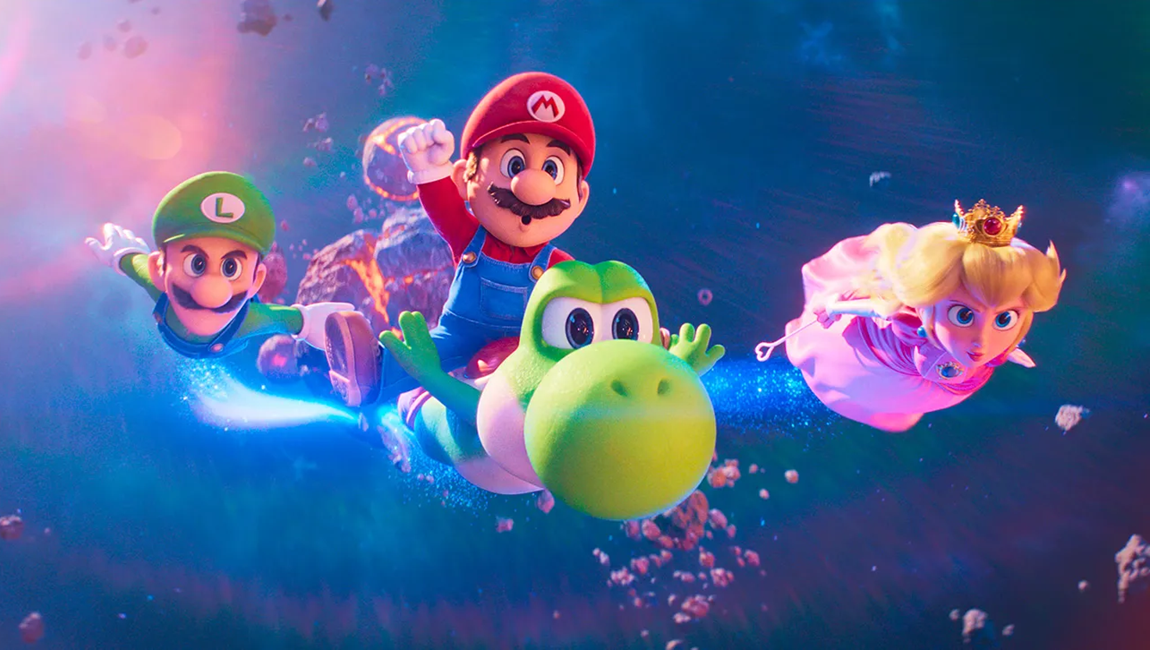
The Super Mario Galaxy movie, a further collaboration between Nintendo and Illumination Studios, after 2023’s The Super Mario Bros. Movie, is bound to be another financial milestone for the billion-dollar blockbuster animation industry. Aimed at kids born since 2016, but also explicitly to their elder millennial parents, this combination of cutting-edge 3D animation, slick family-friendly action, and nostalgic Nintendo references is set on a course for the stars. And there’s reason for that. Inarguably, The Super Mario Galaxy Movie is an example of the very best, and very latest, in 3D computer animation. The best of the best. Other recent flicks like Hoppers, Zootopia, and even recent Illumination Studio films like Minions: The Rise of Gru simply pale in comparison. The colors are absurdly vibrant and sweet like candy. The motion is dynamic and the angles are propulsive. Virtual cinematography has advanced to the point of being epic, even suggestive at times of grand Hollywood opuses.
The aesthetic of the animation here, swimming in shimmering, liquid color, borrows more than anything from recent Nintendo games, including Super Mario Galaxy, Super Smash Bros., and Mario Kart, and the filmmakers have done well to meld style and story into a comprehensive fantasy world, which pulls from Star Wars, Jurassic Park, and the Indiana Jones films as much as it pulls from Nintendo’s own intellectual property. One wonders, however, what Nintendo’s grand vision is for Mario and Luigi. Sooner than later, them and all their friends (and enemies) will be known more for movies than for games. Shigeru Miyamoto, the creator of Super Mario, says that when he “envisioned Mario’s future,” he thought of another “more famous and older character named Mickey Mouse.” Apparently, he always thought of Mario growing “alongside,” and outside of, the video games. What happens when the legacy of the games is surpassed by the monolith of its attendant cinematic franchise?
Setting that aside, in the present the depth that has been added to the characters reflects an admirable effort. Mario very famously has little to say, and subsequently screenwriter Matthew Fogel had little to work with when developing his inner life, along with that of Luigi, Bowser, and Princess Peach. The execution demonstrates an impressive act of imagination and wit, good old-fashioned Hollywood make-believe, and yet it’s fair to ask: has this stripped away some of the appeal of the world, the beautiful simplicity of these pixelated legends? Miyamoto graced us with remarkably interesting and, importantly, strange characters: Italian plumbers? A baby dinosaur? The princess of a mushroom kingdom? Fogel has perhaps made them too common, then, too comprehensive, flattening their singularity through explanation and background. Here, too, the ultimate fidelity of advanced 3D computing haunts the aesthetics of the film. Both Mario and Luigi’s hair, for instance, looks too good, too real and too coiffed. Meanwhile, Princesses Rosalina and Peach appear to have had so many Botox injections that their lips don’t move properly. There’s something antithetical to the franchise’s history in this perfection, and it results in voicework that must fall in line — Brie Larson and Anya Taylor-Joy’s vocal performances accordingly feel awkward and stiff, while Chris Pratt and Charlie Day are too verbose as the brothers, too quippy, too millennial cringe. (For what it’s worth, Donald Glover — perhaps unsurprisingly — turns in the most memorable work, as Yoshi.)
But there’s still the plot to account for, and The Super Mario Galaxy Movie‘s is pushed forward by the destructive ambitions of Bowser and Bowser Jr. This results in a number of impressive battle scenes, and scenes of kinetic, massive disaster, and these are impressive not only as technological and aesthetic feats, but also in their pacing and placement within the film’s narrative flow. Indeed, the film is remarkably well-paced, more in line with the classical breeziness of Pixar than the shaggy escapades of other Illumination titles. This film’s narrative, while perhaps not complex, is at least involved, and the film manages to avoid wasting time with explaining everything to the viewer. The fight sequences also suitably bear out their anime influence, in that they are more engaging and finely tuned than your typical American animation blockbuster. We get hints of an Old West shootout, Kung Fu duels, and, at one point, Princess Peach battling with a variation of the “Crazy 88” from Kill Bill.
Playing off the intergalactic theme, as well as the expected twists and turns that mirror the experience of exciting gameplay, the characters fall through a series of picaresque scenarios. Mario in wonderland, perhaps, and references to Alice include a despotic, glowering queen and the repeated miniaturizing — and subsequent return to proportions — of key characters. But it all begins to feel less and less like a video game as the narrative attempts bolder and more defined arcs. In the melee battle sequences and especially the chase set pieces, actual gameplay mechanics from Super Smash Bros. and Super Mario Galaxy come to the fore, and they are woven in as gracefully as possible, power-ups, levels, speed boosts, and all. But inevitably these fail to inform any larger cinematic visual design and distractingly land like the fan service bids they are, especially when, for instance, power-ups invoke specific, beloved, and often rare characters from these older games, resulting in an endless game of “easter egg” finger-pointing. It’s indicative of where things go wrong.
It’s a strange dilemma that contemporary 3D animation finds itself in. Technologically superior to any other era of animation certainly, and some would argue superior to all other filmmaking today, excepting Avatar; visually competent, even at times — including during this film — visually imaginative, and yet so soul-poor. This is the state of blockbuster Hollywood animation today. The Super Mario Galaxy Movie is perhaps the exemplar of this intersection of potential and lifelessness, of films that burst with color and high-tech digital execution but remain drab in spirit. The recipe for these kinds of films remains fairly legible: a healthy dose of classic Disney — one pinch of the ’40s, two of the ’90s — a dash of “classic” anime, and then run it all through the most state-of-the-art computer on planet Earth. It’s objectively impressive at a technical level, but why does it exist?
The answer is quite simple: fan service. A wholesale plot and nexus of character backstories had to be foisted atop these otherwise rudimentary, though loveable, video game characters. This is about Nintendo. This is about 40 years of Super Mario supremacy. This is about the $500 Switch 2. There is a thread that runs through the film, of the older generation telling stories to the younger, and these stories link together Rosalina and Peach, through Bowser and his son. These are the legends that form the mythological framework of this deeper Mario cosmos. But these scenes are also easy metaphor. The parents who will line their kids up for sold-out screenings of The Super Mario Galaxy Movie, well, they were once kids themselves, playing Super Mario in the 1990s or Super Smash Bros. in the 2000s. There is some comfort, one imagines, in the act of passing this quirky Italian plumber to the next generation. It’s touching, actually. Yet in the same breath, we must admit that Nintendo sees this clearly and also sees through it, dollar signs in their eyes. Words in a film review won’t change that, and The Super Mario Galaxy Movie will likely eclipse one billion dollars. Should it?
DIRECTOR: Michael Jelenic & Aaron Horvath; CAST: Chris Pratt, Anya Taylor-Joy, Charlie Day, Brie Larson, Jack Black ; DISTRIBUTOR: Universal Pictures; IN THEATERS: April 1; RUNTIME: 1 hr. 38 min.
Comments are closed.