
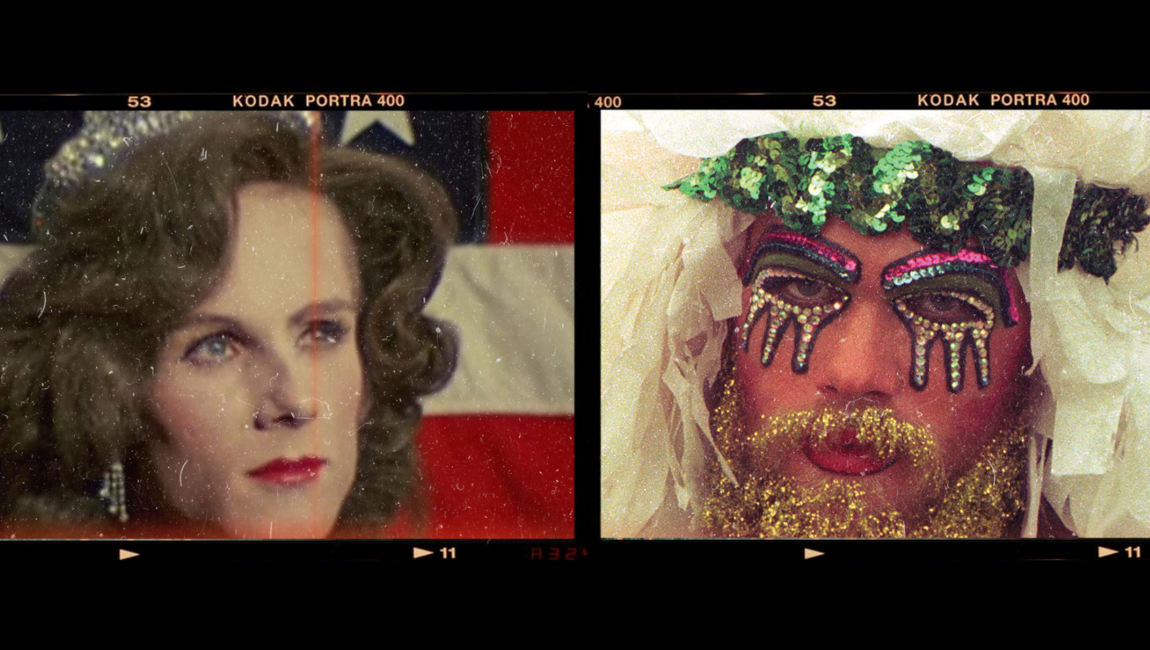
The concept of being a flop, a loser, a dud, an empty promise, and a failure in 2026. The new year is already growing old, but the pressure that came in with it grows ever more ripe. Following the straightforward lines of production and consumption along which time flows under the rhythms of capitalism, “common sense” dictates that if we follow certain rules, we will reap certain rewards. Renew yourself, set lofty goals, subject your body to struggle, and you will receive the bounties of wealth that measure success. Against these thoughts, I came upon the short satirical mockumentary Tricia’s Wedding, the 1971 film by director Milton Miron, and the 2002 documentary The Cockettes, a feature from co-directors David Weismann and Bill Weber. These two films introduced me to the Cockettes, the suggestively self-titled cohort of burlesque-performing, gender-anarchist hippies from San-Francisco who briefly captured the attention of the American glitterati in the late 1960s and early 1970s.
Faced with the debilitating inevitability of failure in the real world, the profound failure I encountered in my adventures into the life and work of the beautiful Cockettes deeply soothed me. Seeing the Cockettes’ artistic work and glimpsing their glittery lives, I came to the question: what if failure is not a dead end, but rather a dark, negative alternative to our conventional understandings of success? What if, rather than submitting to the order of reproductive maturity and wealth accumulation that defines success in heteronormative, North American capitalist society, failure functioned as a productive potential to critique and refuse such rigid binary formulations?
As such, Tricia’s Wedding and The Cockettes both elaborately describe the relationship between failure and queerness as a perfectly imperfect union materialized in the shape of their central troop of eccentric San Francisco outcasts, flower children, and entertainers. Aligned with queer theorist Jack Halberstam’s argument that “failing… may in fact offer more creative, more cooperative, more surprising ways of being in the world,” both Miron and Weismann and Weber present the Cockettes as examples of how failure can be redeployed as a form of insurgency. Both films – one a satirical comedy and the other a documentary – refuse legibility with regard to the “common sense” of what José Esteban Muñoz describes as “straight time.” Instead, they offer an archive of feelings, including camp, pessimism, bitchiness, rage, boredom, earnestness, disappointment, and mania, among others, wielding failure as a sharp negativity with which to puncture the toxic bubble and mass delusion of positivity which defines contemporary life. Like a style, failure, after all, is something queer people do and have always done exceptionally well, as English raconteur Quentin Crisp describes, and as a way of life, in the words of the French philosopher Michel Foucault.
If Tricia’s Wedding shows the Cockettes “at work” with failure, Weismann and Weber’s documentary lifts this eclectic veil to present a picture of the Cockettes in ordinary, everyday hippie life, where they inhabit failure as the perpetually jobless, drug- and sex-obsessed social rejects they were. In entering the hollowed-out memory of the Cockettes this way, and dealing with their absence not just within society but within the straight, “common sense” time of capitalism, a certain pleasure, comfort, and hope presents itself through and as perpetual negativity. As films, Tricia’s Wedding and The Cockettes work within this register of representation, grief, and mourning to imagine and perform an alternative mode of being in society. Through their content, visual language, and narrative forms, both films — one fictional, the other biographical — lay the groundwork for audiences to imagine leaving the temporal, physical, and structural constraints of their own lives as “losers” by leaning into the moniker and escaping into the negative potential for virtuosity known as failure.

As a Black queer person of African descent, a position which immediately fails to be-like-the-rest, which is to say, “straight” and normal, the concept of failure will always appear in relation to queerness and Blackness too. Where the logic of the market economy links success with profit and failure with the inability to accumulate wealth, the Cockettes in Miron, Weismann, and Weber’s films turn the blunder that is queerness-by-nature into negative productive potential and a radical political response to the brutal pragmatism of U.S. capitalism, imperialism, and the fantasy of domesticity. While there isn’t an immediately “Black” reading to be taken from these films — the Cockettes were predominantly white besides a few Black members — I insist that the narrative and poetic darkness of the anti-queer world these films describe can bring us to an understanding of the quintessential queerness of Black life, notably by exemplifying the dangers of “showing one’s color” and the perils and possibilities of exposure.
What exists after failure? What is there to anticipate after a dead end? What possibilities for life can be created on, through, or against the position of social death? Between Weisman and Weber’s documentary and Miron’s film, the latter answers these questions through a more practical example of the relationship between queerness and failure in the work of art. Tricia’s Wedding premiered the night of June 12, 1971 at The Palace Theatre in San Francisco. A garish, wretched scene, the film is a mocking re-enactment of Tricia Nixon’s wedding — the daughter of then U.S. president Richard Nixon — and in stylish guerrilla fashion, premiered the same night of the first daughter’s fairytale White House marriage to her husband, the successful lawyer Edward Ridley Finch Cox.
In Weismann and Weber’s documentary, former Cockette “Sweet Pam” — who plays Golda Meir, the former Prime Minister of Israel, in the film — testifies that on the day of filming Tricia’s Wedding, “nobody knew any dialogue. We never had a run-through. Nothing.” Just as Halberstam describes the relationship between queerness and failure as a “drama without a script” and “narrative without progress” in the essay “The Queer Art of Failure,” the Cockettes crammed lines in as they applied their makeup, and improvised their way to a finished project, tripping on LSD and who knows what else. According to American transgressive cult filmmaker John Waters, a peripheral talking head in The Cockettes, the result was a “terror the White House was humiliated by.” Former drag performer and Cockette Goldie Glitters — who starred as the vastly uglier Tricia in the film — further brags in Weisman and Weber’s documentary that Tricia’s Wedding “beat” Tricia Nixon’s wedding by “100 percent.”
Where official footage of Tricia Nixon’s wedding presents neatly dressed guests, a radiant atmosphere, and a bride as prim and proper as possible — footage still available on the Richard Nixon Foundation’s YouTube channel — Miron’s film instead revels in untidiness, anarchy, and derangement. Rather than recreating the first daughter’s statuesque six-tier, seven-foot wedding cake, the film offers a tilting, sloppily smeared heap of cake and frosting that seems ready to collapse under its own weight. As the titular Tricia, Glitters appears as a scrawny, crooked-toothed, badly made-up, unmistakably gay man in a wedding dress, a figure that reads as monstrous by conventional standards.
Recalling the film’s premiere in Weismann and Weber’s documentary, Miron — identified there by his Cockette name, Sebastian — describes an unforgettable shriek that erupted from the audience when Tricia was first unveiled. His recollection of the audience’s reaction to Glitters’ deliberate ugliness reveals an alternative understanding of how the Cockettes “beat” the first daughter’s wedding. The troupe did not prevent the wedding from becoming a cultural triumph. By commercial measures, Tricia’s Wedding, a poorly funded and chaotically shot short film, was a failure. Yet by grounding their artistic practice in darkness, despair, and abjection, the film became a sensation within underground queer and countercultural spaces. Its notoriety was such that The New York Times refused to run advertisements for the film unless its title was changed to The Princess’s Wedding, while Richard Nixon’s chief of staff, H. R. Haldeman, arranged a secret private screening for White House staff. Through this artful commitment to failure, Tricia’s Wedding, in Halberstam’s words, “brought down the winner,” jolting its audience into confronting the ways in which sympathy for the first daughter’s spectacular marriage ultimately reinforced the very cultural institutions that used the mandates of marriage and domesticity to vilify and exclude them from public life.

While the official wedding footage features no dialogue besides the exchange of the couple’s vows, Tricia’s Wedding generates its satirical atmosphere partly through its expressive cast of world figures. We have President Nixon himself, depicted as a man-child with a fetishistic devotion to a “presidential teddy bear” he calls “Teddy,” presumably a reference to Theodore Roosevelt. Eartha Kitt, the famed actress and Broadway star, appears and later empties a flask of LSD into the wedding reception’s bowl of punch. Coretta Scott King, played by the singing Cockette Sylvester, belts a wedding hymn for the guests. Former first lady and president, Mamie and Ike Eisenhower appear too, with Mamie presenting as a mournful alcoholic next to her deliberately aloof husband. In succession, we see Prince Charles passionately kissing Mick Jagger, a rude and bearded Martha Mitchell poorly decorating the wedding cake, a senile Rose Kennedy reliving the trauma of burying her son from a wheelchair, Prime Minister Indira Gandhi of India enthusiastically declaring that there is no hope for the Middle East, a made-up figure of vague Ghanaian heritage called Oo-gam Ooganda, an eerie bridal procession filmed on a shaky handheld camera leading up to Reverend Billy Graham’s question to Trisha, “Do you, Tricia M. Nixon, take this man… this pig dick and cunt-licker, to be your everlasting, true sweet thing forever and ever?” to which she says, “I do, oh I do!” All the while, Miron’s camera moves between low-angle shots, cinema verité-style stills, and shaky handheld moments that not only appear as the direct opposite of the official footage of Tricia’s wedding from the White House, but in doing so also describe an entirely “other” frame of looking at the world and a way of being, which nonetheless functions on and against the constricting hegemony, brutal pragmatism, and toxic optimism that govern the common-sense world of straight time.
Submitting to the social category of failure, Tricia’s Wedding stands out as a film which performs an existing alternative to the hegemonic systems which define the good life and the American dream. Refusing to apply the common sense of boring, unimaginative straight life, the film applies a nonsensical, narratively dark, deeply negative queer sense to ruin the picture-perfectness of the first daughter’s wedding. It thereby critiques the brutal norms of cultural pragmatism and optimism which raise up such spectacles as national symbols of American exceptionalism and neo-liberal success. Like a resource materialized by the universe to guide me through my questions, the Cockettes showed me that, indeed, failure, queerness, and narrative darkness could serve a purpose. Despite the terror of being unemployed, unloved, and spat out from the good life, failure for the Cockettes became a portal to virtuosity and prolific artistry.
However, in their linear portrait of these artists as young people, Weismann and Weber deny their audience the pleasure of romanticizing the Cockettes’ failure. Instead of a purely utopic approach to their story, Weismann and Weber engage the Cockettes’ utopia as a spectacle constituted by anti-climaxes, poor choices, death, destruction, false starts, and an endless depository of childlike naivete. Where Tricia’s Wedding was a fantasy in response to the fantasy of state-sponsored domesticity, The Cockettes presents the Cockettes’ methodology of failure in embodied, historical terms. By submitting the story of the Cockettes to the very historicism and linear narrativizing by which queer people have been and continue to be written out of society, Weismann and Weber achieve a desired effect of poignantly representing the perpetual mourning and melancholia through which queer life arranges itself in the form of ephemera. Rather than projecting shame or denying suffering, this full picture of failure and virtuosity describes how the fact of failure makes up the impulse for prolific artistry. Faced with the end in sight, the Cockettes had no choice but to leave their mark however they could.
Through these films, I wish to argue for an active, artful embrace of failure as a method of raging against the constraints of life under capitalism. In its relation to monstrosity, queer life has more in common with nonsuccess, defeat, and catastrophe than most of us care to admit. As methodology, style, and way of life, failure can be wielded productively to refuse legibility within a social structure that seeks to fix us in concrete definition. This is where we begin with more important questions: Who benefits from these linear metrics of value? What structures do they sustain? And what might open up if we stopped organizing our lives around them?
Comments are closed.