
There’s an early scene in Amy Wang’s Slanted where our main character, Joan Huang (Shirley Chen), is shown scrolling through social media while wearing a clothespin fastened to her nose. The film never clarifies why Joan, a Chinese immigrant and high school student living with her parents in smalltown America, is doing this, although we can likely assume it has something to do with a dubious online trend that weaponizes low self-esteem and unattainable beauty standards for teen girls. What she does next is less surprising though: before she posts a photo of herself online, she first opens an app on her phone that doesn’t so much give her an artificial “glow up” as it does apply a filter which makes her look, effectively, white (flush cheeks, wider eyes, voluminous frosted hair, etc.). It’s a nifty visual metaphor for the way conventions of what it means to be attractive can take on an insidious, homogenous quality that conditions girls to hate their true selves, one which happens to dovetail with an allegory about the lengths racial minorities go to in order to assimilate. What Slanted, a dark satire with elements of body horror, posits is a world where this sort of race-switching filter exists offline. And is permanent.
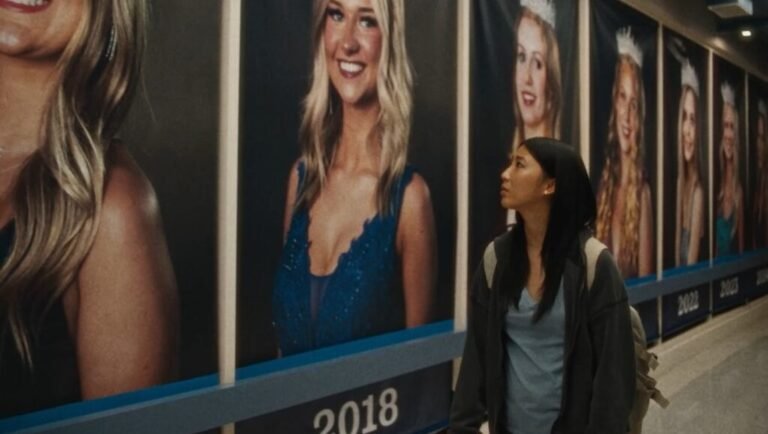
The latest in a recent trend of films that considers the Faustian trade-offs of junk science and pumping god knows what into your body in pursuit of the fleeting high of appearing beautiful — most famously The Substance, but also Max Minghella’s Shell — Slanted is less concerned with anti-aging and more so with internalized self-loathing as it applies to non-white people. In essence, the film treats being Caucasian as something aspirational; a societal cheat code no less desirable than being financially successful or famous. And Wang has quite a bit of fun presenting a skewed perspective on cultural whiteness, predominantly through the film’s art direction: the local coffee shop is called Freedom Beans, the most popular brand of beer is called ‘Merica Lite (and is advertised by buxom white women in bikinis), and even the nickname of the local high school is the Wizards, with the mascot appearing to be wearing a Klan robe. This is the world which Joan moves through and attempts to ingratiate herself to, even clinging to the quixotic dream of being voted prom queen as the ultimate form of acceptance.
Despite her eagerness to fit in, downplaying the heritage of her parents (Vivian Wu and Fang Du), refusing to speak Mandarin at home, and surreptitiously pawning off her authentic and lovingly made Chinese lunches to her best friend Brindha (Maitreyi Ramakrishnan), Joan resides on the periphery of the popular kids who are led by queen bee Olivia Hammond (Amelie Zilbe), a statuesque blonde and online influencer. When presumed favorite Olivia declares that she’s pulling herself from consideration for prom queen — she claims the acting job she just booked will keep her too busy to campaign, not that we ever see the character missing any school — June seizes on the opening and begins promoting her candidacy in earnest. After a home dye job to make her blonde nudges her closer to Olivia’s inner circle and her all-important “endorsement” (although even then it’s clear she’s primarily being used by her new friends to negotiate a discount with the Chinese proprietor of the local nail salon), June begins to receive a series of targeted direct messages from a mysterious beauty company called Ethnos. They promise to transform her into what, deep down, she longs to be: a white woman.
The film brushes past the science of the procedure or how the working class June even affords this groundbreaking surgery — ironing out logistics is not the film’s strong suit — but within a matter of hours she’s reborn as a perky white woman, now played by Mckenna Grace (currently also appearing in Scream 7). It’s a fantastic premise, reminiscent more than anything of John Frankenheimer’s Seconds, and it allows the film to play with the idea of code switching, the pressures to conform (e.g., everyone at Olivia’s lunch table is white and eats the same salad from matching Tupperware containers, dressing on the side, for lunch) and how the surest way to earn racial solidarity is for June — now going by the anglicized name of Jo Hunt — to go full Karen and turn her back on other minorities like Brindha. It also leads to some of the film’s most guffaw-worthy gags, such as a testimonial video where a woman who recently underwent the “ethnic modification” procedure bemoans that in the past “not one NBA player looked my way,” or June’s transition from Chinese to Caucasian being accompanied by a dream sequence-cum-faux-karaoke-video entitled “It’s Good To Be White” which features stock footage of people in khakis swishing wine glasses and being nuzzled by dogs (“The police are a source of safety/I never feel in danger/History is on our side/Never feel like a stranger” are but some of the lyrics).
Yet Slanted feels uncertain about precisely what sort of cautionary tale it’s telling, as well as the accompanying tone it’s trying to strike. An unwelcome strain of earnestness starts to creep its way into scenes, particularly in June’s interactions with her parents, who are understandably confused and heartbroken that their daughter has thrown away their culture and shared physical traits seemingly on a whim. The film’s satirical edge becomes dulled as June finds herself wistful for her old life without offering an actual counterpoint about why being white isn’t all that it’s cracked up to be (the best the film can offer up is how antiseptic white people’s homes supposedly are and how bland their food looks). It’s also here where the film’s haziness about just how nefarious or fly-by-night an organization Ethnos is begins to actively harm Slanted. After June starts to experience facial deformities that result in lesions and drooping skin (it’s basically an extreme form of “Ozempic face”), the film can’t decide whether this is a malady that will render her unfit for public life or an expected side effect of the procedure that she’s meant to temporarily weather like an ill-timed cold sore (the Ethnos receptionist gives June a jar of medicinal cream and scotch tape, with the expectation that she can tape her face back into place).
As Slanted progresses, it becomes harder to reconcile its broadly comedic early scenes, as well as its stylistic elasticity — the film signals June’s physical transition by switching from Academy aspect ratio to 16:9 — with its po-faced sincerity. This is especially prominent in scenes dramatizing June’s falling out with Brindha or when the character is told by her father that he no longer recognizes her grandmother’s eyes when he looks at June. Setting treacly heart-to-hearts against a backdrop of Sabrina Carpenter and Taylor Swift posters isn’t as trenchant a commentary on whiteness as the filmmaker perhaps believes. The film also conflates June’s belated crisis of conscience with her new physical abnormalities, and the takeaway subsequently becomes less that she’s grown as a person and more that she has buyer’s remorse for subjecting herself to shoddy strip-mall surgery. The film’s intentions become dispersed and less focused precisely when it should be crystalizing into something scalpel-sharp. And superficial similarities to The Substance create expectations for a grand, effects-heavy finale that Slanted doesn’t so much subvert as scale down to the point that it plays almost as an afterthought. It all creates the impression of a film that, ironically, can’t decide what it wants to be. Slanted feels caught between two worlds, but probably not in the way it intended.
DIRECTOR: Amy Wang; CAST: Shirley Chen, Mckenna Grace, Amelie Zilber, Vivian Wu; DISTRIBUTOR: Bleecker Street; IN THEATERS: March 13; RUNTIME: 1 hr. 42 min.
Comments are closed.