
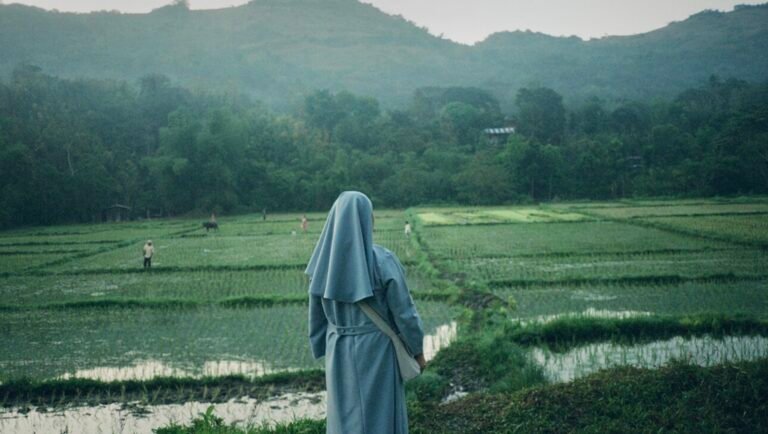
Nearly five years ago, Filipino-Australian filmmaker James J. Robinson hit the headlines after breaking into his alma mater St Kevin’s College, Melbourne’s elite all-boys Catholic school, and setting his old blazer alight on campus grounds as an act of protest against the toxic “hypermasculine culture” historically inherent in same-sex Catholic schools. “St. Kevin’s is just a microcosm of everything else that’s happening in the rest of the world,” he told VICE. It’s an inevitable, and perhaps limited but certainly not disingenuous, point of entry into his directorial debut First Light, now playing at Rotterdam’s Harbour Programme, in that it equally, deftly taps into some awful and systematically upheld secrets of the Catholic Church as an institution. The film, though set in a different context, feels definitely spurred by the filmmaker’s lived experience growing up queer and Catholic, bearing witness to the many ways religion is weaponized to tolerate injustice. For a first feature, Robinson’s style is already impressive and astute.
The colonial mountain community in which the languidly picturesque movie takes place is similarly rendered as a microcosm of something far more sinister. Beneath the sprawling landscape that softly, splendidly comes alive at first light is a rot that spoils the air. Here, the nocturnal beings troubling a young, inquisitive nun seem conspicuously ominous, just as the constant murmur of the weather and the indecipherable voices that intermittently punctuate the film always feel like something’s lurking in the distance. Robinson seems deeply attuned to what the textures of the earth reveal about the people that inhabit it, giving the story a kind of organic, elemental allure.
First Light spends most of its time shadowing the quadragenarian Sister Yolanda (Ruby Ruiz), who lives in a rustic Spanish-built convent already on the verge of collapse and tends to sick patients at the local hospital. At the same time, she looks after the young, homesick novice Sister Arlene (newcomer Kare Adea) and frequents the dying mother of Linda (Maricel Soriano), the wealthy wife of the local construction firm owner Edward (Rez Cortez) — both generous patrons of the local church, whose stately condition contrasts that of the poorly-maintained nunnery. Yolanda devotes her life to putting the needs of others before her own, always wearing a warm smile. And although she came of age in a neighborhood just a jeepney away from the close-knit community, life in the convent has practically erased memories of her past, which only vividly resurface following a terrible accident, involving the young construction worker Angelo (BJ Forez). On the day of the tragedy, Yolanda is asked by a suspicious cop (Apollo Abraham) to deliver last rites on Angelo, who is still alive but has been strangely abandoned by doctors in the emergency room. Seeing the horrified man on his deathbed, Yolanda begins to question the nature of the accident, the integrity of the people around her, and, eventually, the belief system that has both kept her in the dark and kept her going for decades.
Proceedings are by turns softened and escalated by the soundscape of the rural milieu and by composer Ana Roxanne Recto, who experiments with the cello and guitar among other instruments, to sublime effect. The nun soon plays detective, bringing her closer to the source of her unrelenting unease. She tries to connect the dots by visiting the likes of Cesar (Emmanuel Santos), the victim’s father, and local priest Father Claridad (Soliman Cruz), who refuses to hold the dead man’s memorial in the church, citing a reason unbecoming of a servant of God: Angelo has never shelled out a fortune in donations as much as the other churchgoers. This quest allows First Light to unfold as an atypical crime procedural by way of Robinson, which means a poetic and slow-burn approach to articulating harsh truths about a society mired deep in impunity and institutional corruption. But the director is less concerned with resolving the crime at hand or detailing its dramatic specifics than he is with heightening the disillusionment that hacks through the veritable paradise. (That parts of First Light were shot in the northern region of Ilocos, a major political bulwark of the Philippines’ Marcos dynasty, featuring an image of its signature wind turbines, offers the narrative not just a sense of place but a significant historical layer, though from the get-go Robinson is already clear about such larger historical resonances — the specters of colonialism and imperialism, for instance — opening the film with a maxim from Filipino national hero José Rizal; stripped of this text, the assertion still stands via some haunting imagery scattered throughout.)
As Yolanda spends more time outside and starts to come home late, she harbors questions of death and of divinity existing somewhere else, past the decaying walls of the convent. (The film projects the interiors, supposed sites of rest and relief, as more alienating than the verdant, expansive exteriors.) “Isn’t complete death what gives any of this life meaning?” Yolanda contemplates. At one point, the search for clarity takes her to the stretch of farmland where she and her grandmother used to live, now tended by their old neighbor Diwa (Filipino National Artist for Film Kidlat Tahimik, in a rather surprising appearance). This sequence, to this writer, registers as a brighter dream within a darker one due to the subsequent, slow-moving montage of a possible remembered past succeeded by a shot of Yolanda resting on a hill of gravel, as a passerby approaches to scan her.
What emerges most strikingly in First Light is the breathtaking poise and precision with which Robinson shoots the countryside, which feels thoroughly lived-in instead of touristy. Working with cinematographer Amy Dellar, the filmmaker displays his penchant for positioning the camera at an observant distance, so that the characters are dwarfed in the composition and become part of his becalmed, muted aesthetic, steep in sky and storm blue. In the film, the misty hills can convey suspense and the casual offering of an American-branded sparkling water can feel so passive-aggressive. Every interior shot of the convent, in moments of power cuts, can evoke the danger of an undiscovered cave, bats and rainwater trickling from the ceiling and all. The camerawork, at the same time, flirts with geometries — lines of towering trees giving a frame a sense of scale or an interior shot using curved architectural design to mirror the shape of the human eye, as it simultaneously shows two different floor levels of the local hospital.
While some critics keenly point out how the director’s work as an editorial photographer for the likes of Vogue and Wonderland serves as a major influence in his shot-making, our focus here should be less on his photographic sensibilities and more on his cinematic ones — and his ability to activate all elements of the moving image. Yet, Robinson offers a compelling compromise: the latter is on full display here, without ever betraying the strengths of the former. Perhaps to argue that he isn’t one to abandon his roots, which is evident in the way his long takes so gently commune with the land and so poetically capture entire histories and the marginalia of life, redolent of The Wind Will Carry Us by Abbas Kiarostami, whom the director cites as a formative figure.
In rare gestures of a medium close-up the filmmaker offers his protagonist, we absorb Yolanda’s declining sense of spiritual duty through the sheer power of Ruiz’s emotive visage and cogent take on the character, and the film is a lot better for it. The lack of a proper closure to the case leaves Yolanda far more jaded than she already is, just as Robinson leaves us hanging, though not stuck so much as profoundly changed by the ensuing inaction. There are no miracles waiting to happen here.
For the rest of the townsfolk, life simply resumes, assimilating into the ways of the community for self-preservation. Save for Sister Arlene, who seems to be the only character here who sees through the faux placidity draping over the colonial, subtly violent village. Somehow, she moves on unscathed from the jadedness and indifference, finally committing to a real, and perhaps more divine, calling elsewhere. Rarely has a directorial debut looked as stately and confidently composed as First Light.
Published as part of IFFR 2026 — Dispatch 2.
Comments are closed.