
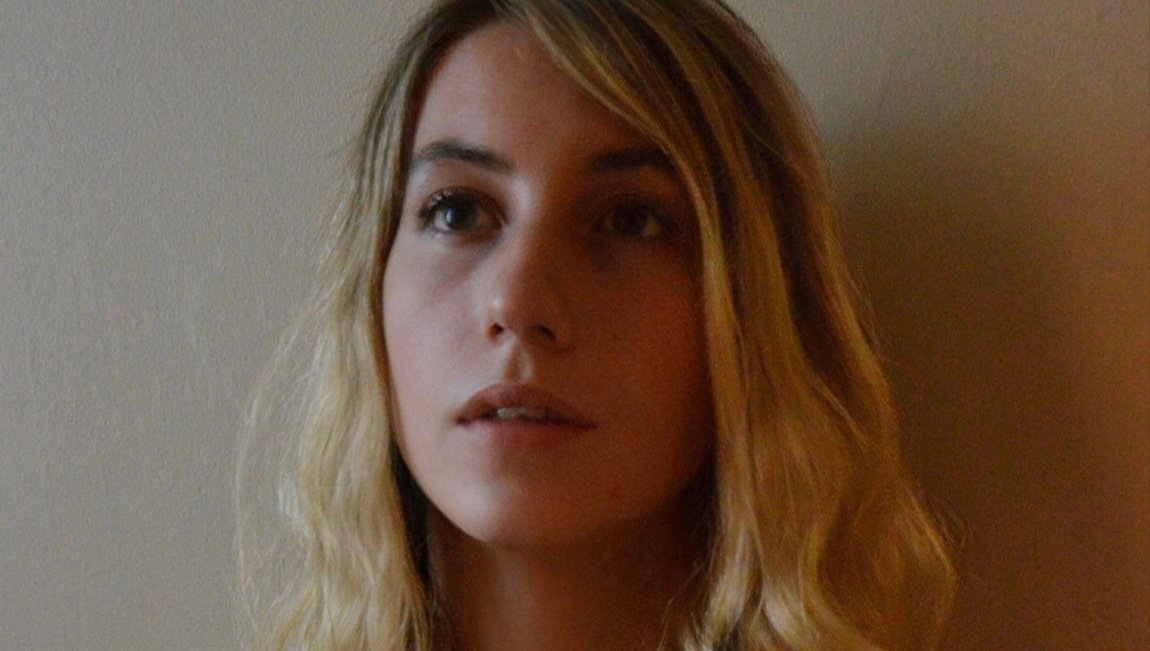
In just a few short years, it’s been a thrill to watch Alice Maio Mackay’s ascension. From her debut feature, So Vam, to Carnage For Christmas, Mackay has created an entire ecosystem to herself. Her dreamy, hypnotic visions of a world where trans and queer love can thrive unabated are like a balm against the typical “it’s about trauma/grief/any assortment of existential crises” that proliferate genre cinema. In Mackay’s films, her characters struggle, sure, but when we meet them, they’ve already gone through the battles of being who they are. Our introductions to her heroes are through lovely, hazy hangouts with friends where the appearance of demons or aliens or anything in between feels almost incidental.
That’s no accident, as Mackay tells me she’s not interested in making “scary movies,” but rather character-driven works that happen to have genre elements. Take her latest, The Serpent’s Skin. Anna and Gen (Alexandra McVicker and Avalon Fast) discover a bond between one another while the former is having sex with her boyfriend. Gen, seeing this telepathically, begins to pleasure herself, and when it’s over, sets off to find Anna. As their telepathic link binds them romantically, they unwittingly release a demon, sending them on a journey of sensual discovery to stop it.
Immediately apparent in her latest is that this is easily Mackay’s most romantic and sensual film yet. An ethereal pull takes hold in The Serpent’s Skin, and you find yourself drifting along her singular rhythms. As she’s grown more confident as a filmmaker, her craft has grown with her, and this might be her best work to date. McVicker and Fast bring a new, exciting wrinkle to Mackay’s images, the former a patient and quiet performer, and the latter a being of tension. The two work in tandem with their director to create a wavelength unlike any other, a purple- and green-tinted, lovely hangout picture that just happens to have a demon. It’s spellbinding stuff and furthers Alice Maio Mackay as a premier voice in independent horror.
As The Serpent’s Skin hits theaters, I caught up with Mackay to discuss the film, the fallacy of her work being “more personal than the last,” why Buffy and Charmed will forever resonate, and how she’s grown as a filmmaker six films in (with a seventh on the way!).
Brandon Streussnig: This is your most romantic film yet, and there’s so much immediate chemistry between Alexandra McVicker and Avalon Fast. What made you want to pursue more of that in this feature?
Alice Maio Mackay: Yeah, I feel like it’s different from my other films in a lot of ways. I knew that I wanted to approach something different and darker and from the heart. I talk a lot about Charmed and Buffy, but I mean, I also grew up reading Twilight and Beautiful Creatures, and in the era of Mortal Instruments and things like that, where that was my escapism, reading about these Gothic, almost fairytale love stories. It’s like their love is greater than anything, all these monsters and creatures and stuff like that. So, I think for me, I wanted to put my usual spin on the film but have the focus be trans love, and love is the magic and is this almost spiritual and holier otherworldly thing that trumps everything, despite being set in the current world. The other shit that’s going on in their lives, it’s this bigger thing, and it’s even bigger than the magic itself and the villain and everything.
BS: This is also your most sensual. We constantly hear about how that’s missing from today’s cinema. Was that on your mind?
AMM: It’s not a super explicit film, but I feel like I knew I wanted to have this thread of sensuality in it. I mean, I don’t know, I feel like everyone’s become so prudish, and I don’t want to be jumping on that bandwagon and being like, “Oh, Gen Z hates sex.” But when I watch films and shows, especially queer shows, I mean outside of Heated Rivalry and stuff like that, but especially with trans people, it always cuts away or fades to black. The only other instance I can think of would be the Queer as Folk reboot and Sense8, both of which I loved. So yeah, I wanted to show that trans romance is romantic, but it can still be sexual and fluid and special and explicit.
BS: Something I love about your films, and it’s especially present here, is how you cast. You just let your actors speak with the accents they have, and you’re never trying to explain it away or justify why they’d be in this country or that. It gives your films a universal feel.
AMM: I know some people will take issue with that. When the trailer came out for Serpent, there was a lot of, “Oh, where is this set? It sounds American, but looks Australian.” It’s never been an issue to me. Don’t get me wrong, I love it when actors do crazy, cool accent work. I think that’s iconic. But I’ve always wanted to choose the best actors for the part. Especially when working with smaller budgets, I’ve also wanted to choose the best collaborators. I love making movies with people who inspire me and have been in works that inspire me. At the end of the day, there’s magic and witches and curse tattoos. I’m not telling a real grounded story. I wanted to give it this fairy tale sensibility anyway, so it’s not something that really crosses my mind a lot. I just want people to be the best in the role, rather than concerned about, oh, this character’s from Australia or America, or locked down in geographical stuff.
BS: Speaking to that, you have an incredible cast in this one, and that starts with Alexandra McVicker. Much like the rest of the film, she stands out among your other leads to me. She brings such a tender, soft quality to Anna that I found so lovely. Was that how Anna was written or something she brought to the role?
AMM: I think a little bit of both. It was always a very sensitive and vulnerable role, but yeah, we really crafted it together. I was a fan of her work. I’d seen her in Vice Principals on HBO before she transitioned, but this was her first feature-length movie after she’d transitioned. So, I think crafting the role together was really special. Knowing that it was her first film as an actress was really special to both of us. That’s why this film will always have an extra special place in my heart, because it just feels very sensitive and an honor to have done that with her, especially with this role and within the context of the film.
BS: Then you have Avalon Fast as Gen, who’s also great here. She’s also an accomplished filmmaker. How did she come aboard as an actor? Did you have her in mind for something like this?
AMM: She was just someone whose work I’ve always been really inspired by. We’d hung out a little bit when I was assisting on a film in Canada. She was also friends with the director, so we just hung out a little bit, and then we stayed in contact, because she’s really cool and just a really sweet person as well. Then she messaged me saying, “Oh, I would love to get on set, and I’m so down to audition for anything as well. I’m looking to get into acting.” It all just happened to coincide. The timing was perfect. I was just starting to cast for the film. I remember I sent her the sides to audition with, and she not only delivered a great audition piece, but I knew she was the right vibe I wanted. She was wearing this 2000s metal band shirt as well, incidentally. And I was like, “Oh, this is all shaping up to be exactly how it was meant to be.”
BS: You’ve also cast Scott Major and Charlotte Chimes, both of whom have been in Australia’s very famous soap, Neighbours. This is less about the film and more just my own general curiosity: Is that something you watched growing up? I just feel like it’s such a blind spot for us over here in the States. But you hear about it all the time, with any Australian actor, it seems like they’ve all done a stint on the show.
AMM: Yeah, I mean, I feel like so many of our great Australian export actors are from either Home and Away or Neighbours. I watched it religiously, especially during the pandemic. I was like, this is my switch off Mondays to Thursdays. I knew Neighbours was going to be there. That was during Charlotte’s big run as well. That was when she was on. We had a mutual friend who introduced us, and she thought I was joking, because I was like, “Oh, I love Neighbours.” It was my comfort show. I actually got to shadow Scott Major because he [directed] for a few episodes, before it ended after 50 years or something, which is really sad. But yeah, for me it was really special getting to work with people I’m a fan of as well, and kind of surreal.
BS: Speaking of television, you’ve already said that you’re so clearly inspired by Buffy and Charmed. Those shows mean so much to both of our generations. Tell me about what they meant to this film.
AMM: Yeah, in general, the aesthetic of the Demon was directly inspired by Buffy, which I think is an obvious reference. The tone that both of those shows seem to capture, I mean, visually, it’s this aesthetic ’90s, cunty show to watch that on the surface seems quite lighthearted, but then also delves into really dark themes — both deal with sexual assault and trauma and depression and things like that through the lens of genre. But really, to me, at least as a fan, I watch the shows because of the character development and the emotional turmoil and struggles the characters go through, which is then moved forward by the genre elements, which is always something that I’ve taken on board. I never want anything to feel scary. I don’t make scary movies. I make these films that are character-focused, and the genre elements allow me to go to extreme lengths with the story.
Especially when it came to the visual effects outside of prosthetic work, I knew I wanted it to feel unlike modern VFX, and it wasn’t just a budget thing. I wanted to feel like a queer kid discovering and watching the film through a Charmed lens almost, but with explicitly queer characters.
BS: Something I’ve been wanting to ask you since we last spoke like this is that I’ve seen you push back on the idea that each new film of yours is “your most personal” yet. You’ve said that it’s often men who assume this when either interviewing you or writing a review. What is it that bumps for you with that assumption?
AMM: To me, it was just like I’ve made a couple of films now that are vastly different in terms of story or characters. I think it stemmed from Bad Girl Boogey when people were like, “Oh, this is really personal and blah, blah, blah.” And then it continued throughout each film. At the end of the day, I mean, obviously, these films are personal to me because I care about the story, and they all come from the heart. It’s indie film, you’re not doing it for money. But it kind of frustrated me that people assumed every film I made was super autobiographical. I’m not going to correct anyone, because at the end of the day, the people who know me will see what resonates with them, but I don’t think it’s necessarily up for debate with every critic who watches my film to know how personal each film is when it’s not true all the time.
BS: All of your films have been shot by Aaron Schuppan. Tell me about that long-running collaboration because it’s been so cool to see the look of your films evolve and keep getting better.
AMM: Our minds have become almost one when it comes to being on set. He’s also brought back Astra [Vadoulis], who’s a camera assistant for pretty much all the films as well. So, it feels like we’ve grown as one unit, and he knows what I want, and I can communicate with him super easily. Visually, we went from So Vam, where I wanted the film to feel like Party Monster, to Bad Girl Boogey, where I wanted it to be more Rob Zombie-esque, to this film, which was more Charmed and Twixt-inspired.
It’s just been really beautiful and special getting to grow across these different films and take each film as a new experience and gradually grow. Not with the budget, but we had access to different gear as well this time, which was really cool. We went from So Vam, which had three cameras, because it was such a short schedule, to gaining a little bit of time with each film. We shot this film in 12 days, two six-day weeks. It’s just been this nice thing to share the experience creatively alongside someone who is fully on board from 16-year-old me wanting to make So Vam to this film.
BS: You’re also working with Vera Drew again on this one. What’s that relationship been like, especially with such an idiosyncratic filmmaker herself?
AMM: It’s always nice to work with a friend, but before we were friends, I just looked up to her as another trans woman in the industry who was doing really cool things. I mean, we have so many similar reference points and inspirations. What I really like about working with her is that she is a filmmaker in her own right, and she knows what she can do to enhance my creative vision. With Serpent, she knew what I wanted, she knew the footage, she knew the tone. Then, especially with a lot of the montages and overlays and stuff like that, she was able to craft something that wasn’t just directly from the footage into a stock standard edit, but crafting that into something else and something bold and fresh through my vision that she understood completely, which was really nice.
BS: This is your sixth movie, and the seventh is already finished. What do you think is the biggest thing you’ve learned going from a kid picking up a camera and saying, “fuck it, I’m going to make a movie,” to now, having more of a base around yourself?
AMM: I feel like I’ve just become more confident in my directing and on set and in the editing room. Also, just being confident in knowing how to achieve my vision without compromising anything with such a limited budget. Obviously, after the new one that’s coming out, not Serpent, but my next film, I’m writing for a budget. But yeah, I think confidence is a big thing. Not to harp on the fact that I was super young when I started, but I was 16 working with a lot of adults, which is great that they had trust in me, but I didn’t always feel comfortable sharing my voice, correcting, and nitpicking shots and things like that. Whereas now it just feels so collaborative, and I feel like I know exactly what I want. Even if other people can’t see it, I have a clear, concise vision, and I’m able to communicate that with every different person and actor and artist involved.
Comments are closed.