
The time travel mob comedy Mike & Nick & Nick & Alice opens with the actor Ben Schwartz singing a foul-mouthed rendition of the Billy Joel song “Why Should I Worry?” from the little remembered late ’80s Disney animated film Oliver & Company under the opening credits, and it really does provide a public service to the viewer. Schwartz, an actor who has never once taken the note to play things “smaller” and is best known — depending on your viewing habits — for appearing as Jean-Ralphio on Parks & Recreation or as the voice of Sonic the Hedgehog, is shown bopping around a janky laboratory, scatting along while he works on some kind of mysterious invention, before being surprised by an unseen assailant who arrives in a bright flash of light and guns him down. If that combination of irreverence and unexpected violence with a generous dollop of laser-targeted nostalgia sounds inviting, then rest assured you are in the hands of a compatriot who shares your weird interests. However, if even reading that description makes your teeth itch, do yourself a kindness and press stop on your remote (the film is being released on Hulu following its premiere at the SXSW Film Festival) because the sledding doesn’t get any easier.
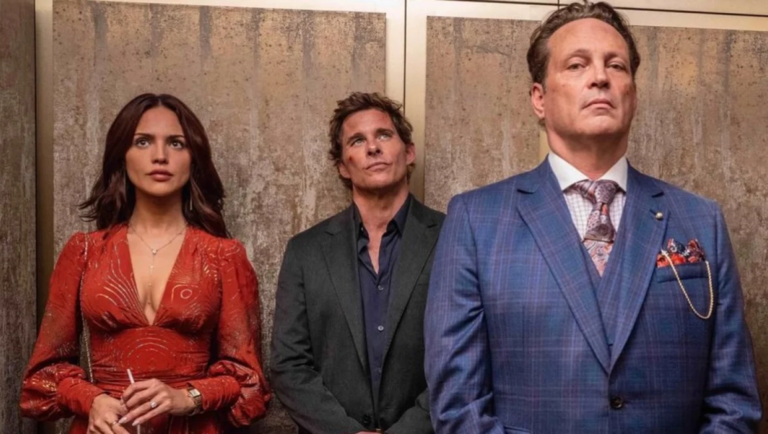
Schwartz’s character, Symon, isn’t terribly important to the film, but he does set the plot in motion. We learn it’s the night of the homecoming party of Jimmy Boy (Jimmy Tatro), the nitwit son of mob boss Sosa (Keith David), after spending six years in prison. Amidst the festivities — we’re informed there will be several after and after-after parties before the night is over — Sosa lets it be known to the gathered well-wishers, gangsters, and low-level enforcers that the turncoat who ratted on Jimmy Boy is among them and Sosa intends to exact his violent retribution at some point… but until then everyone should enjoy themselves! Also in attendance is reluctant “button man” Mike (James Marsden, not remotely believable as a gun-for-hire with the nickname “Quick Draw”) who has reason to be nervous. Not only is he planning on quitting the organization, but he’s having an affair with Alice (Eiza González), the wife of his buddy and fellow thumb-breaker Nick (Vince Vaughn). Mike’s plans to sneak away to a hotel room for a secret tryst with Alice are interrupted when Nick shows up at his door demanding that Mike ride shotgun on an urgent job that’s only just come up. Mike’s protests fall on deaf ears, and he finds himself driving around with a glowering professional killer who may suspect that he’s been sleeping with his wife. When Nick drives them to his own house and instructs Mike to Chloroform whoever opens the front door, Mike perhaps suspects a trap. What he couldn’t possibly expect is that when the door opens, another Nick is standing there.
Mike is understandably confused, but the viewer picks up the basics relatively quickly. The Nick back in the car is actually “future Nick,” having time-travelled from six months in the future to save Mike from being murdered that very night. You see, Symon, the Billy Joel-loving space cadet from the film’s opening, borrowed some money from the mob to build a time machine — it’s table stakes for the film and we’re meant to accept this on its face with few follow-up questions — that future Nick found himself stepping into, motivated to right this particular wrong of the past. The instrument of Mike’s demise is “present Nick” (Vaughn plays both iterations, although the film is judicious about when they appear in the same shot), and future Nick, knowing this, sets about incapacitating his past self so everyone can safely make it through the night and survive to the morning, although that will prove easier said than done. Present Nick shrugs off the Chloroform — apparently that stuff really does lose its potency after it expires — and, after a comedic fight sequence with Mike that trashes the house, present Nick escapes into the night. In short order we learn that someone has set Mike up to be the rat in the crew and Sosa is on the warpath, having called in a mysterious cannibal-assassin known only as The Baron (the identity of the actor playing them is a surprise best left to be discovered) to kill Mike, and the only way to keep Mike and Alice alive is if they can track down present Nick and get him to work with his sanguine future self, the wife who two-timed him, and the best friend who betrayed him.
If that sounds complicated, it’s actually relatively easy to follow. That’s some small credit to writer-director BenDavid Grabinski (Happily) for streamlining the sci-fi exposition — there’s a cute gag about how every subsequent character that finds out what’s happening locks into the fantastical premise much more quickly than Mike — as well as to Vaughn, who plays both versions of Nick as possessing wildly different dispositions, if somewhat to the determinant of the character — it’s nearly impossible to reconcile snarky, spiteful present-day Nick growing into soulful, sage-like future Nick in all of six months. Where the film has considerably less success is in getting us to become invested in much of anything that happens once our four title characters are aligned in a common goal. Mike & Nick & Nick and Alice (henceforth shortened to M&N&N&A) is in the vein of crummy, nihilistic action-comedies like Smokin’ Aces and much of the rest of Guy Ritchie’s aughts’ output; the sort of films where characters gets their faces blown off and then the “camera” tracks through the gaping exit wounds in their skulls, where we get plenty of pedantic, improv-sounding riffing from hardened criminals about any number of quotidian topics, where everything is scored to ironic needle drops and characters are given self-consciously silly tough guy names like Jackie Napalm and Roid Rage Ryan. Tarantino spawned an entire cottage industry for these sorts of films back in the mid-’90s, but we’re fully in copy of a copy of a copy territory here.
Grabinski, perhaps owing to a compressed shooting schedule or the logistical challenges of staging action sequences where one actor plays multiple combatants, leans heavily on quick cuts and tight close-ups, all the better to obscure the stunt doubles and lend the film some freneticism. One needn’t look any further than last summer’s Splitsville to identify a low-budget comedy that honors realistic-looking fight choreography and emphasizes both the artistry and innate comedy in clumsy men whaling on each other, but we’re a ways from that here. Further, and genuinely confoundingly, M&N&N&A incorporates the technique of step-printing — most indelibly employed in Wong Kar Wai’s Chungking Express — where the film creates a dreamy yet jittery effect that evokes slow motion as well as stop-motion animation, though it’s executed with no internal logic and to no discernible purpose. Whether it’s a prolonged action scene, a character dramatically walking away from the camera, or an insert shot of a cat, seemingly everything gets this particular treatment, which in addition to being pretty hideous-looking, doesn’t deflect from criticism that the modest, one-crazy-night scenario doesn’t exactly move with urgency. M&N&N&A regularly grinds to a crawl so the characters can engage in tetchy, sitcom banter that uses a smart guy/dumb guy (or occasionally dumb guy/dumber guy) dynamic as a creative crutch. Or we get impromptu therapy sessions where the characters sit and talk through their messy feelings, often couched in incongruous pop culture references. There’s even an interminable scene that finds our four leads hashing out the contentious subject of Rory’s dating history on the TV show Gilmore Girls and how it mirrors their own personal lives, and the only thing more dispiriting than the sequence itself is the absolute certainty that we’ll be getting a callback to the exchange during a tense moment later on in the film.
Prior to this, Grabinski was perhaps best known for co-developing the Netflix animated series Scott Pilgrim Takes Off. Others might argue that he’s best known for being a familiar personality and frequent poster on what was formerly known as Film Twitter, and that’s relevant for a couple of reasons: the first is it represents a further muddying of the waters in parsing the distinctions between fandom, filmmakers, and critics. But even more importantly it means the filmmaker is “very online” (as we all are), and accordingly the film’s lingua franca is pop culture aimed at the film geek set. Grabinski’s greatest gift is that he’s an enthusiastic panderer and the audience in his sights are elder-millennial gatekeepers of nerd culture. M&N&N&A never misses an opportunity to cram an easter egg or secret handshake into the film, be that costuming a day player in a “Cronenberg for President” T-shirt or including a blink-and-you’ll-miss-it Big Trouble in Little China back tattoo or using the throbbing techno song from the blood night club scene in Blade on the soundtrack. Factor in a handful of presumably expensive soundtrack cuts from Oasis and The Chemical Brothers and the way remedial pop culture references casually pepper scenes, and the whole thing feels nakedly pitched at the level of “we all like the same stuff, yeah?”
Late in the film, during what is intended to be the film’s lump in your throat climax involving a frantic drive to the emergency room, Grabinski pointedly includes a camera move that highlights the name of the hospital on the side of the building: Wampler Memorial. It’s so prominent in the frame and holds on screen for such a relatively long period of time — although realistically it’s still less than a few seconds — that it actually draws attention from the scene and even unconsciously throws off the temporal rhythms of the sequence. This is a reference to the late film critic and Austin film personality Scott Wampler who died unexpectedly in 2024, and it’s hard to begrudge a filmmaker paying tribute to their deceased friend. However, it’s also indicative of the film’s essential folly: shoehorning in an applause moment for those in the know where it doesn’t remotely serve the emotions of the scene, while subconsciously kneecapping the moment for everyone else who might be oblivious to its significance. It’s an undoubtedly heartfelt homage on a human level, but also unfortunately instructive as to the film’s ham-handed, in-crowd posture as a piece of art. Good intentions and smart filmmaking aren’t mutually exclusive, but Mike & Nick & Nick & Alice fails to offer conclusive proof of that.
DIRECTOR: BenDavid Grabinski; CAST: Eiza González, Vince Vaughn, Keith David, James Marsden, Stephen Root; DISTRIBUTOR: Hulu; STREAMING: March 27; RUNTIME: 1 hr. 47 min.
Comments are closed.