

I have one weak spot in my cinephile repertoire: war films. I like to say that I’m curious about any form film can take, and that to engage with film semi-professionally means to throw aside any prejudice toward genre or style, but it’s still difficult for me to start even the most experimental and invigorating war film without first imagining it being a dull hum of planning, maneuvers, yelling, gray-and-brown battlefields, and a bevy of, well, lifeless deaths. My worst self imagines the film to be yet more sloppy pop history for a History Channel audience — one whose intellectual diet for the subject consists only of the fetid meaty gobbets found downwind from the corpse of Great Man History. I am frequently, if not always, proven wrong, as even the bad war films look and feel nothing like this. Yet my prejudice continues.
When the all-too-inevitable Iran War started, I sought to eliminate this prejudice through a form of immersion therapy. Not that that’s necessarily helpful for anyone, but world historical moments have a way of shifting perspectives. Though I watched a few big ones that I’d been putting off forever — The Unknown Soldier, which Finnish film critics consistently call one of their country’s best movies, and Fumio Kamei’s quickly banned anti-propaganda piece about the Japanese in Shanghai, Fighting Soldiers — I was mostly curious about a four-hour-long East German documentary about the Vietnam War. Pilots in Pajamas currently has fewer than 100 logs on Letterboxd, but for a time this piece of Soviet-GDR propaganda was the holy grail of Vietnam coverage. In it, ten downed American pilots sat in front of the camera in a North Vietnamese POW camp and answered direct questions about their role in America’s imperial journey.
Directors Walter Heynowski and Gerhard Scheumann were no strangers to propaganda. They were not coerced to enter their careers as journalists for the nascent GDR; born in the 1920s, they were a part of the first generation to come of age after the Nazi regime, they reacted against their country’s shameful Nazi past, and they ultimately welcomed Soviet influence (to a point). Heynowski, coming from a career in print journalism, was beloved by the officials of the GDR after his Mord in Lwow, which used a sympathetic West German mole to capture footage that exposed a West German official’s Nazi past which led to his expulsion from FRG leadership. Scheumann was a news anchor who could brilliantly dance between light criticisms of daily life in the GDR without provoking the ire of the censors. The officials were pleased that he could offer constructive criticism of obvious problems all while towing the party line. Both Heynowski and Scheumann saw no problem with reenacting events if they missed the real thing, and both were liberal in forging evidence, so long as the real evidence existed somewhere out there.
Rising through the ranks quickly, they met and formed a joint venture with unprecedented independence in the GDR, Studio H&S. They split their responsibilities: Heynowski planned out the actual documentary production and Scheumann supplied the journalism and lines of questioning. And what questioning! Though any journalist today would accuse Scheumann of obviously leading questions, the team specialized in “attack journalism” that feels like a continuation of the prosecution at the Nuremberg trials.
The most successful of these projects was their 1966 documentary on Wehrmacht officer and Congo mercenary Siegfried Müller, The Laughing Man. Here, the directors broke from journalistic ethics by pretending to be a team sympathetic to Müller, giving him shot after shot of liquor such that he’d proudly admit his Nazi past and recent war crimes on camera. The Laughing Man was fascinating for its footage of the chuckling, remorseless Müller spilling out lines of reasoning that were usually kept behind closed doors. Even obvious successors to this kind of doc, like Errol Morris’s The Fog of War and The Unknown Known, don’t tread this deep into this territory.
But Heynowski and Scheumann still felt that the GDR’s control over film production was hampering their ability to make the film they wanted. The state-run media monopoly, the DEFA, was acutely aware of the effect film could have on a populace and sought to — very carefully — produce works that could counter the decade-long onslaught of melodrama and heimat pictures produced by the Goebbels-controlled UFA. In fact, the DEFA was formed before West German film production began in earnest and began producing its own works before the GDR was even officially established. But the half-Soviet and half-German managers of the studio constantly wavered about what kind of pictures this studio should produce. Party-approved Soviet realism bored audiences who wanted to see the previously banned American films and developments in European art cinema, but letting GDR filmmakers experiment too much risked undoing the “Nazi deprogramming” mission statement of DEFA. Mirroring China’s vague censorship today, what was banned by DEFA leaders today could be encouraged tomorrow and vice-versa, putting filmmakers in an impossible position to plan any long-term expensive project.
But the success of The Laughing Man made Heynowski and Scheumann unique to the DEFA. The duo ardently pushed socialist messaging, with even Scheumann’s deviations from the party line accepted as honest inquiry from a true believer, like Kierkegaard’s doubt forging a stronger Christianity. They were also in constant contact with DEFA and GDR officials at every step of production in order to secure trust (and funds). The Laughing Man was also an extremely rare international success, being sold to neighboring European nations but also piquing the interest of some within the FRG. So, when they asked for complete autonomy to shoot the first ever foreign film in North Vietnam, the DEFA — hungry for more television productions anyway — granted it. This was Pilots in Pajamas.
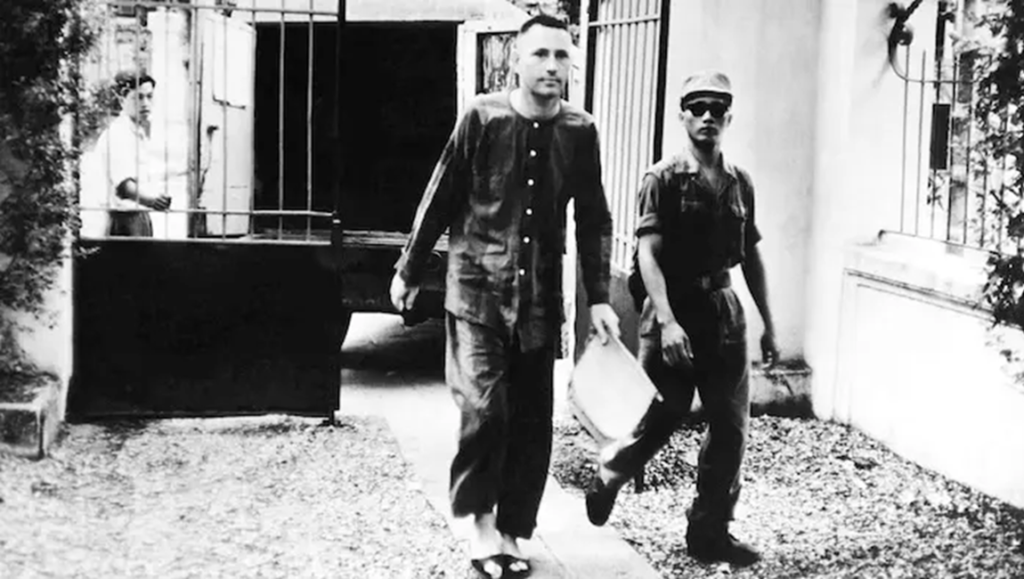
Operation Rolling Thunder was supposed to win Vietnam. By using a strategic aerial bombing campaign that would target military outposts in North Vietnam, the American Air Force could theoretically halt Hanoi from making frequent troop movements southward and force them into severe concessions during diplomatic talks. This did not happen. Instead, the expensive American bombers (both in terms of aircraft costs and the years of training these expert pilots) were downed by cheap MiG aircraft and air defenses, leading to frustration in Washington. That frustration led to the far less strategic and sometimes indiscriminate carpet bombing of civilian infrastructure, and, of course, civilians themselves. By 1968, some American pilots had flown hundreds of missions in which they used ballistic missiles that explode like grenades on impact, sending out shrapnel and further rounds of miniature explosives for maximum damage. 12 such pilots were downed, captured, and sent to Hỏa Lò Prison (originally a French colonialist prison in Hanoi, and jokingly called — to the East Germans’ endless and humorless fascination — a “Hanoi Hilton” by American servicemen), and 10 of these volunteered their responses to Scheumann’s pointed questions.
All four episodes of Pilots in Pajamas barely deviate from Heynowski’s dry setup: one camera for medium shots, another for side-profile close-ups. The camera is never turned to the interviewer, who speaks off-screen while a translator repeats the questions in English through the pilots’ earpieces. Occasionally, bits of archival footage show the damage wrought by such American pilots throughout Vietnam. Even rarer still, in significant moments the film meditates on the upbringings and inner lives of the pilots onscreen. But it’s clear that the questions and the pilots’ invariably uncomfortable responses are the stars of the show. Though this promises a didactic, propagandistic, and admittedly boring approach, the film begins to deviate into stranger and stranger territory for everyone involved.
Scheumann’s questions (the complete transcript here) start with table-setting basics, such as “what aircraft do you fly?” and “what is your religion?” but even these are mere fodder for his “attack journalism” when followed up with questions about whether Jesus would approve of using F105s to carpetbomb children. Slowly, the questions shift to how much the pilots know about the amount of damage their missions cause (a lot), if they know why they’re attacking their targets (not really), and how much they understand why America’s here in the first place (a mixed bag). These, too, are merely asked such that the pilot can be shamed into submission confronted with the fact that they, personally, have caused so much damage in the name of American imperialism. It happens so frequently that Scheumann’s interviews begin to look less like journalism — less like propaganda — and more like a predator playing with its captured prey. After all, this was made at a time when the trajectory of the Vietnam War was still uncertain and Soviet victory was beginning to look plausible.
But at multiple points in each episode, the narrator admits being taken aback at some of the responses to these questions. The very first episode cuts away from the questioning to present a few clips from B-Westerns, only to note that none of the pilots behave with the cavalier bloodlust of their on-screen expansionist lookalikes. They’re calm if a bit visibly shaken and they’re consistently polite, appending every sentence with their cadet tic of “sir.” Some have master’s degrees in international affairs and fully understand the geopolitical ramifications of their actions (if just now personally asked to reflect on the amount of children they’ve killed), others joined the Air Force simply to learn how to fly, and this was one pilot’s very first mission. The married ones speak directly to the camera to assure their families they’re coming home when it’s all over, and they hope it’s soon. They’re embarrassed that the Vietnamese know English and they don’t know Vietnamese. In fact, temporary embarrassment seems to be the only consistent quality amongst all the men here — a far more brittle quality than either the loud Roy Rogers or the proud Gary Cooper display on screen.
In appropriately dialectical terms, Pilots in Pajamas both fails and succeeds is in its attempts to defend two opposing theses: one, that these American pilots are heartless devils and emissaries of the great imperial evil, and the second that these are mere humans who’ve gotten wrapped up in the machinations of the American empire. It is both a continuation of the Nuremberg trials and the Arendtian reflection upon them, especially since most pilots’ justification for their actions is some variant of that perennial “just doing my job.” The filmmakers so desperately need this film to be a conversion narrative, one where the pilots are shown the extent of their crimes against humanity and suddenly start singing The Internationale, but most continue to hold their own seemingly contradictory assertion that it’s good to do one’s duty, even if one’s duty is bad. One pilot, after admitting that these missions had been futile and needlessly violent against civilians, is then asked “who is more free, you or the [Vietnam War protesting] dissidents in jail?” to which he responds, “Right or wrong, I’ve served my duty and they have not.” This is neither the bloodthirsty American killer nor is it the universal embodiment of human reason who’s willing to listen to the best argument and take sides accordingly.
When I first watched Pilots in Pajamas, I expected something like The Laughing Man, where some journalistic malpractice leads to some fascinating results. But unlike Müller, these American pilots are clearly coerced to provide at least agreeable and anodyne answers for the Soviets. Though they’d been treated well by the North Vietnamese so far, there’s no guarantee that this would continue, especially as the war worsens and POWs become negotiation currency. We learn that they believe such shocking things as “killing innocent people is bad” and “I would not like it if my family were killed.” Such defenses are the predictable result of “attack journalism.”
Yet, this is still an endlessly fascinating document of 1968 Vietnam. Americans had never been accountable to such direct questions about the endless bombing campaigns that clearly implicated innocents, and to see these pilots at least finally putting together the math of their payloads along with the amount of missions they’ve flown is at least a little cathartic from a world-historical perspective. It’s fascinating to learn what the GDR saw as effective propaganda for their own audiences compared to American messaging about the war and compared the homegrown dissident messaging here. More fascinating still was learning that a small bidding war gave NBC the exclusive rights to show the entirety of Pilots in Pajamas to American audiences during a year in which the public was beginning to question the whole venture. That they would pay even $13,000 for the rights implies that they expected enough American public interest in GDR propaganda. How would that have possibly been received? NBC did not air it, but ABC played a small clip of Lieutenant Galanti (one of those who refused an interview) flipping off the camera and assured audiences that these experienced pilots would return. Most did.
Despite all their annoying gotcha questions, Heynowski and Scheumann were able to make these pilots realize that their aircraft, flying high above their targets in North Vietnam, isolated them from the destruction they were causing. They were able to kill so many because the cockpit was simply their workplace, and pressing those buttons in the way they were instructed was simply their job. None of them would have killed hundreds of civilians otherwise.
As we reach the fifth week of the American “special military operation” in Iran, it’s clear that this distance from responsibility is itself one of the deadliest weapons in our arsenal. Not a single missile or drone has been fired without mediation from a screen, rendering casualties into mere pixels. But the deadliest version of this, the weapon with the furthest distance from human responsibility, was evident in the Minab attack, where Anthropic’s AI agent Claude allegedly had a role in targeting an elementary school. No human will stand before a tribunal for that, as AI’s real purpose for our military is to outsource responsibility. We’re not even “just doing our job” anymore.
Pilots in Pajamas
Directed by Walter Heynowski & Gerhard Scheumann · 1968 · East Germany · 276 min
Comments are closed.