
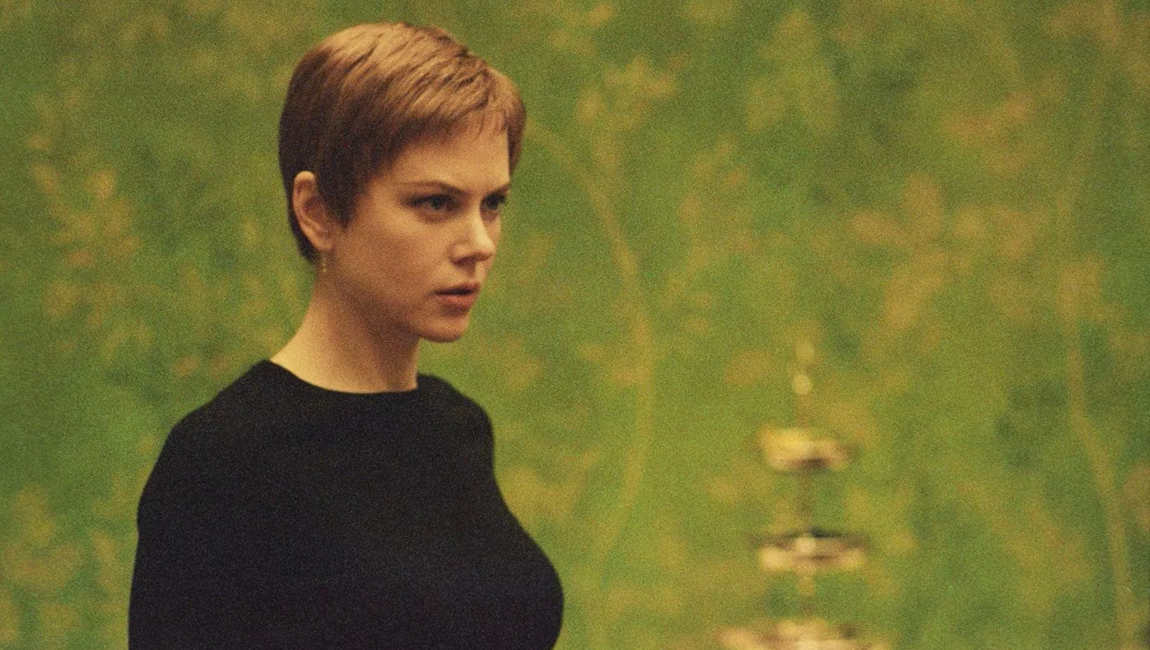
From above and behind, we watch a man running through a wintry Central Park, his dark clothing marking him as a silhouette against the snow-frosted scenery. He is observed from an impersonal distance, and his relentless forward movement is underscored by chirping woodwinds and sonorous strings played in a mutually questioning counterpoint. Later, we see the face of a woman straight-on; she sits silently and gazes ahead as an opera’s orchestra, unseen, performs the thundering prologue of Wagner’s Die Walküre. Her face quivers and shifts; tears pool in her eyes; she can barely humor an unheard remark whispered to her by the person sitting to her right. We remain fixed in front of this woman as she experiences roiling internal revelations that only the architecture of her face can convey. These two shots — one distanced and fluidly animated, the other emotionally intimate and still, both meticulously controlled — contain in them the fundamentals of Jonathan Glazer’s 2004 film Birth. Implacable craftmanship and visual precision are deployed to reveal the tender, terrifying vulnerability of the human spirit to love.
The woman at the opera is Anna (Nicole Kidman), who is preparing to re-marry 10 years after the sudden death of her husband, Sean — who, as we learn, is the man who was running through Central Park in the film’s first shot, a scene that ends with his collapse. At a family dinner, a young boy (Cameron Bright) walks in and claims that he is Sean reincarnate, that he is still in love with Anna, and that she cannot marry her fiancée, Joseph (Danny Huston). Anna at first dismisses the boy (whose given name is, in fact, Sean), but he persists in tracking Anna down and insisting that he is her husband, bolstering his case by revealing a series of details about their relationship that only her late husband could have known. Anna becomes convinced that the boy truly is the reincarnation of Sean, and the concern and protests of her fiancé and family cannot stop her from growing progressively more attached to the boy who, after all, seems by all accounts to be the long-departed love of her life in a new form.
Birth was Glazer’s sophomore film after his debut, the slick crime thriller Sexy Beast, received positive critical attention and netted actor Ben Kingsley an Oscar nomination. Glazer was struck by the philosophical idea of eternal love, and he used a story that involved possible reincarnation as the framework for exploring this thematic conceit. After a long writing process alongside Milo Addica and former Buñuel collaborator Jean-Claude Carriére, Glazer commenced the film shoot with star Nicole Kidman, who he reported to be initially hesitant to cast given the attention-grabbing nature of her global celebrity at the time, but who impressed him as being “ready to inhabit the role” on their first meeting.
The film premiered at the Venice Film Festival, where it received a polarized response and caused a minor controversy because of its taboo-skirting storyline; spurring particular consternation was a scene where young Sean takes a bath with Anna. Critics largely dismissed the film — with exceptions including Roger Ebert, who deemed the film “an effective thriller” — yet its reputational stock has risen over time, reaching a symbolic zenith with its recent entry into the Criterion Collection. Birth’s third-rail-brushing premise and detected whiffs of overly-studious Kubrick imitation dominated critical discourse at the time of its release. Yet the film’s flirtation with taboo as a means to plumb philosophical and spiritual depths, and its Kubrickian formal virtuosity, are two hallmarks that have allowed its reputation to transcend a disappointing entry into the world.
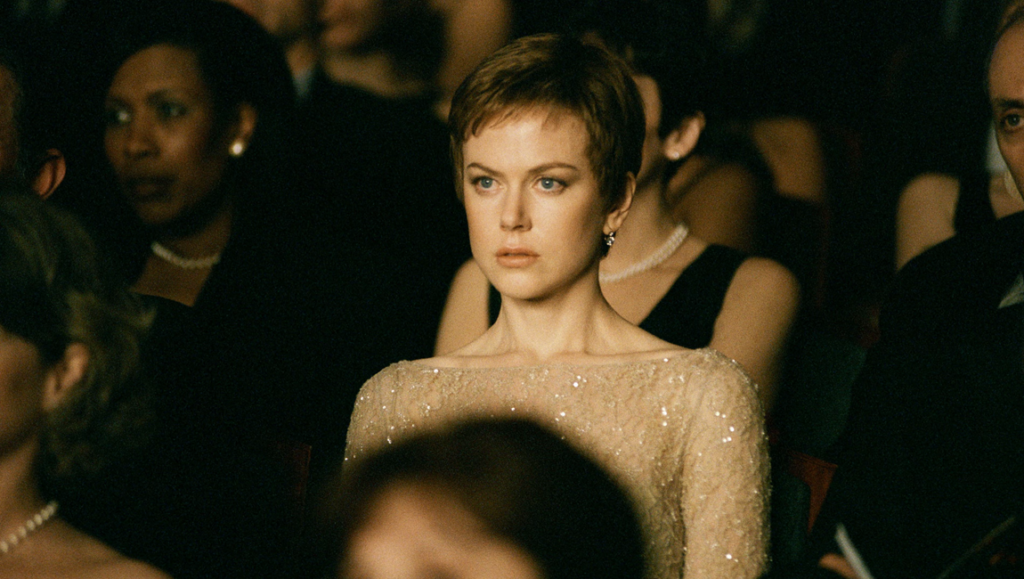
The formal elements of Birth are indeed carefully considered and precisely aligned. As director of photography, Harris Savides presided over smooth, controlled camera movements. The film has many long takes, including the notable tracking shot and closeup previously discussed, and Savides’ execution is defined by a sense of visual finesse. As shot by Savides, the film seems suffused by a gelid, twilit atmosphere — befitting the wintry setting — with its chilly frames containing near-uniformly drab apparel and interiors, designed by costume designer John Dunn and production designer Kevin Thompson. Underscoring this dim cinematic world is Alexandre Desplat’s darkly whimsical score, in which the light tinkling of woodwinds and soft percussion are complicated by brooding string sections and pounding timpani. The score cuts in and out of the film, and many scenes are silent other than sparse dialogue; the overall sonic effect is that of a constant toggling between reality and fantasy.
The self-sustaining aesthetic world overseen by Glazer extends to the dialogue, characterization, and tone. The characters, most of whom live in a wealthy enclave of Manhattan, speak in clipped sentences and default to patrician reserve, represented most vividly by the casual hauteur of Lauren Bacall, who plays Anna’s mother. The introduction of young Sean into their world, bringing with him the implausible invocation of the supernatural, draws out what they have buried. The child’s individual presence is all-too-real, particularly for the unsettled and besotted Anna, yet he also becomes a proxy for the adults’ still-fresh feelings about the deceased Sean. As a result, none of them quite treat young Sean as a child, but they do not treat him as an equal adult either. Viewed with oscillating suspicion, repulsion, fascination, and adoration by the adult characters, young Sean becomes a sort of chimerical man-child-ghost, acted on tenderly and violently.
The ultimate anchor of the film is Kidman’s performance. As Anna, Kidman appears gaunt and tired, always dressed in plain, dark clothing and adorned with the close-cropped hairstyle of Mia Farrow in Rosemary’s Baby. She speaks softly and in short sentences; she moves with jerky hesitancy. She is a woman trying, and failing, to forget a catastrophic loss and move on from a love that can no longer sustain her; she ensconces herself in family life and a passionless relationship, slipping between a grey office job, dinner parties, and excursions to the opera. The seemingly impossible reintroduction of Sean into her life bursts the weak barrier separating her from her emotions. As established by the remarkably transparent emotionality of Kidman’s silent, sustained closeup — which implicitly marks her acceptance and assimilation of her belief that the child Sean really is the second coming of her dead husband — Anna’s simultaneously perilous and soul-restoring descent into love etches itself across her face.
Young Sean’s embodiment of a dead man is referred to in Birth as a “spell.” Through his dark, emotionally turbulent fairy tale, Glazer suggests that love itself acts as a spell. Anna explains to her baffled fiancé that she had no choice but to believe the child who stood in front of her and explained that he was her husband, because if there was even a possibility of this being true, she could not resist the reunion. For young Sean, played with a powerful lucidity by Bright, his love for Anna is as persistent and as real as Anna’s is for the husband she could never stop loving. Glazer provides a plausible, rational explanation for the child’s appearance in Anna’s life by the film’s conclusion. Yet Sean signs off his goodbye note to Anna by stating that they could meet in another life. The lingering possibility of love’s return, despite all evidence to the contrary, exerts an irresistible pull in Birth: here, love is a spell stronger than death.
Comments are closed.