
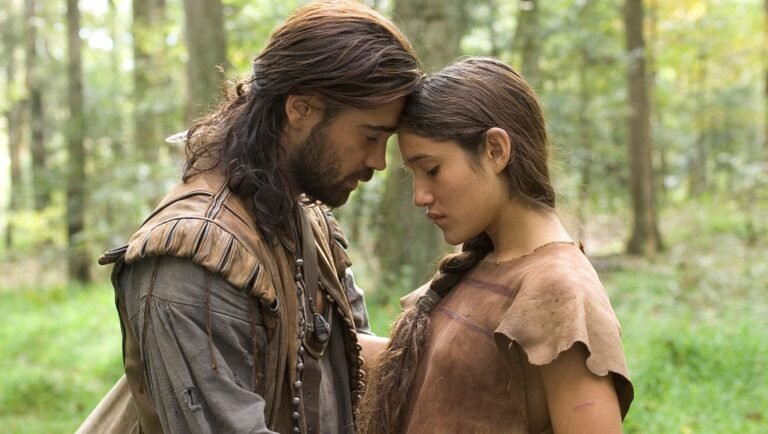
“Look out Mama, there’s a white boat coming up the river!”
— Neil Young, “Powderfinger”
It’s the sound of waves parting, or maybe an atom splitting. It could be the sound of the beginning and the end of the universe collapsed into one. It’s not the first time it’s been used in a movie, and it wouldn’t be the last: Werner Herzog deployed it in Nosferatu the Vampyre, and Danny Boyle remixed it just this summer for 28 Years Later. But never has a piece of music been used to greater effect in movie history, not even “Also sprach Zarathustra” in 2001: A Space Odyssey — Wagner’s “Vorspiel” to Das Rheingold belongs to The New World.
Terrence Malick begins his masterful historical drama about the landing at Jamestown with a beam of sublime light borrowed from the greatest (or at least most) German composer of all-time. Gliding among Briton and Powhatan alike with godlike benevolence, he plays it out under what Alex Ross calls in his book Wagnerism “an emanation of primordial nature, the hum of the cosmos at rest.” The music is, technically, an anachronism — the film spans a decade in the early 1600s, and Wagner didn’t write Das Rheingold until 1852. But with it, Malick achieves an emotional truth that no other juxtaposition of music and image could have.
“The prolonged stasis engenders a new sense of time,” Ross continues. “Perhaps an instant passing in slow motion, perhaps eons passing in a blur.” Capturing humanity at the most pivotal inflection point in our history, The New World is both condensing the weight of those eons into a single moment and slowing time down for us to see clearly what we had — and what could have been. With it, Malick reconciled his Germanic sensibility by applying it to America’s Indigenous people, and in doing so made the quintessential American movie. Much like how Heidegger’s Dasein can’t be fully understood unless you know German, America only makes sense once you’ve seen The New World.
In a film culture awash with fawning adoration for Terrence Malick — 2025 alone saw two high-profile tributes in Train Dreams and Hamnet — The New World reminds us that nobody does it like the man himself. Malick imitators can shoot at Golden Hour and layer their images with mumbling voiceover all they want, and the naysayers might even think they can outsmart him: Christopher Plummer once chided Malick in an interview long after appearing in The New World, saying he “needs a writer.” But while Malick’s reputation as intellectual filmmaker par excellence precedes him, his fourth film is not actually all that avant garde: The New World is exceptionally satisfying as a piece of drama despite its staggering ambition and daunting runtime (172 minutes in its extended cut, accept no substitutes). He makes the emotional stakes of history clear like the undisturbed water of the Chesapeake Bay, grounding the story in a romantic tragedy between British captain John Smith and Powhatan Princess Pocahontas. It’s the most perfect articulation of Malick’s particular magic — a mad swirl of philosophy, spirituality, and good old-fashioned Hollywood love affair.
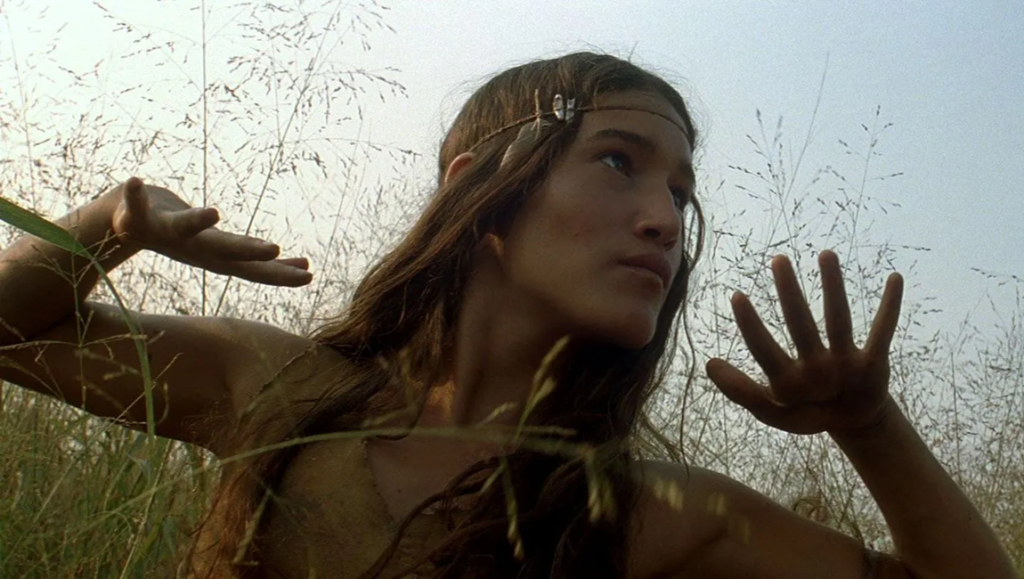
Both Pocahontas and John Smith are exemplars of their respective peoples: Powhatans embody a connection to the earth, an understanding that human beings and the land are inextricable; God is alive to these people, and she is Good. “Come Spirit. Help us sing the story of our land. You are our mother,” we hear Pocahontas say in the opening lines of the movie as an overture, only moments later to find the opening titles showing us ships and maps under James Horner’s stirring score: the Euro-masculine urge to conquer the earth, chart it, and contain it. This tension between old and new, between conservation and exploration, is the solar panel running The New World — it gives the movie an endlessly renewable energy that makes it the permanent rendition of the Pocahontas story on screen.
The British arrive to the New World with greed in their hearts, yet John Smith, who came in a cage, enters America with a wide-eyed sense of possibility. “We shall build a true commonwealth,” he says in voiceover as he skims down a river to initiate trade with the Powhatans. “Hard work and self-reliance our virtues. We shall have no landlords to wrack us with high rents or extort the fruit of our labor.” A man born low can rise and live well: it’s the birth not only of the American Dream, but of American-style democracy. “No man shall stand above any other, but live under the same law,” he continues. The words could have come straight from Thomas Paine.
But words are not enough. There’s a fairly common thought experiment in which we ponder how destabilizing it would be for someone from our past to travel to our present — even someone smart like Galileo, who contributed mightily to the development of the scientific method but would nevertheless be totally flabbergasted by what we’ve achieved since the 17th century. Malick’s filmmaking offers that the opposite could also be true: can we, in the present, fully appreciate what America has lost in the intervening 400 years?
The film’s second chapter, “The Stranger,” wherein John Smith is stolen into the Powhatan tribe and ingratiates himself with the clan after Pocahontas saves his life, tests this hypothesis. Complicating the popular conception of Native Americans as passive and peace-loving, it’s effectively a 20-minute montage that shows that the Powhatans, like the Brits, are defiant and fierce. They’re also generous and curious and hardworking; they’re human. John Smith gets unprecedented access to an America defined by a spirit of play and virtue, and so do we. Working with craftspeople doing career-best work — including DP Emmanuel Lubezki and legendary production designer Jack Fisk, to say nothing of the extraordinary costuming and makeup work here — Malick moves among the Powhatans with total freedom, cycling through a series of elemental images that bring them to life and draw out the true nature of America. No longer a punchline or a historical inconvenience, the sequence commands that we accept Native America as the foundation of all that is good about the nation. It undoes centuries of mythology and shows us the land where all people, regardless of race or creed, have more in common than we’ve been led to believe, and can live together in harmony. It’s also where Malick’s propensity for spontaneous dancing finally finds its rightful home: Smith and Pocahontas dance under “Vorspiel” and Mozart’s Piano Concerto No. 23 as they get to know each other, drawing out the eternal poetry of love.
“Vorspiel” fades, of course, when John Smith returns to Jamestown. The fort is so decrepit, you can almost smell it. In a riveting, swirling scene that feels like one take even though it utilizes copious jump-cuts — the film is the most effective argument in favor of Americans implementing the technique this side of Buffalo ‘66 — Smith is handed control of the fort after Winfield, its malevolent leader, is dispatched by Captain Argall. (“His name is not even Winfield,” Argall shouts. “It’s Woodson.” Smith is far from the only one who has come to the New World to start over.) Slowly, Pocahontas takes over the movie as Smith becomes consumed by his duties as president of Jamestown, neglecting Pocahontas and his own intuition.
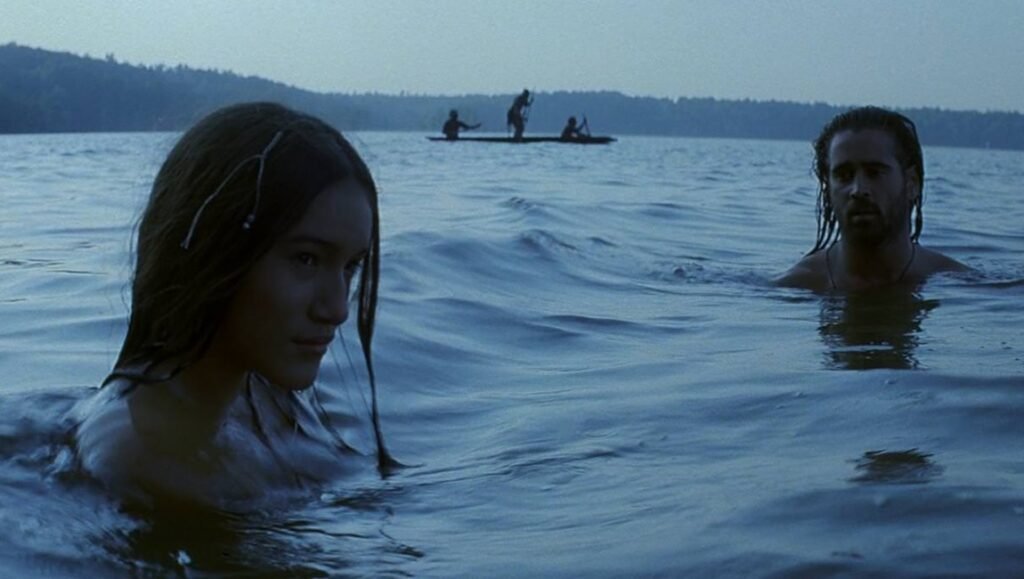
Pocahontas is the richest character in the Malick canon: both symbolic and deeply real. It would be so easy for her to be nothing more than a cipher, a bad personification for the beauty of nature. Maybe in the truncated cut she tilts more that direction, but in the extended version she takes on the role of dual protagonist, endlessly inquisitive and searching. The colony becomes functional after a series of serious stumbles and well-drawn battles (there are many great, well-organized war movies, but Malick gets at the messiness and insanity of it), and Pocahontas is traded into it for a kettle following her exile from the Powhatan nation. She meets tobacco farmer John Rolfe there once Smith departs to explore other lands. Their courtship is short, and it ends in a marriage proposal soundtracked to the crack of thunder. “You do not love me now,” Rolfe says. “Someday you will.” Thus the long, slow decline toward modernization begins.
The New World is good at so many things, but among the greatest of these is its ability to hold complex, heavy emotions, like Rolfe’s conflicted relationship with Pocahontas — both wanting to own her (“Married?” he asks her in an insane double entendre once she discovers Smith is not dead like she had been told. “You don’t know the meaning of the word exactly.”) and respecting her free spirit even after she sort of assimilates — and Pocahontas’ own relationship to her newfound domestic life. Again bending white history to restore dignity to Pocahontas, late in the film Malick frames her against an open window strikingly similar to the shot of Ethan Edwards at the end of The Searchers. It’s brief, and it has a fraction of the portent, yet it serves a similar function: she looks out from a black portal into the future (Edwards on the outside looking in), both her own and the country she inhabits. She looks on at a quintet of fieldworkers, at least one of whom is Indigenous: she’s witnessing the birth of industry in America.
Rolfe grows wealthy, and he receives an invitation to return to London with Pocahontas. We’ve seen London in a thousand movies, but it appears here alien and wretched. The camera flitters about, and Malick’s staccato editing rhythm takes on an anxious quality: dead ducks hang by their necks and chickens leap about in small cages; dogs bark and men shout in the background; Pocahontas’ uncle, Opechancanough, stands perplexed with a piece of coal in his hand. Yet Pocahontas keeps her cool — she’s even enthused by the novelty of it all, finding God in the glass windowpane of a front door. Pocahontas finds Opechancanough in a vast courtyard among carefully manicured trees, a stark contrast from the wild, innocent place they call home. “They are like blades of grass,” Opechancanough says with an implicit understanding that there’s too many of them. “I hope someday my people will forgive me,” she responds. This consummation between the Old World and the New will wreak untold havoc on the Earth — but it had to happen. Pocahontas gets the chance to meet Smith one last time, and the entire scope of the movie is inverted — instead of these two standing in for this epic quest for a new world, the epic quest stands in for their love. “Did you find your Indies, John?” Pocahontas asks. “I may have sailed past them,” he responds. It’s an extraordinary trick: the meeting of old lovers is as consequential as the meeting of two civilizations. Pocahontas is given a choice, now that she knows Smith is alive. She chooses Rolfe, and her son with him.
“Vorspiel” returns one last time. Those circuitous strings begin again, then the guttural brass. Pocahontas dies in Britian, farther away from her homeland than she ever could have imagined. It is enough that her child will return. We know what happens from there: the America we live in today proliferates, one subsisting on materialism and self-interest. But for a moment, a different America was a reality — a land where all can have a fresh beginning. The New World gives us a glimpse at that America, one where people were free from want and equal in the eyes of a higher power. That America becomes harder and harder to find with each passing day, yet it persists. “Listen,” the child whispers. Listen to the laughter of water over stones, to the whistling of wind through the trees, to the babbling of birds. America is there still, waiting.
Comments are closed.