
The year 2000 was a typically busy year for typically prolific filmmaker Steven Soderbergh, who released legal biopic Erin Brockovich and hyperlink crime drama Traffic a mere nine months apart. Both films were greeted with critical acclaim and healthy box office returns, with Soderbergh going on to win a Best Director Oscar for his work on the latter film, beating out three others and, well, himself. Armed with a runtime that was then traditionally reserved for epics but is now the status quo for contemporary releases, Traffic saw Soderbergh delving into the seedy underbelly of the illicit drug trade from multiple perspectives — law enforcement, U.S. politicians, and the drug dealers themselves — weaving a complex narrative tapestry that capitalized on the turn-of-the-millennium drug scare with his characteristic formal prowess. A quarter of a century later, very little has changed: Soderbergh is still managing to release two films in a single calendar year (ghost story Presence and espionage thriller Black Bag in 2025, for instance), and America’s war on drugs hasn’t improved — only evolved. Commemorating this moment in narcotic history is writer/director John Swab (Candy Land), taking a page from Soderbergh’s book to examine the grim realities of the country with King Ivory. Swab doesn’t quite possess — or necessarily aspire to — the assured directorial hand of Soderbergh, aiming instead for the grungier aesthetic of the Den of Thieves films. And while King Ivory is not as accomplished as any of those films, it’s still memorable in its own right, offering the requisite sequences of suspense and intimidation, and goosed by bang-on casting that offers up a coterie of committed actors giving riveting performances.
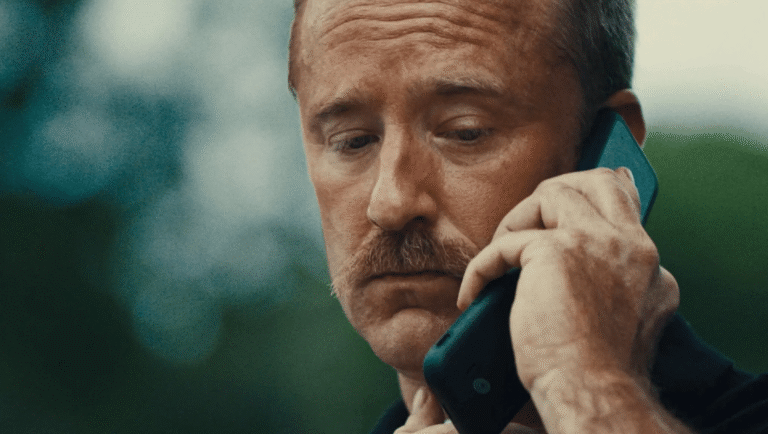
Like Traffic, King Ivory is intertwined with multiple players from different walks of life, all vying for the same thing. Some onscreen text offers necessary statistics, including the fact that the rise of fentanyl in the United States has disrupted the traditional cartel system, leading to the ascent of various smaller organizations that only grow in power each day. The leader of one such organization is Ramon Garza (Michael Mando, of Better Call Saul), a ruthless enforcer who oversees the movement of the eponymous “king ivory” — street name for fentanyl — from Mexico into the U.S. On the opposite side of the law is unflappable hero cop Layne West (James Badge Dale), an efficient officer who puts his job first as he battles for justice in the field. Also in the mix is George “Smiley” Greene (Ben Foster), a prisoner with a tracheostomy who moonlights as a killer-for-hire when called upon, disguising his deadly ways with his meek and unassuming persona. Smiley’s assignments are usually handed out by Holt Lightfeather (Graham Greene, in one of his final film roles), an incarcerated crime lord who still maintains rule with an iron fist. Younger personalities are explored as well, including Lago (David De La Barcena), a small-time pusher thrust into Ramon’s empire, and Jack (Jasper Jones), Layne’s son and a teenager who falls under the seductive spell of fentanyl. When one of Ramon’s operations leads to 43 immigrants suffocating to death, he’s put on Layne’s radar, with the cop vowing to bring the criminal to justice through any means necessary.
There are a lot of names and faces to King Ivory, and Swab’s in no particular hurry to introduce everyone at once. An opening raid on a stash house headed up by Layne and his crew provides a few thrilling moments to hook the audience in, but the bulk of King Ivory is more deliberately paced, opting for a methodical approach as character motives are fleshed out. Layne is a tough cop with a cool head, but even he can’t hold everything together, with trouble brewing at home as soon as his son starts using, bringing disruption to the cop’s family life. Ramon is a similarly pragmatic individual driven by his professionalism, carrying out his business with a no-nonsense attitude that serves him well — at least until the unthinkable happens and many innocents are taken under his watch. There’s growing pressure on all sides, and King Ivory is at its best when it highlights the Sisyphean nature of the drug trade, with neither side able to gain much purchase over the other.
It can’t be overstated what a serious boon the cast is here. Dale is utterly dynamic as Layne, affirming his place as one of the most reliable and unheralded actors working today, while Mando matches him well, delivering the same intensity that served him well during his years on television. The two make for a terrific adversarial duo, and effortlessly carry the film across the finish line. Even Foster, a habitually mannered over-actor, largely dials back his reliance on tics, despite the fact that his character’s condition results in him speaking in a squeaky voice for the duration of the film. And, of course, there’s the distinct pleasure of seeing Greene one last time, casually reminding viewers of the gravitas he brought to each role, no matter how limited his screentime. Much of King Ivory’s narrative and dramatic conflict has been done to death before, recycling a healthy number of its plot beats from superior efforts, which ultimately leaves the finished product feeling a bit too derivative to go down entirely smoothly. And if you’ve seen Traffic, then the structure of King Ivory will also feel quite familiar, with the film inevitably suffering from comparison to Soderbergh’s work. Then again, Swab isn’t and hasn’t ever been out to make a prestige Oscar-winner, and though the director’s latest may call up such associations in content, make no mistake: King Ivory is another winning, muscular B-picture from one of cinema’s underrated genre filmmakers.
DIRECTOR: Josh Swab; CAST: Rory Cochrane, James Badge Dale, Ben Foster, Melissa Leo, Graham Greene; DISTRIBUTOR: Roadside Attractions/Saban Films; IN THEATERS: November 14; RUNTIME: 2 hr. 10 min.
Comments are closed.