
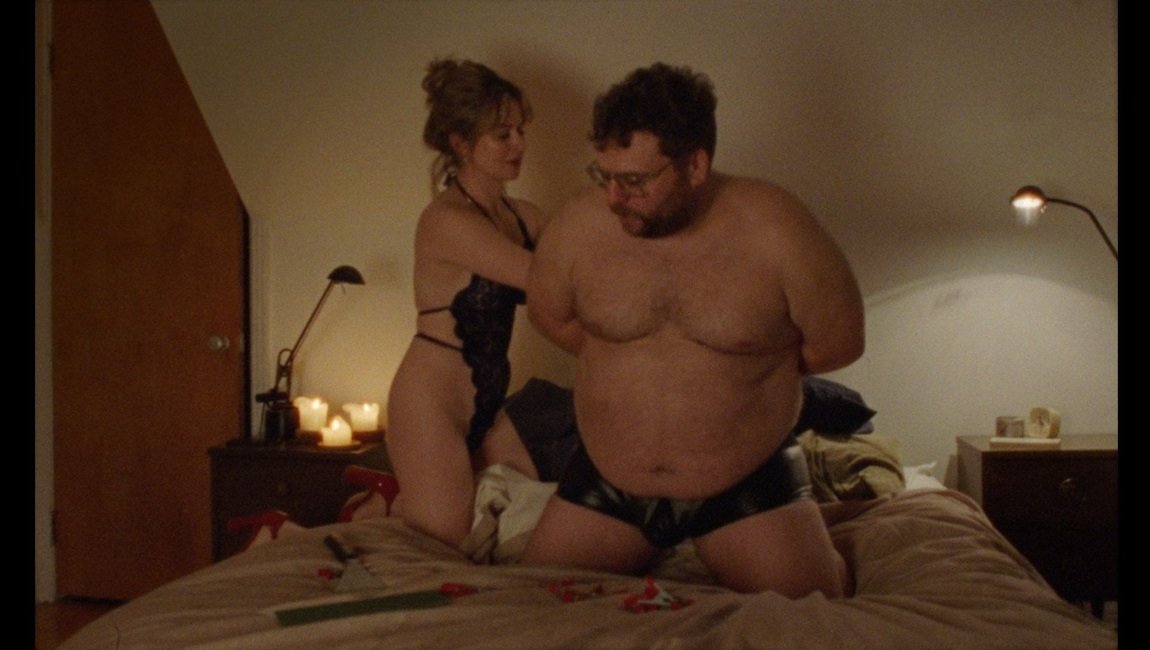
If the sex comedy has become a rare breed in the two decades since its American Pie-to-Apatow heyday in the aughts, the marriage comedy, a staple of the classical Hollywood screwball comedy with origins in Shakespearean romance, has been largely dead as the dodo since the 1940s. Perhaps that’s why a film like Québécois writer-director Eric K. Boulianne’s Follies, ostensibly a comedy of remarriage that might make Stanley Cavell smile as much as blush, needs to cloak its melodrama in so much fucking, sucking, spanking, yanking, cheating, and cumming. It’s The Awful Truth for an age averse to upper-class refinement, sophistication, and playful innuendo, one that privileges direct communication and therapy-speak over witty double entendres.
The first shot of the film is a wonderful encapsulation of how Boulianne is able to juggle these two styles in a mature, invigorating way. We open with a McCarey-esque sustained medium shot of our two protagonists, married couple Francois (Eric K. Boulianne) and Julie (Catherine Chabot), sitting next to each other at dinner with a younger, sexually open couple across from them and offscreen. As they silently watch the other couple go through the various minutiae and pitfalls of getting rim-jobs from their various lovers, Francois and Julie’s body language — they way they squirm, glance quickly at each other before averting their eyes, nod half-heartedly, chuckle when they shouldn’t — tells us everything we’ll need to know about where their 16 years of marriage have led them. They need a change, it’s obvious to both of them before they even talk about it, and, at Francois’s request, that comes in the form of opening up their relationship.
It’s a journey that leads through all of the expected awkwardness and jealousies — weird foursomes with swinger couples, casual hook-ups that end in acrimony, uncomfortable questions from their two 10-year-old daughters — while also dredging up all of the dormant problems of their coupledom and pushing it further toward its breaking point. Follies is, if nothing else, a very accurate portrait of an increasingly pervasive 21st century relationship pattern, and a lot will feel familiar to anyone who’s gone through similar situations or observed it amongst friends. Problems proliferate almost instantly, but when Julie starts falling for a lesbian couple who seduced her, Francois, who instigated the open relationship, becomes overbearingly disappointed and jealous. He childishly slams doors, pouts at the sex club, and obsessively prowls dating apps while Julie lovingly cooks breakfast and giggles with her lovers.
Shot on celluloid by François Messier-Rheault, Denis Côté’s frequent collaborator, the film has an intimate, subtly beautiful feel to its images. Boulianne is an adept naturalist with the frame, composing shots with comic grace and emotional depth without drawing too much attention to them. The film soars in its prolonged medium shots, allowing for actions and reactions to build across scenes, unfurling character depths through nuances of gesture that make for a rich viewing experience. Every dinner table conversation feels loaded, like an elaborate game of hide-and-seek where what the characters say and what they really mean never quite seem to spring out from the same hiding place. The cityscape of wintertime Montreal also becomes an essential element to the film, even as scenic sights and dense street sequences are smartly eluded. Details, like the way Francois walks alone down nearly empty streets at night or the erotic fixation one swinger couple has on a very bland hotel room, lend the film a wonderfully sharp sense of place.
If the film falters, and it does slightly, it’s in its rosiness. While occasionally erotic, Julie and Francois’ sex life looks far from fulfilling or desirable, so when the film lets them have their cake and eat it too, to stay together while fully living a life of hedonism, it feels strained. Boulianne knows how to separate and fracture the couple well, but he’s less adept at bringing them back together. The ostensible remarriage we witness at the end is almost depressing: it posits that the couple can still feel together while having very physically separate sex lives because they can still feel emotionally attached virtually, through brief sext exchanges. It comes across too much like therapy-speak, telling us we’ll all be okay so long as we learn to accept the lonely, isolating, and demeaning circumstances we’re given. If that’s what a happy modern couple looks like, two lonely people deluding themselves into feeling connected, God help us all.
Published as part of Tallinn Black Nights Film Festival 2025 — Dispatch 1.
Comments are closed.