
In the 21st century, almost every film beyond a certain tax bracket is transnational in nature. Choose even a lower-budget indie film, ostensibly maintained in the 19th century Ozarks or a tongue-in-cheek zoomer comedy shot almost entirely in a Ridgewood, Queens apartment, and one is sure to find at least a couple slides dedicated to foreign grants or donors, the generosity of X Austrian film-fund, and a “Special Thanks” sent out to “Y” Kiwi talent agency, or “Z” Qatari private equity firm. The economic dystrophy of the American and European independent film necessitates this change. With Miramax imploded and Disney practically unavoidable even among mid-budget pictures, the rise of A24 and Neon has been littered with the limitations of private equity institutions, forcing most artists to question if such “alternatives” aren’t as ruthlessly exploitative as the norm. Thus, filmmakers look overseas for possible donors. Similarly, those living in any country, especially in the first world, where these major studio startups are nominally situated, find themselves in increasingly complicated national situations. New attacks on the very concept of citizenship worldwide make clear that wherever you’re from isn’t always what you are, and one is always a single crisis away from disownership. The real world, like the cinematic one, becomes more hyphenated every day. Case in point: Winter in Sokcho, originally a very buzzy novel by French-Swiss-Korean writer Elisa Shua Dusapin, and now a movie by French-Japanese director Koya Kamura.
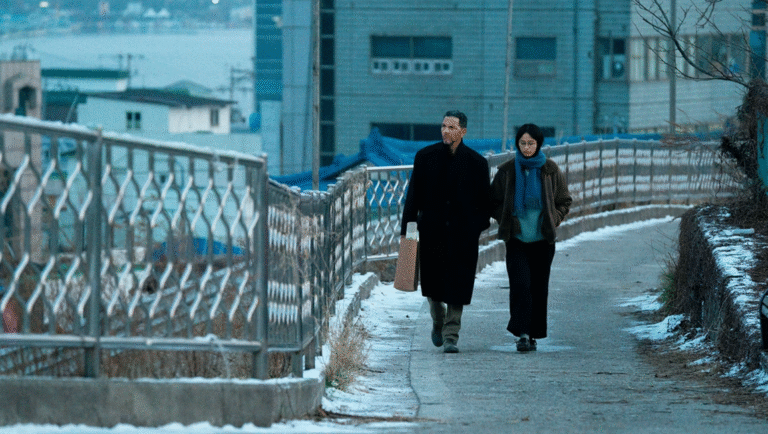
The film concerns a young woman named Sooha (Bella Kim) living in the titular town — a dreary, industrial seaport — where she works as a cook for a grieving widower’s hotel. She spends much of her time with an aspiring model boyfriend (Gong Doyu) and her mother (Park Mi-hyeon), a fugu (pufferfish) chef. Sooha’s mother is rather secretive about her father, a French fisherman who left before she was born, and leaves a lasting mark on her intellectual activity. Sooha is transnational almost by her own volition, learning French despite having no way of ever contacting her father, and little luck of ever using her knowledge in a rural environment like Sokcho. This initial staging, identical to the novel’s, is fairly gripping in its own right. Sokcho, the muted drabberies of an inescapable but homely hometown, is intruded upon by an itinerant stranger, a tall, dark, and handsome French illustrator (Roschdy Zem) taking up indefinite lodging at Sooha’s hotel. He is fiercely isolated and voraciously curious about life in the town, thus threatening not only Sooha’s vague self-image in the face of her origins, but the town’s plaintive seclusion.
Kamura paints the region with wide, melancholic strokes. Prettified landscapes of ramshackle casinos and convenience stores, frozen rivers under bleak gray bridges; all the while, the foreign illustrator praises Sokcho’s exacting geometry, its “illustrative” qualities, which for most of the film are invisible to the audience. Otherwise, the larger share of the film’s visual bombast lies in frenetic animated interludes, usually following a sexual or sensual encounter in Sooha’s life. Spacey pink streaks mingle on a black, star-studded canvas, usually composed in the same slapdash earnestness as your average student film submission, but perhaps more cloyingly pleasant than anything. But Sokcho’s central problem is not its amateurish construction, which is mostly harmless, but an indecisiveness in Kamura’s camera. Two POVs vie for supremacy: the Frenchman’s and the Korean’s. The former is detached but hungry for the exotic, always hunting for the rare morsel of simple heaven under the East’s impenetrable drapery. The latter is bored but nostalgic, waiting for the chance to take the next bus to the big city, but warmed by the embers of forgotten history.
Neither is ever committed wholeheartedly. Instead, Kamura is purposeless, the quick-moving but impermeable eye of the goldfish, poking around the tank without hope of any decided interest. Part of the challenge is in character: Zem’s Frenchman doesn’t seek out the exotic so much as the mundane and the basely miserable. He finds inspiration in the everyday life of distant characters, not the environs themselves. The tourist is unenthused by the usual oriental excitements, instead striving for a certain other in the foreign land, some inner thing that cannot be found anywhere else, but much like the film itself, finds that essence to be nothing, made of a substance lighter than air and less cinematically valuable. Instead, the camera settles for a constant barrage of Instagram-worthy money shots, which becomes almost excruciating whenever Kamura shoots for coverage.
Like most of its ilk, the film is more skeleton than animal, occasionally resuscitated by a commanding performance (namely Zem’s and Park’s), but always from an unfortunate, cowardly distance. What is especially infuriating, however, is the promise made within that scaffolding. The film dances around a very potent thematic obsession: the embarrassment of internationality, a pervasive disappointment in the shirking of one’s own identity for the adoption of the capitalist worldview; Sooha, the Frenchman, and Sokcho at large must choose to confront their distance or die, and all three inevitably choose the latter. What could be more pertinent to the film world’s own problems? How does an artistic self exist in the hands of not only a studio, but a baker’s dozen of financiers and distributors? What changes when a French director joins a Polish studio, takes a Danish grant, and premieres the film in Spain? Can the same film still claim to be “about” the French people? If not, then what does it reflect? It’s no secret that the construction of a film changes drastically according to its flounderings or successes in the international bazaar, but very few are interested in composing the film itself to reflect it.
Winter in Sokcho presents the international as the mundanely taboo, a structure that is different from the self but without any shape to note those differences. The film, too, acts as a congealed glob of discreet elements. Like a can of SPAM, it contains a laundry list of ingredients without boasting the flavor of any one of them. It’s difficult to blame Kamura, however, when the larger film world commits the same sin.
DIRECTOR: Koya Kamura; CAST: Bella Kim, Roschdy Zem, Park Mi-hyeon, Ryu Tae-ho; DISTRIBUTOR: MUBI; STREAMING: November 26; RUNTIME: 1 hr. 44 min.
Comments are closed.