
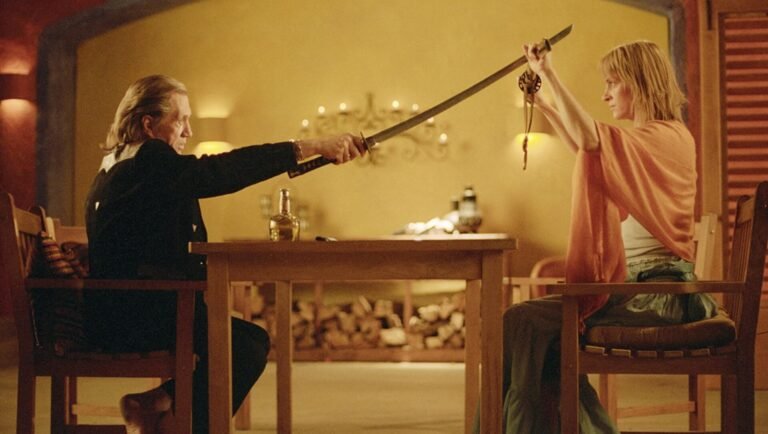
Of film history’s lost White Whales — the complete Magnificent Ambersons, for example, or The Day the Clown Cried — the eventual release of The Whole Bloody Affair was among the likeliest to actually happen. We knew the full, uncut version of Kill Bill existed, but that didn’t make the wait any less excruciating or the possibilities any less enticing. Kill Bill is already impressive enough as two separate movies, yet throughout the years Tarantino has made his fair share of noise insisting it’s one movie, and that it’s among his very best; he just wouldn’t let anyone outside the Greater Los Angeles area see it until it could accompany a lucrative video game tie-in. The nationwide release of The Whole Bloody Affair unfortunately proves him right: it’s an unmatched movie orgy, making a handful of crucial tweaks that elevate the drama and set Kill Bill apart as a work worthy of its (many) forebears. And for Tarantino fans who love the horse race of ranking his filmography, it changes the betting odds on a solid pair of middle-of-the-pack movies (relative to the director’s oeuvre) considerably — it’s impossible to conceive of Kill Bill as two movies anymore.
Kill Bill has one of the easiest elevator pitches of all-time: The Bride (Uma Thurman, earning every inch of the frame and every second of screen time — a real movie star turn) is riddled with bullets and left for dead by The Deadly Vipers, a squad of assassins with whom she used to associate led by the wily, charismatic Bill. She wakes up from a four-year coma determined to kill ‘em all. If that pitch were turned into a story told in the typical chronological fashion, it would be less than 90 minutes long, but that’s not the Tarantino way. Kill Bill is rife with flashbacks, callbacks, and backstory, all of which are justified by a moving affection for the potpourri of material he’s riffing on — Spaghetti Western, Anime, Horror, Blaxploitation, Kung Fu, Samurai, and Gangster movies. Kill Bill should be a total mess, but Tarantino’s genius is his ability compile the pastiche under a unified vision, an epic about identity — the names we give ourselves, the names given to us by allies and enemies, and the names thrust upon us by destiny — shot through with an Eminemian sentimentality that one might call the vulgar infinite.
No, Kill Bill’s coarse blend of Eastern and American influences is not taken up without cause. Tarantino understands his references: their humor and cartoonish appeal, true, but also that the movies from which they come were made with serious respect for their craft. When the Crazy 88s flank The Bride on all sides and she kicks each and every one of their asses to Timbuktu (finally in full, glorious color), it’s done with a genuine reverence for the artistry of fight choreographer Yuen Woo-Ping, and when Bud buries The Bride alive, it’s suffused with the righteous fatalism of Sergio Leone and the ghastly transcendentalism of Rob Zombie. The Whole Bloody Affair is still neatly sliced in two with an intermission, with part one taking on more of an Eastern flavor and part two a more Western, country-fried one (while nixing an egregious cliffhanger spoiler meant to drag audiences in for Volume 2 during Kill Bill’s initial run), but taken together it’s clear that Tarantino is synthesizing his influences into a depiction of a porous globalized world filled with open cultural exchange: “You like Japanese swords, I like baseball,” Hattori Hanzō (Sonny Chiba, who also — no joke — served as credited Samurai Sword Advisor on the film) quips to The Bride when she asks him to make her a katana.
In the early 2000s, digital technology was only just beginning to take over. Cellphones are scattered throughout Kill Bill — a means of quick communication for a story (and a time) that moves at a pace which justifies them — but they’re flip phones. Quaint by today’s standards, and to watch Kill Bill in 2025 is to watch a transmission from an era when film history was, strangely, more accessible on VHS and DVD than it is today in the black hole of the streaming wars: The Whole Bloody Affair is our clearest expression of the power of intertextuality in the period straddling the analog and digital eras, and in it we find the difference between assembling a mixtape with the care of one given to a lover and a playlist contrived at the whim of an algorithm. Tarantino knows that pop culture — high and low — is best shared with the warmth of human feeling, and nowhere is that more powerfully expressed in his work than when The Bride lies with her daughter BB and watches Shogun Assassin on tape right before the climax of the movie.
Highfalutin aspirations aside, Kill Bill remains a work of supreme confidence and exuberance — it’s the everything movie. Extreme close-ups and everlasting landscapes. Split screen, freeze frames, rack focuses, and snap zooms. Trunk shots, overhead shots, hero shots, Scorsese’s Copa shot — every stylistic tic from seemingly every movie under the sun finds its way in, and Tarantino makes no attempt to conceal his references. There’s no doubt it sets a really bad precedent, and we’re still suffering the consequences of it via a film culture that subsists almost entirely on references to itself, but what separates Tarantino from lesser pastiche artists is his understanding that while there’s great power to be found in loving movies and giving oneself over to their essential power, they’re really just a prism through which to engage the world outside the screen. The chance to see The Bride dig her way out of six feet of dirt and punch her hand into the open air in victory (itself a recontextualization of the classic zombie movie image) is a nice reminder of that — the beauty of the will to live.
Partially due to the SAG strike, partially due to COVID, partially due to the rapid ballooning of nostalgia as its own cultural product, a lot of re-releases have been coming out to fill empty screens. Few are justified; The Whole Bloody Affair changes the conversation about Tarantino forever — even an embarrassing “lost chapter” set in the world of Fortnite can’t take that away. It comes appendaged to The Whole Bloody Affair like a little brother on a first date — you can only leave him in the car with the radio on for so long before he comes out to spoil the fun. You have plenty of time to vacate the theater before it begins, but it’s only 10 minutes, and in its macabre way is necessary for Tarantino completists — we should not avert our eyes from the stumbles of our favorite filmmakers. Titled “Yuki’s Revenge,” it opens with a monstrous transmogrification of the classic “Let’s All Go to the Lobby” ad, “Get Your Squad Some Noms.” It’s exhibit A for the bastardization of media under the reign of billion-dollar tech companies, and Tarantino should be ashamed for going along for the ride. The greatest tragedy is not that he directed it in Fortnite per se, but that he fails to utilize the potential freedoms granted by the Unreal Engine and chooses instead to clown around and sell some skins. Then again, perhaps it simply demonstrates that he’s savvy enough to stick a wet finger out and determine where the wind of the zeitgeist is moving. If this is the direction a bit of the old ultraviolence inevitably blew us in, so be it. The Whole Bloody Affair is worth it.
DIRECTOR: Quentin Tarantino; CAST: Uma Thurman, ddd; DISTRIBUTOR: Lionsgate; IN THEATERS: December 5; RUNTIME: 4 hr. 41 min.
Comments are closed.